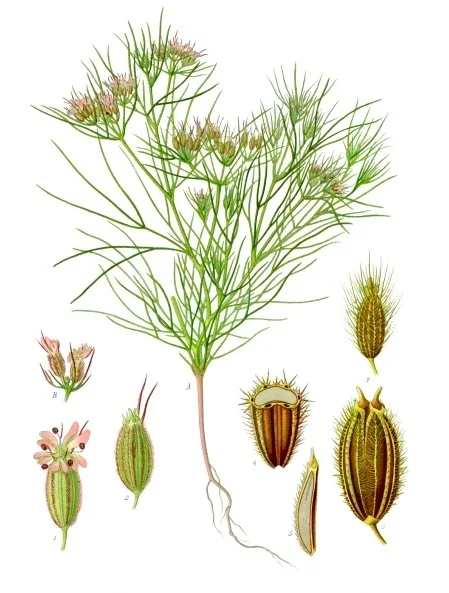
A plant related to carrots that grows up to 60 cm, branching from the base with similar leaves and flowers; its seeds have a strong smell and are used in cooking and medicine.
About Cumin
A herb from the carrot family that is grown for its fragrant seeds. The seeds are used for seasoning food (Isaiah 28:25–27; Matthew 23:23).
Cumin (Cuminum cyminum) is believed to be native to Egypt and the eastern Mediterranean region. People have grown cumin for a long time to harvest its strongly aromatic and sharp-tasting seeds.
Key References
When he has leveled its surface, does he not sow caraway and scatter cumin? He plants wheat in rows and barley in plots, and rye within its border.
Surely caraway is not threshed with a sledge, and the wheel of a cart is not rolled over the cumin. But caraway is beaten out with a stick, and cumin with a rod.
Woe to you, scribes and Pharisees, you hypocrites! You pay tithes of mint, dill, and cumin. But you have disregarded the weightier matters of the law: justice, mercy, and faithfulness. You should have practiced the latter, without neglecting the former.
All Scripture References (3)
Isaiah (2)
When he has leveled its surface, does he not sow caraway and scatter cumin? He plants wheat in rows and barley in plots, and rye within its border.
Surely caraway is not threshed with a sledge, and the wheel of a cart is not rolled over the cumin. But caraway is beaten out with a stick, and cumin with a rod.
Matthew (1)
Woe to you, scribes and Pharisees, you hypocrites! You pay tithes of mint, dill, and cumin. But you have disregarded the weightier matters of the law: justice, mercy, and faithfulness. You should have practiced the latter, without neglecting the former.