A special embroidered garment made of linen, worn by the high priest from the shoulders to the waist, holding the Urim and Thummim.
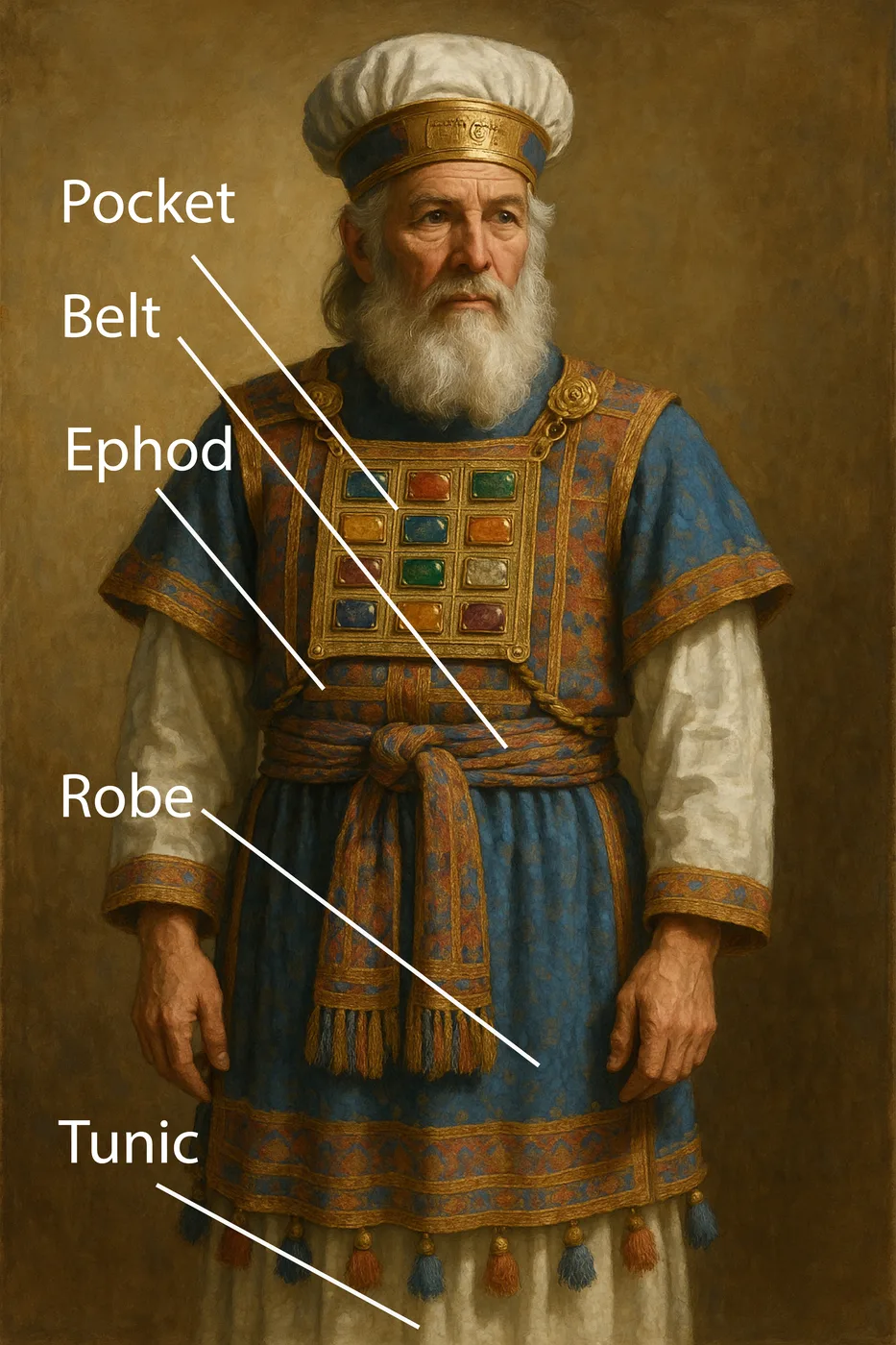
About Ephod
An ephod was a special upper garment worn during religious services at the tabernacle or temple. The term "ephod" generally referred to the decorated vest that the high priest wore over a blue robe (Exodus 28:31). The ephod held the Urim and Thummim, which were holy objects (lots) used to determine God's will. Sometimes "ephod" meant the complete outfit of the high priest or similar clothes worn by other priests (1 Samuel 2:28; 23:6, 9; 30:7).
The ephod was made of colored material and fine linen. It was decorated with blue, purple, scarlet, and gold thread. At the upper part were two shoulder straps. Each strap had an onyx stone with the names of Israel's 12 tribes engraved on it. The breastplate, which also contained the tribal names, was attached to the ephod by a series of cords and chains (Exodus 28:22–29).
Key References
They are to make the ephod of finely spun linen embroidered with gold, and with blue, purple, and scarlet yarn.
He put the tunic on Aaron, tied the sash around him, clothed him with the robe, and put the ephod on him. He tied the woven band of the ephod around him and fastened it to him.
From all this Gideon made an ephod, which he placed in Ophrah, his hometown. But soon all Israel prostituted themselves by worshiping it there, and it became a snare to Gideon and his household.
(Now Abiathar son of Ahimelech had brought the ephod with him when he fled to David at Keilah.)
All Scripture References (35)
Exodus (21)
and onyx stones and gemstones to be mounted on the ephod and breastpiece.
These are the garments that they shall make: a breastpiece, an ephod, a robe, a woven tunic, a turban, and a sash. They are to make these holy garments for your brother Aaron and his sons, so that they may serve Me as priests.
They are to make the ephod of finely spun linen embroidered with gold, and with blue, purple, and scarlet yarn.
Fasten both stones on the shoulder pieces of the ephod as memorial stones for the sons of Israel. Aaron is to bear their names on his two shoulders as a memorial before the LORD.
You are also to make a breastpiece of judgment with the same workmanship as the ephod. Construct it with gold, with blue, purple, and scarlet yarn, and with finely spun linen.
and fasten the other ends of the two chains to the two filigree settings, attaching them to the shoulder pieces of the ephod at the front.
Make two more gold rings and attach them to the other two corners of the breastpiece, on the inside edge next to the ephod.
Make two additional gold rings and attach them to the bottom of the two shoulder pieces of the ephod, on its front, near its seam just above its woven waistband.
The rings of the breastpiece shall be tied to the rings of the ephod with a cord of blue yarn, so that the breastpiece is above the waistband of the ephod and does not swing out from the ephod.
You are to make the robe of the ephod entirely of blue cloth,
Take the garments and clothe Aaron with the tunic, the robe of the ephod, the ephod itself, and the breastplate. Fasten the ephod on him with its woven waistband.
and onyx stones and gemstones to be mounted on the ephod and breastpiece.
The leaders brought onyx stones and gemstones to mount on the ephod and breastpiece,
Bezalel made the ephod of finely spun linen embroidered with gold, and with blue, purple, and scarlet yarn.
Then they fastened them on the shoulder pieces of the ephod as memorial stones for the sons of Israel, as the LORD had commanded Moses.
He made the breastpiece with the same workmanship as the ephod, with gold, with blue, purple, and scarlet yarn, and with finely spun linen.
and they fastened the other ends of the two chains to the two filigree settings, attaching them to the shoulder pieces of the ephod at the front.
They made two more gold rings and attached them to the other two corners of the breastpiece, on the inside edge next to the ephod.
They made two additional gold rings and attached them to the bottom of the two shoulder pieces of the ephod, on its front, near the seam just above its woven waistband.
Then they tied the rings of the breastpiece to the rings of the ephod with a cord of blue yarn, so that the breastpiece was above the waistband of the ephod and would not swing out from the ephod, just as the LORD had commanded Moses.
They made the robe of the ephod entirely of blue cloth, the work of a weaver,
Leviticus (1)
He put the tunic on Aaron, tied the sash around him, clothed him with the robe, and put the ephod on him. He tied the woven band of the ephod around him and fastened it to him.
Judges (6)
From all this Gideon made an ephod, which he placed in Ophrah, his hometown. But soon all Israel prostituted themselves by worshiping it there, and it became a snare to Gideon and his household.
Now this man Micah had a shrine, and he made an ephod and some household idols, and ordained one of his sons as his priest.
Then the five men who had gone to spy out the land of Laish said to their brothers, “Did you know that one of these houses has an ephod, household gods, a graven image, and a molten idol? Now think about what you should do.”
And the five men who had gone to spy out the land went inside and took the graven image, the ephod, the household idols, and the molten idol, while the priest stood at the entrance of the gate with the six hundred armed men.
When they entered Micah’s house and took the graven image, the ephod, the household idols, and the molten idol, the priest said to them, “What are you doing?”
So the priest was glad and took the ephod, the household idols, and the graven image, and went with the people.
1 Samuel (6)
And out of all the tribes of Israel I selected your father to be My priest, to offer sacrifices on My altar, to burn incense, and to wear an ephod in My presence. I also gave to the house of your father all the food offerings of the Israelites.
including Ahijah, who was wearing an ephod. He was the son of Ichabod’s brother Ahitub son of Phinehas, the son of Eli the priest of the LORD in Shiloh. But the troops did not know that Jonathan had left.
That day David fled from Saul and went to Achish king of Gath.
(Now Abiathar son of Ahimelech had brought the ephod with him when he fled to David at Keilah.)
When David learned that Saul was plotting evil against him, he said to Abiathar the priest, “Bring the ephod.”
Then David said to Abiathar the priest, the son of Ahimelech, “Bring me the ephod.” So Abiathar brought it to him,
Hosea (1)
For the Israelites must live many days without king or prince, without sacrifice or sacred pillar, and without ephod or idol.