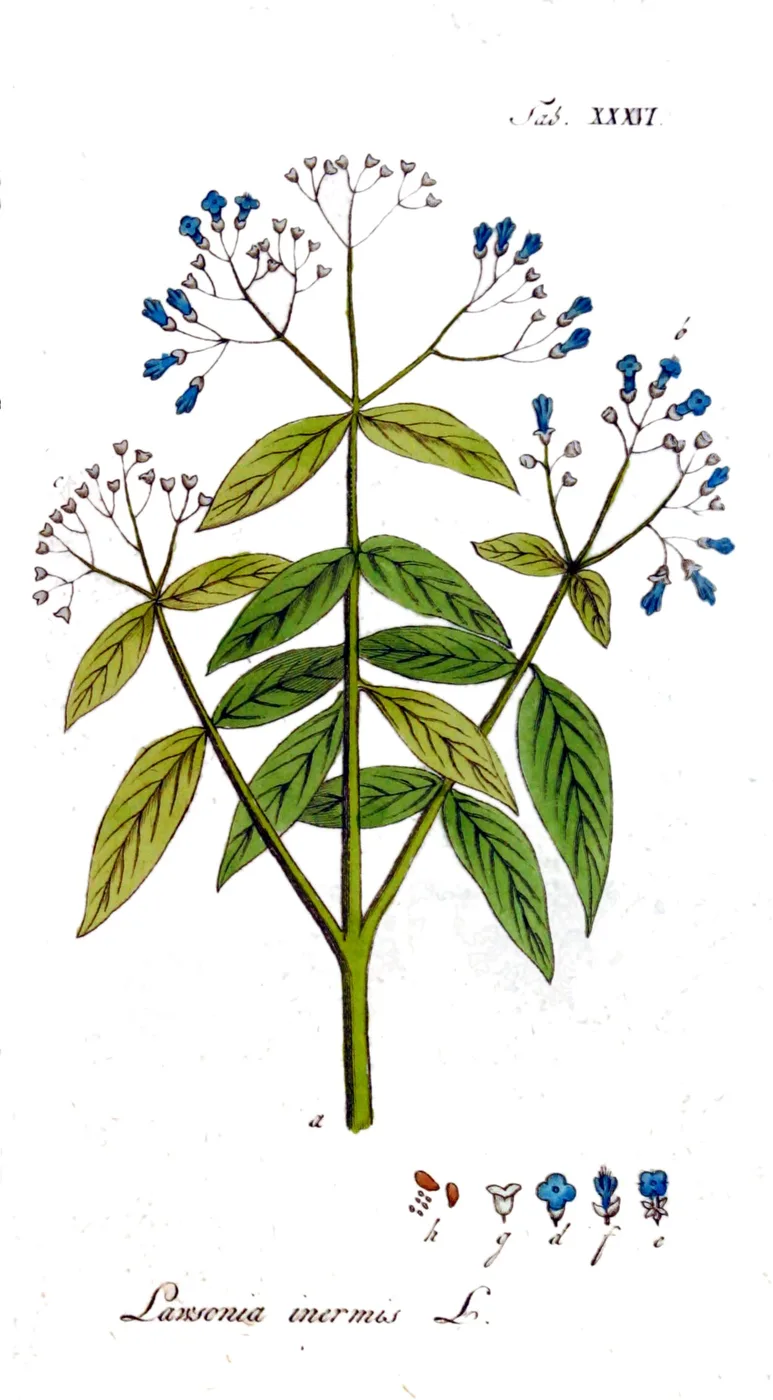
Henna is a tall shrub with fragrant white flowers and leaves that produce a red dye for coloring skin and hair.
About Henna
A sweet-smelling, flowering shrub mentioned in Song of Songs 1:14 and 4:13. In older Bible translations like the King James Version, the Hebrew word kopher was translated as "camphire." But scholars today agree it refers to the henna plant (Lawsonia inermis).
Henna is native to northern India and grows wild in the Sudan, Egypt, Arabia, Syria, Lebanon, and Israel and the surrounding areas. It grows between 1.2 to 3.7 meters (4 to 12 feet) tall. Its fragrance is similar to that of roses.
Key References
My beloved is to me a cluster of henna blossoms in the vineyards of En-gedi.
Your branches are an orchard of pomegranates with the choicest of fruits, with henna and nard,
Let us go early to the vineyards to see if the vine has budded, if the blossom has opened, if the pomegranates are in bloom—there I will give you my love.
All Scripture References (3)
Song of Solomon (3)
My beloved is to me a cluster of henna blossoms in the vineyards of En-gedi.
Your branches are an orchard of pomegranates with the choicest of fruits, with henna and nard,
Let us go early to the vineyards to see if the vine has budded, if the blossom has opened, if the pomegranates are in bloom—there I will give you my love.