Discussion
Commentators and translators are unanimous in identifying the Hebrew word pol as the Broad Bean Vicia faba or Faba vulgaris. Beans were cultivated in the Middle East for millennia, and they probably originated there. No wild species are now known, and it is quite possible that the ancestors of the bean are extinct. Samples of beans have been found in excavations at Jericho dating to 7,000–8,000 years ago.
Description
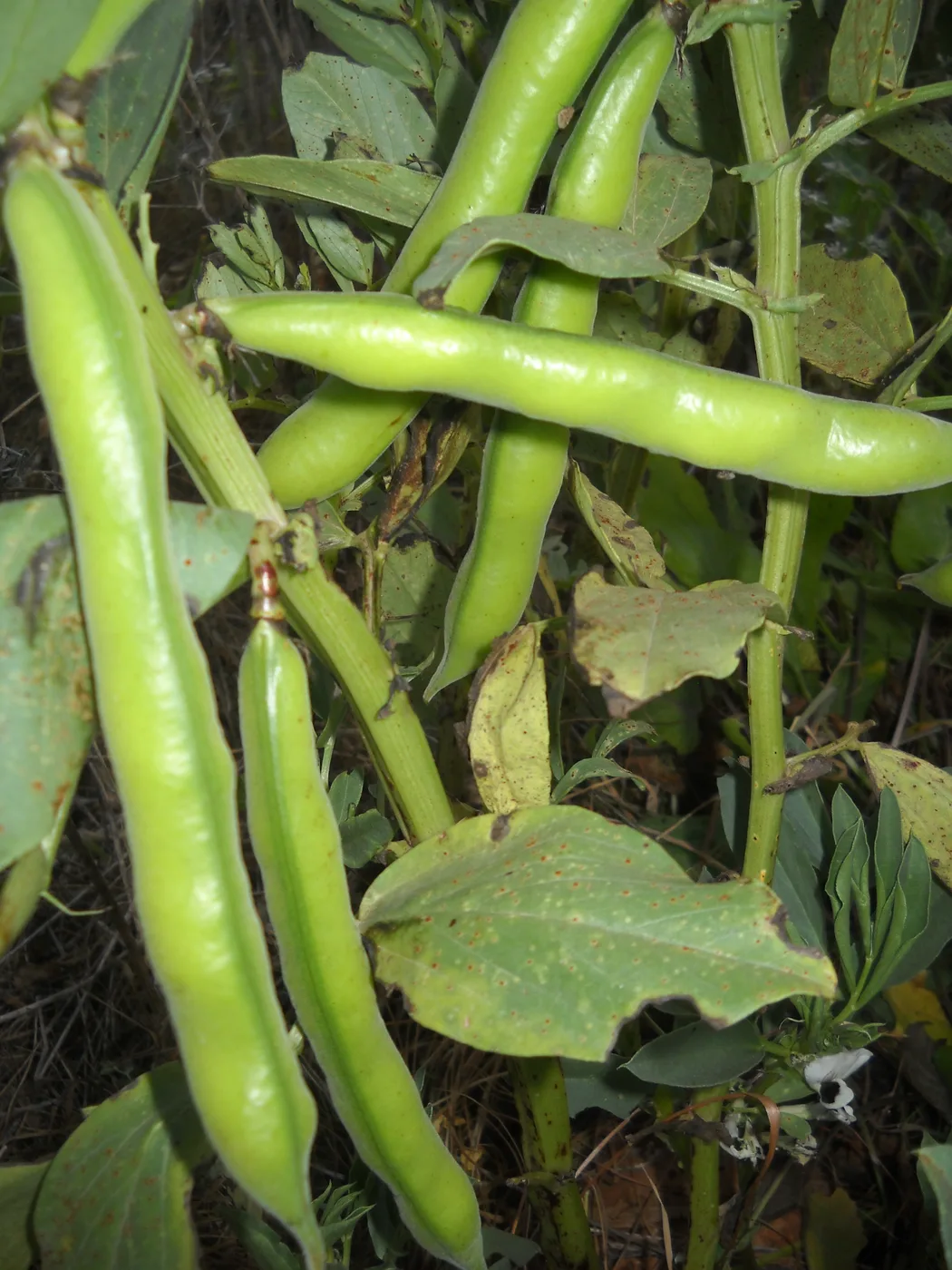
The broad bean is an erect plant, not a vine, reaching to 1 meter (3 feet) in height. The stem branches only in the upper part. It has no tendrils like many types of bean have today. The flowers are white, and when they ripen, they form pods containing 3–6 large flat beans of a cream or tan color.
Special significance
In 2SA 17:28 people bring food, including beans, to King David as he flees from his son Absalom. In EZK 4:9 Ezekiel is instructed to publicly make “bread” out of wheat, barley, beans, and lentils—whatever he could find—the point probably being that good quality bread will soon be scarce in Jerusalem.
Translation
There are at least two hundred species of the genus Vicia to which the broad bean belongs. Vicia itself is part of the vast family of legumes. It is possible that the Hebrew word pol actually refers to more than one type of bean, including what we now know as peas. Since beans and peas are known around the world, translators will probably be able to find a local equivalent. In both contexts (2 Samuel and Ezekiel) the word is used in a list of items, and if a local species of bean is not available to the translator, a transliteration should be used (for example, Arabic adas; French faverole, fève, haricot; Spanish frijol; Portuguese fava, favarola, feijão; Swahili haragwe; Latin vicia).