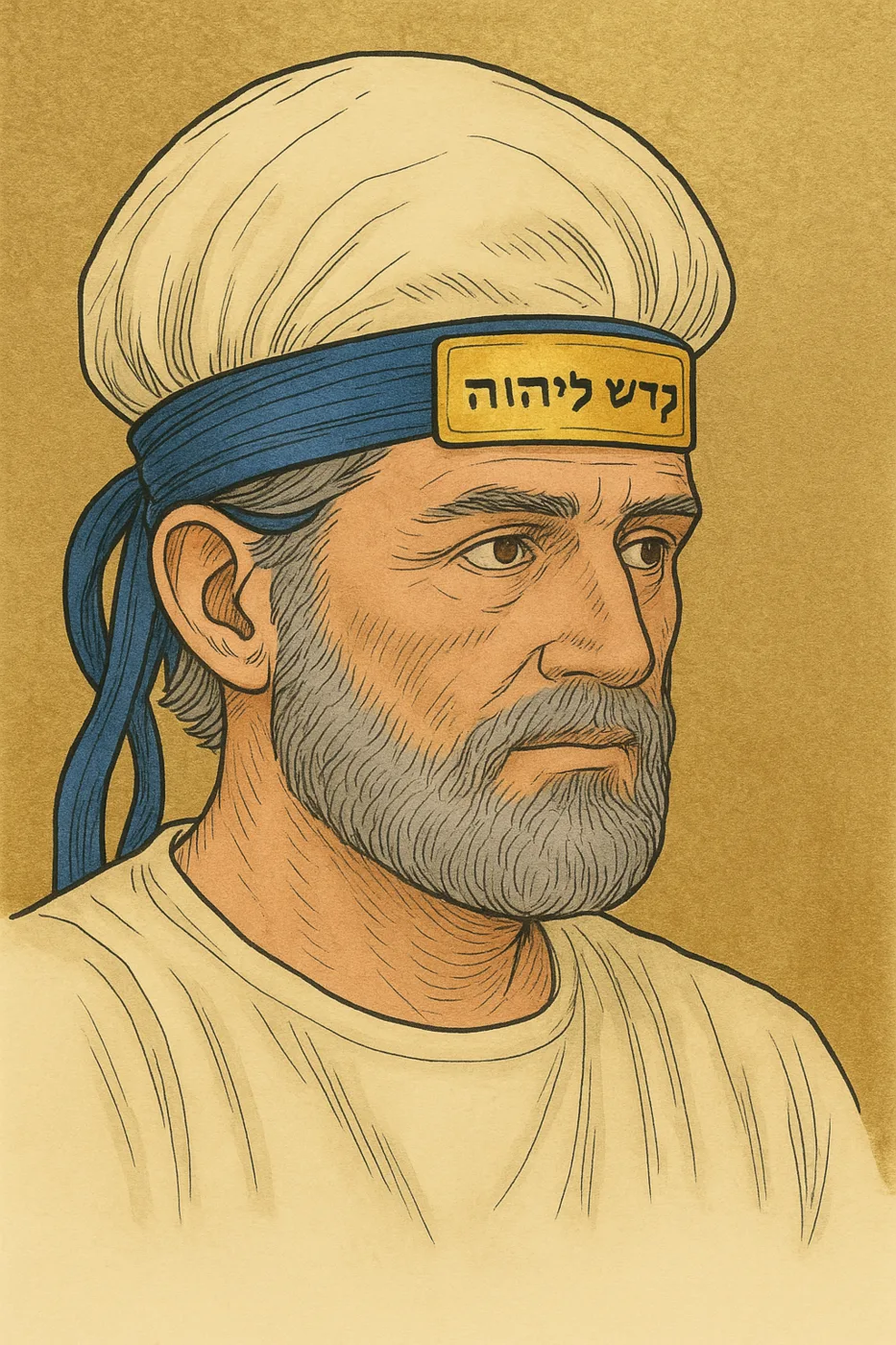
Description
The High Priest was commanded to wear a kind of headband on his forehead just below the level of his turban. It was made of two materials. In the front was a thin piece of gold beaten into the form of a narrow band. On this plate were inscribed the words “Consecrated [or, Dedicated/Holy] to the LORD).” Through the ends of this band were threaded blue ribbons or threads. These were tied at the back of the head holding the band against the forehead.
Translation
Ten English translations of EXO 28:36 that were consulted had eight different renderings of the Hebrew word tsits. Something like CEV “narrow strip” or GECL “small plate” will probably be best. Another possibility is “gold headband.”
LEV 8:9 has the literal expression “the golden flower, the holy crown.” In the first phrase “flower” renders the Hebrew word tsits. This word may mean “blossom” or “flower,” as in NUM 17:23 (verse 23 in Hebrew), or “shining thing.” When it is used with the qualifying word “golden,” many English versions understand it in the sense of “plate” (for example, RSV and NIV). FRCL, however, translates “the golden jewel in the form of a flower.” NJB has simply “the golden flower.” However, these words in Hebrew are in apposition with the phrase “the holy crown” and are explained by it. “The holy crown” was clearly not a crown in the sense of a sign of royalty. The Hebrew word translated “crown” may also mean “consecration,” and the whole expression probably indicates that the golden plate was a symbol of the High Priest’s dedication to God. It has been suggested that the meaning of the second phrase may be rendered by an expression such as “the sign showing that Aaron was given over to [or, consecrated to] God.” A possible model for translating the whole expression is “the golden object showing that he was dedicated to God.”