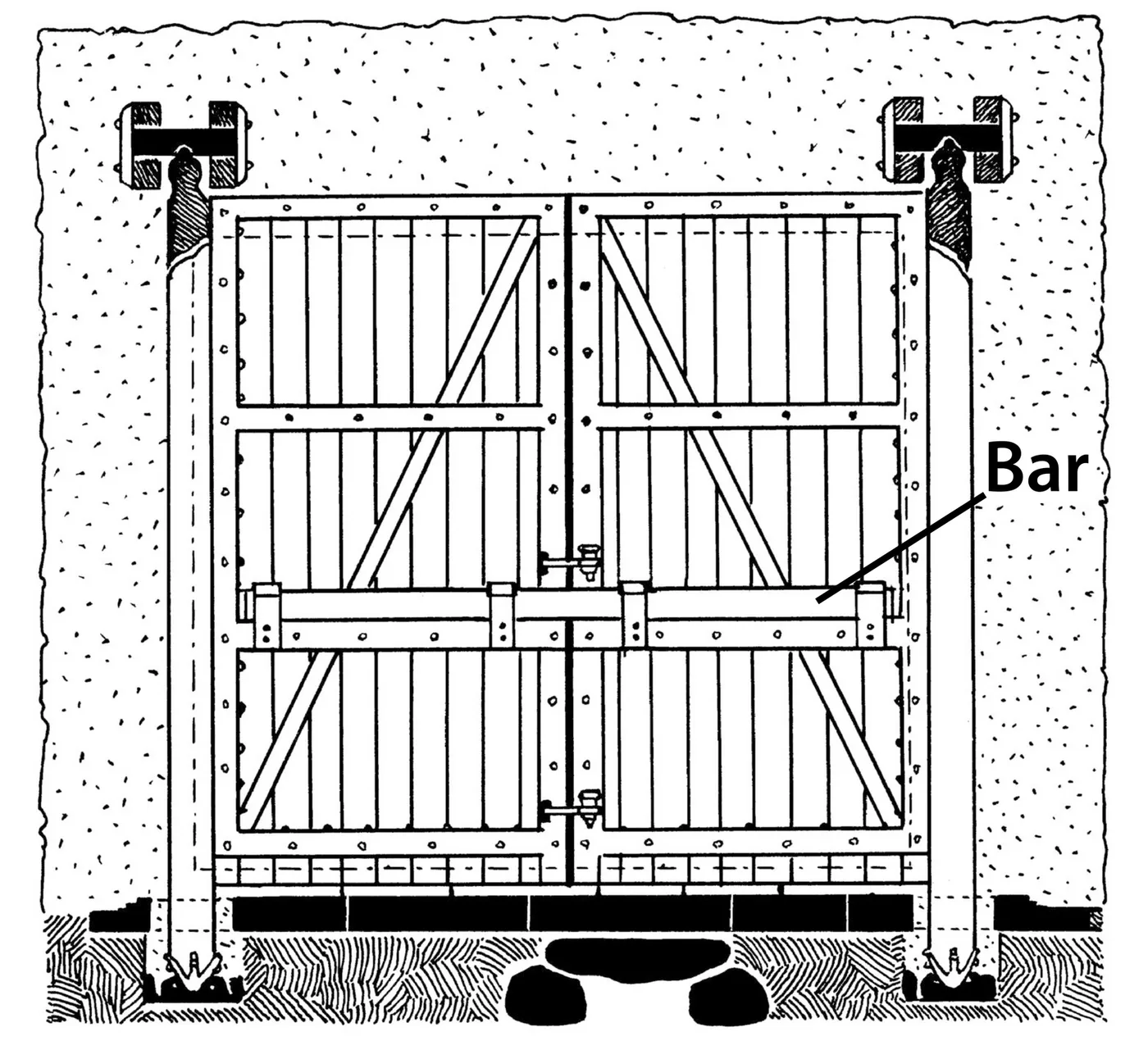
Description
The bars of gates were usually made of wood (see the description of the gate at City gate). However, there are several specific references to bars made of metal (1KI 4:13; PSA 107:16; ISA 45:2), but even these bars may have been made of wood that was reinforced with metal.
Translation
In some languages it may be necessary to use a descriptive phrase for “bar,” such as “big stick that held the doors closed.” Another model is “bar that bolts the doors of the mouth/opening/entrance in the walls/fences around the city.” Since the bar functioned to secure the gate in much the same way a modern lock would, translators may wish to speak of a “lock” rather than a bar; for example, in JER 49:31GNT refers to “locks.” In DEU 3:5GNT presents another model: “bars to lock the gates.”
JOB 38:10: See the discussion under Gate or gateway to house or building complex.
In AMO 1:5RSV renders the Hebrew word briach literally in the first line, saying “I will break the bar of Damascus.” Like RSV, most translations treat the first line as a literal threat to destroy the city of Damascus. NIV has “I will break down the gate of Damascus,” CEV says “I will break through the gates of Damascus,” and GNT translates “I will smash the city gates of Damascus.” This is also the only option presented by A Handbook on The Book of Amos. It is possible, however, to see a parallelism between the first two lines of the verse and the last two lines, where “gate bar” in the first line is parallel to “scepter” (shevet in Hebrew) in the third line. This would mean that the gate bar is a metaphor for the ruler. Of the translations consulted, only REB comes close to this approach with “I shall crush the nobles of Damascus ... and the sceptred ruler of Beth-eden.”
NAM 3:13: It is not clear whether the bars and gates mentioned here are to be taken literally or figuratively. If they are understood figuratively, then the “bars” probably stand for the fortresses that guarded the mountain passes, which are called “gates” earlier in the verse. If they are understood literally, then the “bars” would be the wooden beams that prevented the gates of Nineveh from being opened. GNT follows this interpretation and renders the last half of this verse as “Fire will destroy the bars across your gates.” Probably it is better either to take both the gates and bars as figurative, or both as literal. If translators take both the gates and bars as figurative, a possible translation model is “The borders of your land are wide open to your enemies, and fire will destroy your fortresses.”
NEH 3:3; NEH 3:6; NEH 3:13; NEH 3:14; NEH 3:15 lists both briach and man‘ul as part of the gate. They were in fact parts of the system for securing the gate from the inside so that it could not be opened. The Hebrew word briach refers to a pole or bar, while the word man‘ul comes from a root meaning “to close.” Most translations render the two objects as “bolts and bars.” CEV “metal bolts and wooden beams as locks” suggests the materials from which these objects were made and the function they served. The exact structure and function of the man‘ul is not clear. The rendering of GECL (expanded a bit) may come close: “the bars and the mechanisms that secured them in place.”