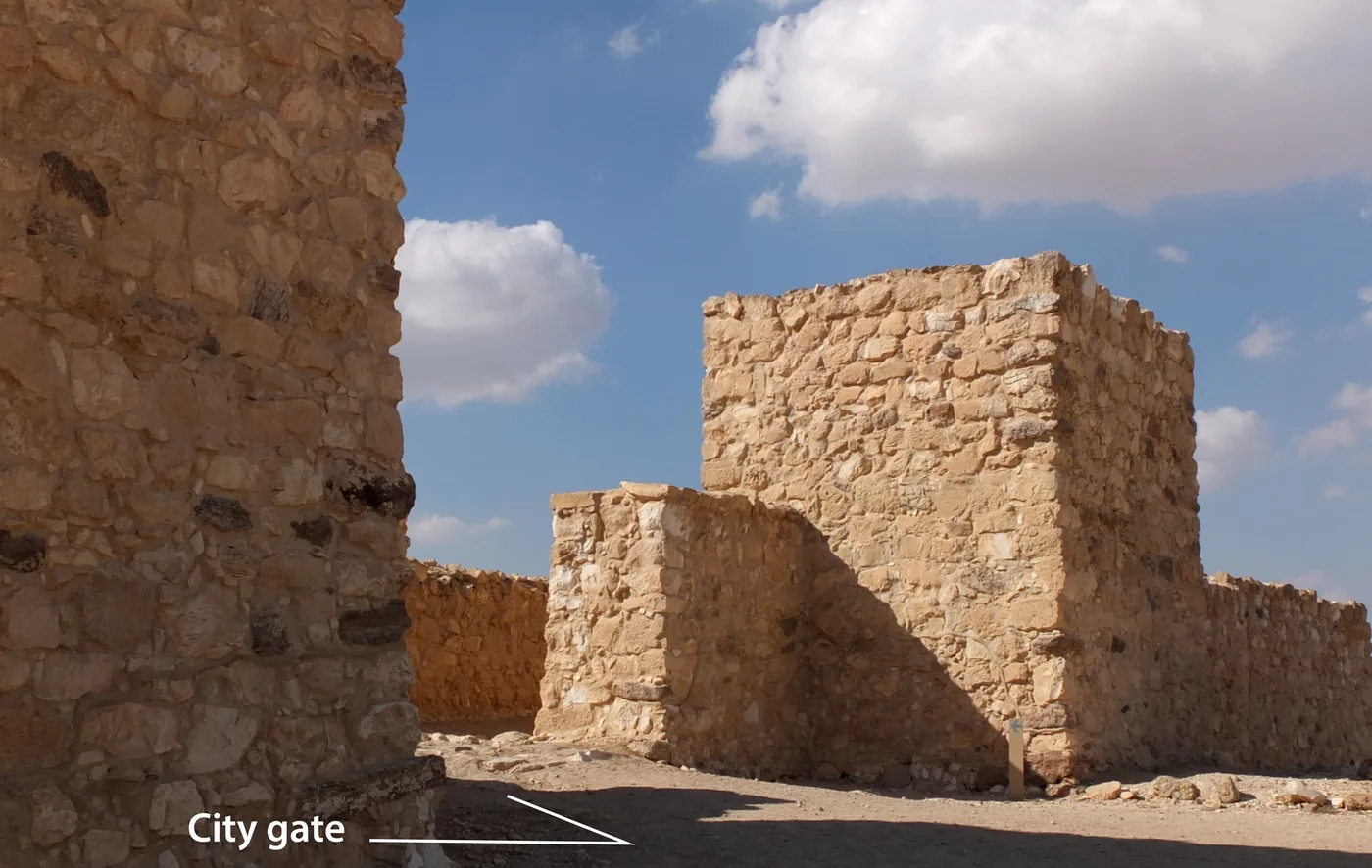
Description and usage
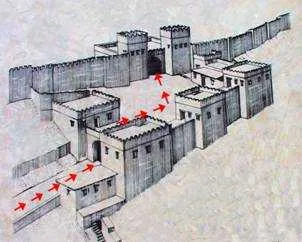
The gate was an entranceway into a city through its defensive wall. Large gates could also be found at the entrances to large complexes such as the Temple or the residences of the rich. Gateway construction varied at different periods, having two, four, or six parallel guardrooms on either side of the gateway. At other times gateways were built having one or more ninety degree turns, usually to the left (in order to expose the side of the attacking soldier which was not covered by his shield). The entrance of the gateway was closed by a thick door, normally made of wood. The door was usually made of two parts, each part hanging on hinges from each side of the gateway. These two parts of the gate were pushed together and then secured in place by one or more heavy wooden bars from the inside (see Gate bar, bolt).
Translation
In ancient cities, business and discussion were often conducted in the gateway (see GEN 23:10; GEN 23:18; RUT 4:1; RUT 4:11; see also Square, marketplace). It was the place where the elders or important men of the city gathered (JOB 29:7). The city gate could also serve as a place of judgment (DEU 21:19; JOS 20:4) or punishment (DEU 17:5; DEU 22:24). JOB 31:21 probably refers to the city gate as a place of judgment also. The second line of this verse is literally “because I saw my help in the gate.” This refers to having the support and backing of the other officials in the town. If Job had wanted to mistreat anyone, he could have counted on those men who sat on the town council to defend him. GNT “knowing I could win in court” means that Job has the support of the local court system (that met at the city gate) to defend his case. We may also render the whole verse as “I have never threatened to harm an orphan, even though I knew the officials would be on my side if I did.” PSA 127:5 also refers to the city gate as a court. The second half of this verse is literally “He shall not be put to shame when he speaks with his enemies in the gate” (RSV). The “enemies in the gate” are a man’s adversaries in a legal dispute; the open space near the inner gate of the city was the place where legal disputes were settled. If he had a number of grown sons with him, a man would be more likely to win in a legal dispute with his adversaries. In some languages there is a term for a designated place in the village where village elders meet for hearings. In cases where there is no such customary place, “in the gate” is sometimes rendered “in the place where men meet to decide matters.” Compare also PRO 22:22; PRO 24:7; PRO 31:23; ISA 29:21; LAM 5:14; AMO 5:10; AMO 5:12; AMO 5:15; ZEC 8:16.
GEN 22:17; GEN 24:60: The literal expression “shall possess the gates of their enemies” (RSV) in GEN 22:17 is an idiomatic way of saying “will conquer their enemies” (GNT) or “will defeat their enemies” (CEV).
EXO 20:10: Here a Hebrew idiom speaks of people who are “within your gates” (RSV). This refers to the territory controlled by someone. So GNT has “in your country,” CEV uses “in your towns,” and NCV says “in your cities.” Compare DEU 5:14; DEU 12:12; DEU 12:15; DEU 12:18; DEU 12:18; DEU 12:21; DEU 14:21; DEU 14:27; DEU 14:28; DEU 14:29; DEU 15:7. Generally this idiom may be rendered “in your land,” “in your towns,” or “in your cities.” The expression should not be misunderstood as referring to people who, by a different metaphor, “sit in the gate,” that is, are members of the local leadership.
RUT 3:11: In the literal expression “the whole gate of my people,” “gate” refers to the city, and “the whole gate” is a reference to the whole city in the sense of “all the people of the city” or “all of the citizens.” It is rare that a translator can use a term for “gate” in reference to a city. RUT 4:10 speaks literally of Mahlon’s name not being “cut off … from the gate of his place.” Here again “gate” is a metonym for the whole town. GNT expresses this positively, saying “his family line will continue … in his hometown.” CEV is also good: “he will be remembered in this town.”
2SA 18:24: The literal phrase “between the two gates” (RSV) reflects the construction of city gates. The stronger walled cities had an outer and an inner gate, with a covered passage or narrow entrance hall between them. Along the sides of the passage were usually rooms occupied by guards (see Guardroom). The translator can make the picture reasonably clear with an expanded translation, for example, “between the inner and outer gates” (NIV) or “between the inner and outer gates of the city” (GNT). CEV is similar to NIV and adds the following note: “The city gate was often like a tower in the city wall, with one gate on the outside of the wall and another gate on the inside of the wall.”
PRO 31:31: “and let her works praise her in the gates” (RSV). Here “gates” stands for the place where people gather, a public place. CEV says “praise her in public for what she has done” (similarly NCV), and GNT has “She deserves the respect of everyone.”
MAT 16:18: The literal phrase “the gates of Hades” is an idiom for death or the power that death holds over humanity. RSV and NEB have “the powers of death.” For the last clause of this verse, CEV says “death itself will not have any power over it.” There is a parallel expression in ISA 38:10, where Hezekiah complains that the little time he has to live will be dominated by the fact of his impending death: “I had thought: I must depart in the middle of my days; I have been consigned to the gates of Sheol [meaning ‘world of the dead’] For the rest of my years” (NJPSV). Compare GNT: “I thought that in the prime of life I was going to the world of the dead, Never to live out my life.” In both passages the translator should not try to retain the reference to gates unless it will be natural in the receptor language; for example, in ISA 38:10 in English, Hezekiah might speak of being “at death’s door.”
ACT 3:2: There are two opinions concerning the identification of the gate mentioned only in this passage. Some authorities believe it was the Nicanor Gate, made of polished Corinthian bronze, which according to Josephus exceeded all the other gates in value and which gave access from the Women’s Court to the Court of Israel. But from the context, which says that Peter and John were “going in,” it seems more probable the gate here called “Beautiful” was the Golden Gate, also called Shushan. Jewish tradition knows nothing about a gate called the Beautiful Gate. However, translators do not need to concern themselves with the identification of the gate; it is sufficient to say “the Beautiful Gate” or “the gate called Beautiful.” Translators normally capitalize the name of the gate.
About 40 verses make reference to “gatekeeper[s].” A gatekeeper was a man who was responsible to sit by a closed gate and identify those desiring to enter. He would open the gate (of the city, the Temple, a palace, or perhaps to the courtyard of a rich man) only for those who were allowed to enter.