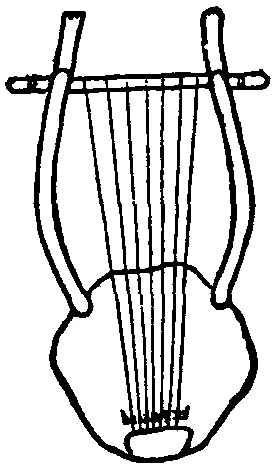
Description
The lyre consisted of a sound box out of the ends or sides of which projected two arms. The arms supported a crosspiece. Strings descended from the crosspiece over the sound box. As with the nevel, the number of strings could vary. Their varying thickness and tension gave the instrument a range of notes. The lyre was normally made of wood. The strings were made of animal intestines (perhaps from sheep).
Usage
The strings were normally plucked with the fingers. The kinor in particular is frequently depicted as an instrument that accompanied singing.
Translation
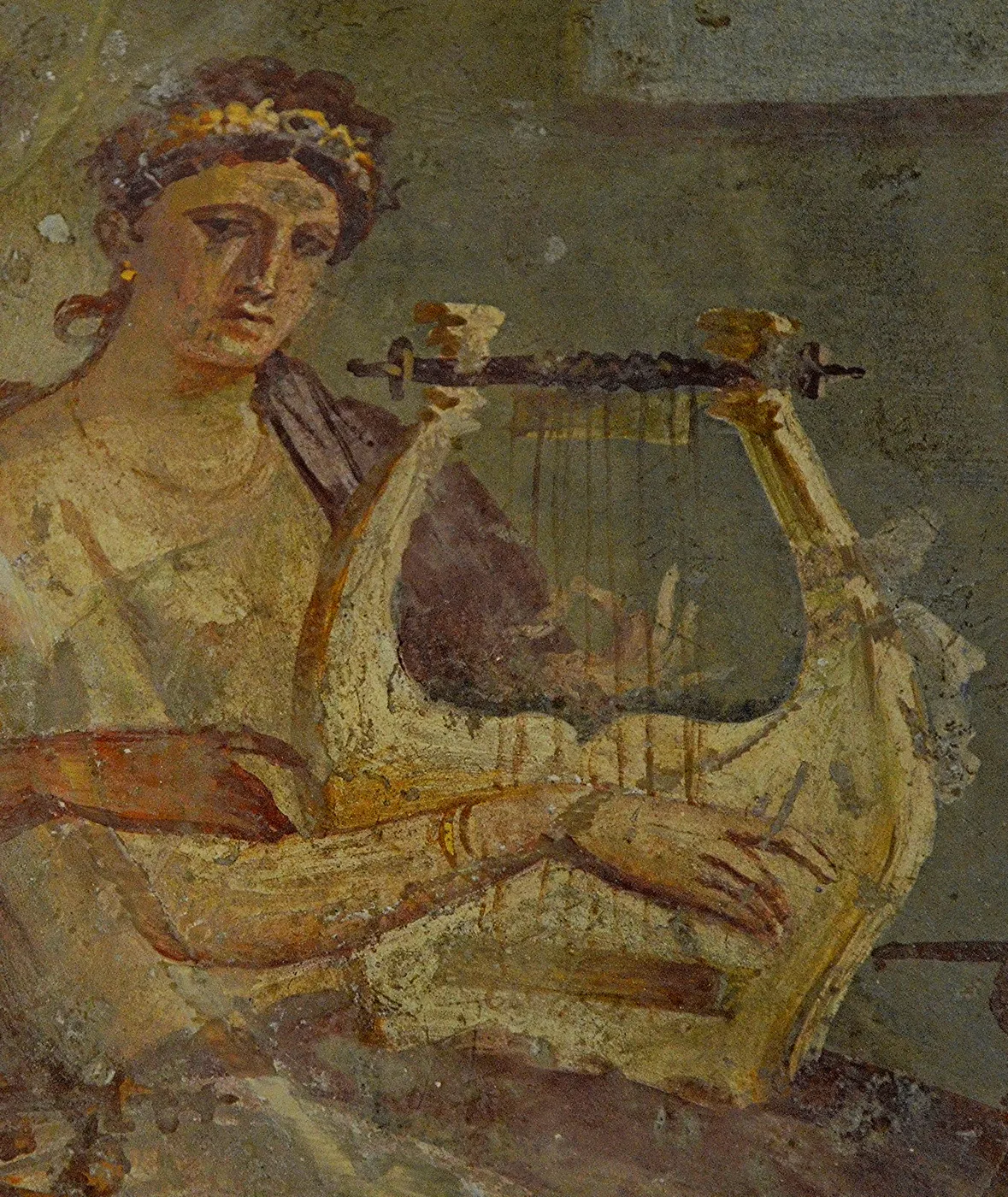
JOB 21:12: For the stringed instrument (kinor in Hebrew) accompanying the tambourine, FRCL has “guitar” and La Bible de Jérusalem has “zither,” which seems to be an instrument used in 1SA 10:5. The first line of this verse may also be rendered “The children sing as people play the tambourine and the lyre.” In some languages these instruments will be a local drum and a stringed instrument; the latter may be a guitar. If no instruments can be found to render any of the instruments in this verse, the translator may have to express the whole verse differently; for example, “The children dance and sing and make joyful sounds/music.”
The identity of the instrument called sabka’ in Aramaic in DAN 3:5; DAN 3:7; DAN 3:10; DAN 3:15 is uncertain. RSV renders it “trigon,” which is a small triangular lyre-type instrument with four strings. Probably trigon is technically correct, but it is unknown to the average English reader. GNT has attempted to find a better-known equivalent with “zither,” but the zither has far too many strings (over thirty). Some translations use “lyre” for sabka’ and render the Aramaic word qathros before it as “zither” (NIV, NJPSV, NLT). REB has “triangle,” but most readers will wrongly identify that as a percussion instrument. CEV avoids the problem by rendering only the first three instruments in the list and grouping the last three together, including sabka’ as follows: “Trumpets, flutes, harps, and all other kinds of musical instruments.”