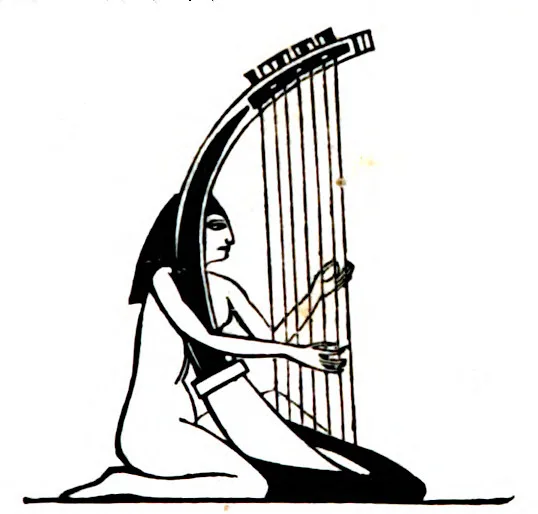
Description
The exact identification of the nevel is very problematic. Some take it to be a kind of harp. The harp consisted of a neck projecting out of a soundbox. Strings were stretched from the extremity of the neck down its length and into the sound box. The body of the harp was made of wood and its strings of animal intestines (perhaps from sheep). The number of strings varied.
Others place the nevel in the category of lyres, where the strings are stretched over top of and parallel to the soundbox (see Lute). While this is the interpretation preferred here, we will discuss the harp-type of instrument, since the identification is problematic and many translations have preferred “harp” for nevel.
Usage
The strings were plucked either with the fingers or with a thin piece of ivory or metal to give a resonating sound, probably in a lower register than that made by the kinor.
Translation
In several Psalms (PSA 33:2; PSA 92:4; PSA 144:9), the nevel is linked to the Hebrew word ‘asor, which could indicate it was “ten-stringed.”
Some degree of cultural adaptation must be made in the translation of these stringed instruments since cultures differ from each other in the shape, the number of strings, and the function of their instruments. Translators will have to select an equivalent instrument in the receptor language. In most passages the most accurate translation for nevel will be “guitar” or some equivalent medium-sized stringed instrument on which the strings are stretched over a sound box and are plucked.
In those passages where nevel and kinor appear together it is recommended that the translator use an instrument that can vary in size and then render the two words as “large and small X,” for example, “large and small guitars.” Alternately, it may be possible to select two stringed instruments that are similar in construction but different in size, for example, “guitar and lute.” It is also possible to say “large and small stringed instruments” or to combine the two, saying “stringed instruments.”
PSA 33:2: “Praise the LORD with the lyre” (RSV) contains two major translation problems. The first problem is that in many languages, the phrase “with the lyre” must be changed into a verb phrase or clause; for example, the whole line may be rendered “Praise the LORD by playing music on the lyre” or “Make music with the lyre, and praise the LORD.” The second problem, which applies also to the second line of this verse, is the terms to be used for the musical instruments here. In languages in which there are several stringed instruments, translators may use one of the smaller ones for kinor (“lyre”) and a larger one for nevel (“harp” in RSV). In languages where there is little or no choice, they should use the known local stringed instrument for the kinor, and a more generic expression for the nevel. Where there are no known stringed instruments, it will often be necessary to say “small instruments with strings” for kinor and “large instruments with strings” for nevel.