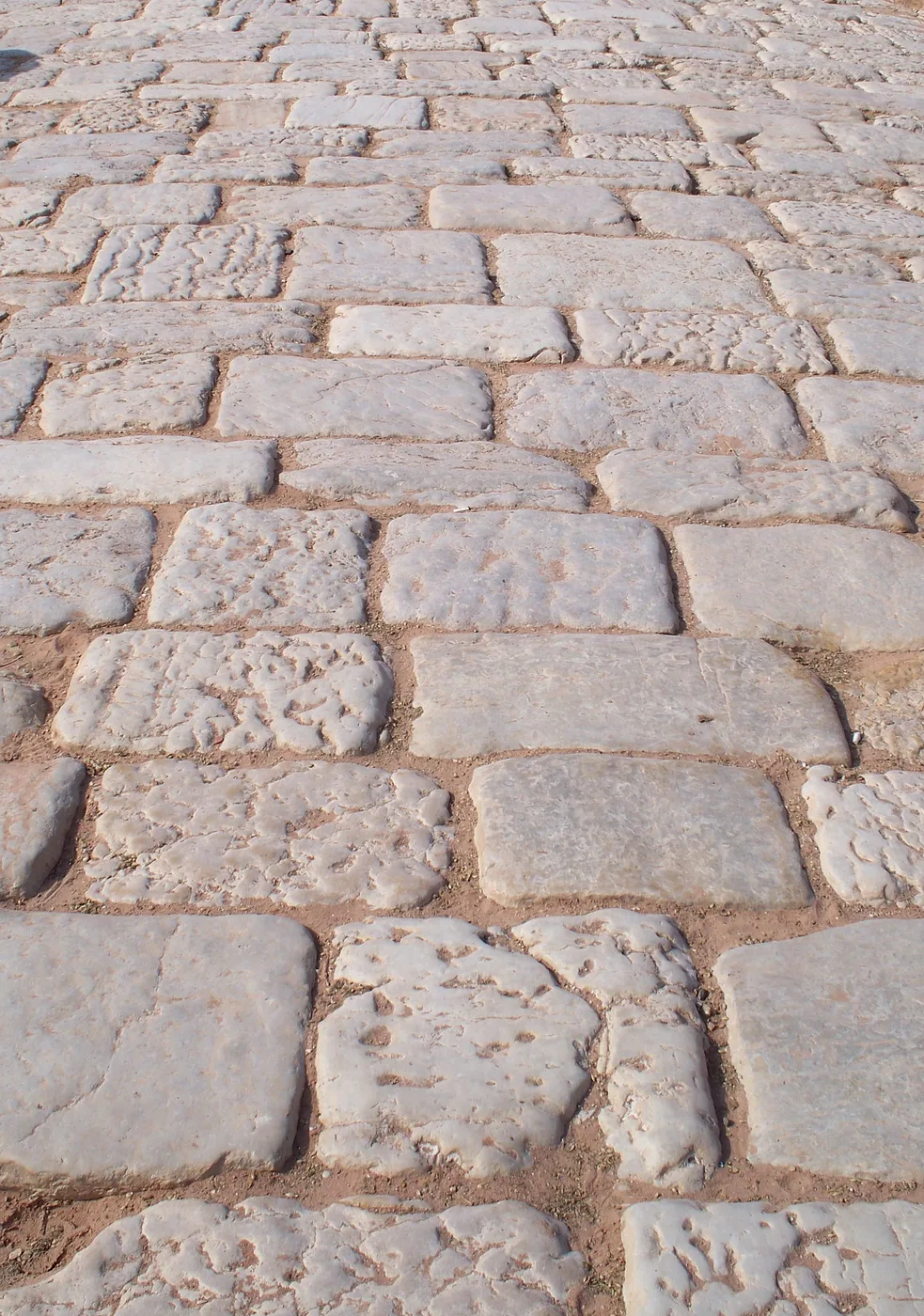
Description and usage
Pavement was an area paved with flat blocks of stone to form a courtyard (not a road). “The Pavement” was the name given to the inner courtyard of the Roman fortress of Antonia, which bordered the northwest corner of the Temple complex in Jerusalem.
Translation
JER 43:9: The Hebrew word malben occurs elsewhere with the meaning of “brick mold” or “brickkiln” (see the discussion and references at Brick mold, brickkiln). Here it seems to indicate the material from which the pavement is made; NIV, NCV, and CEV all render it “brick pavement.” Jeremiah is told to hide the stones “in the melet of the malben.” The Hebrew word melet occurs only here, and its meaning is uncertain. Translations usually render it as some material in which the bricks would be set, for example, “clay” (NRSV, NIV, NCV), “mortar” (RSV, GNT), or “cement” (REB). CEV avoids finding a specific material and focuses instead on the location, saying “underneath the brick pavement.”
JHN 19:13: In some languages translators may render “The Pavement” as “the court covered with large blocks of flat stone” or “the stone-paved courtyard.”
The Greek word edafos does not refer to a specific place or even to a particular kind of construction. Thus it may be translated with a generic term such as “floor” or even “ground.”