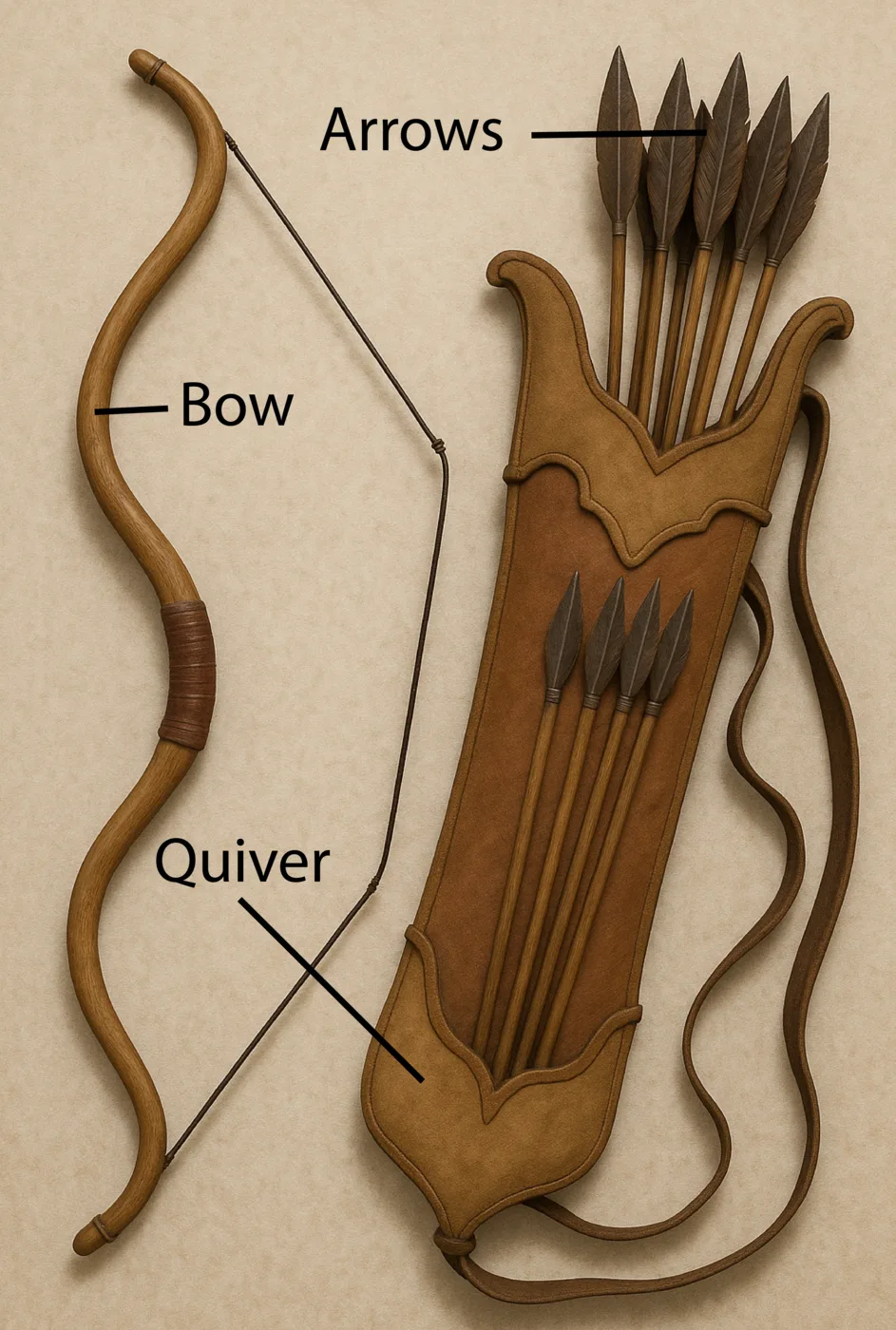
Description and usage
The quiver was a cylindrical leather container, closed on one end, for holding arrows. It was slightly shorter than the arrows it held. It was strapped to the back of the archer so that both hands were free to use the bow. It was large enough to hold 20–30 arrows.
Translation
“Quiver” may be rendered “container holding the arrows” or “arrow box.”
The following is adapted from A Handbook on Lamentations (page 81) on LAM 3:13: The Hebrew phrase bene ’ashpah (literally “sons of the quiver”) refers to arrows. The quiver as the container for the arrows is not central to the description of God’s attack here, and translators handle this expression in various ways; for example, GNT omits the word “quiver” as unnecessary when speaking of the action of “his arrows” (similarly FRCL “all his arrows” and GECL “Arrow after arrow”). However, translators who are translating into poetry may need to retain the word “quiver” by rendering the whole verse as follows: “His quiver gave [or, produced] arrows that he shot into my heart.”
In SIR 26:12 “quiver” is used in a euphemism for the female genitalia. The last half of this verse is literally “she will sit in front of every tent peg and open her quiver to the arrow” (NRSV). GNT says “She’ll spread her legs anywhere for any man who wants her.” Some translators may consider GNT ’s English euphemism to be too explicit. If possible, translators should look for an expression that indicates that the woman in the verse is promiscuous without being more explicit than the intended audience can tolerate. One possibility is “she is ready to have sex with anyone who comes along.” Where a suitable euphemism cannot be found, it may be necessary to keep a literal rendering and explain in a footnote that the imagery of the quiver and arrow is intended to portray sexual promiscuity.