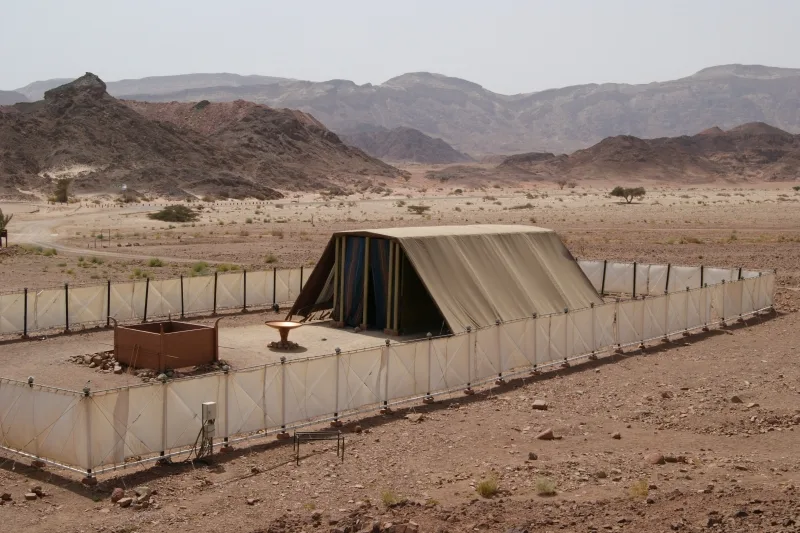
Description and usage
The Tabernacle was a relatively large tent with a surrounding enclosed courtyard, used as a central place of worship by the Israelites prior to the building of the Temple.
Translation
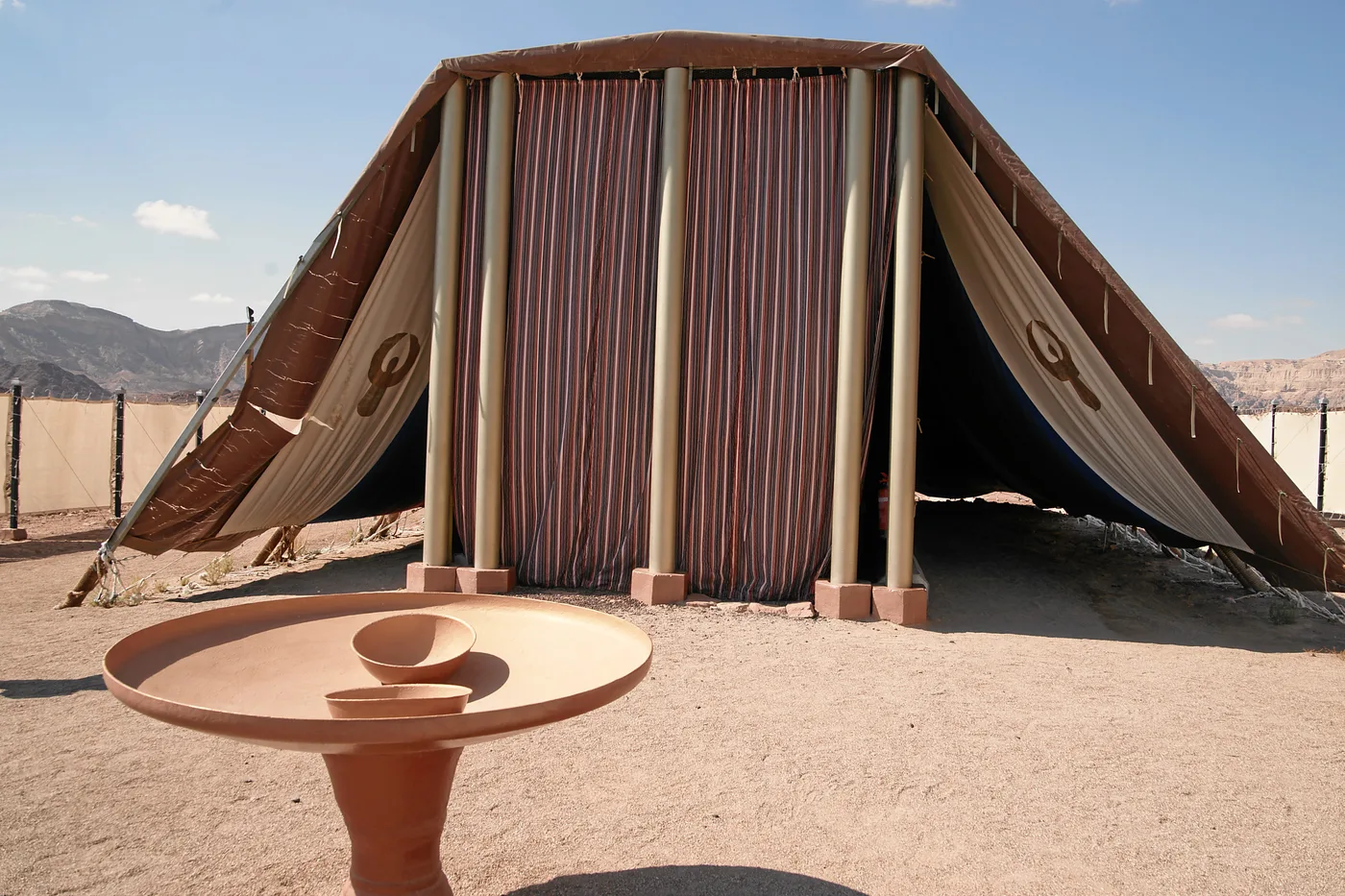
The Hebrew word ’ohel, which means “tent” (see Tent), can indicate the Tabernacle proper (EXO 26:36) or, as explained above (see Tent of Meeting and Tabernacle), the Tent of Meeting.
In some languages “Tabernacle” may be rendered “largest tent in which God lived,” “large tent for worshiping God,” or “holy tent.” In selecting a proper designation, it is important to indicate that the function of the Tabernacle was essentially the same as that of the Temple; there was only a difference of construction and not a difference of use or of religious relevance. Refer to the discussion at 3.14.1 “Jewish Temple.”
Osborn makes the following comments concerning the translation of “Tabernacle”: “A few recent translations have broken from the traditional rendering of ‘tabernacle’ and simply translate it as ‘Dwelling.’ The Translator’s Old Testament (TOT) uses the word ‘Shrine,’ which is perhaps a bit more appropriate for what was to become the wilderness dwelling of Yahweh. Either term, of course, could still refer to the tent within the enclosure or to the entire structure including the tent. Both terms suggest, however, something different from the more permanent Temple of Solomon, which seems to have influenced the priestly description of the tabernacle.”
EXO 39:32; EXO 40:2; EXO 40:6; EXO 40:29; 1CH 6:17: The Hebrew in these verses combines the terms mishkan and ’ohel mo‘ed, which RSV renders “the tabernacle of the tent of meeting.” In the three references in EXO 40:0, it is probable that mishkan refers to the inner tent, made of the frames and four coverings, while ’ohel mo‘ed refers to the entire Tabernacle complex. In EXO 39:32 the two terms are used for the same thing, the second term explaining the first one. GNT uses only one expression for both terms in this verse: “the Tent of the LORD’s presence.” NIV is better with “the tabernacle, the Tent of Meeting.” Another way to express this is “the sacred tent, where the people met with the LORD.”
HEB 8:2; HEB 9:11; REV 15:5: These verses speak about a sacred tent, using the same Greek word skēnē that refers to the tent in the wilderness (for example, HEB 8:5). However, in these passages the text is speaking of a heavenly or spiritual counterpart (actually, original) of the physical tent. Where possible, the translation should keep the same word to render skēnē, whether it refers to the physical tent or its heavenly counterpart.
The following is adapted from the comments in A Handbook on The Revelation to John (pages 226–227) at REV 15:5: There is some uncertainty concerning what is meant by the compound genitive “the temple of the tent of witness” (RSV /NRSV). This literal rendering is quite ambiguous, but the average reader probably understands it to mean that in the tent of witness there is a temple. There are three possible meanings for this expression: (1) “the tent of witness” and “the temple” refer to the same thing, so it may be rendered “the temple, that is, the Witness Tent” (so AT, NJB, SPCL, NIV); (2) “the Witness Tent in the Temple” (so GNT, FRCL, Brazilian common language version); (3) “the sanctuary in the Witness Tent” (so The Translator’s New Testament [TNT], REB, Brc, Phillips [Phps]). In favor of the last interpretation—which is the one that is recommended—is the fact that the word translated “temple” (naos in Greek) is the special term for the inner sanctuary of the Temple, as contrasted with the Temple’s large worship area (hieron in Greek). The inner sanctuary (in which the Covenant Box was kept) was separated by a heavy curtain from the worship area, in which were located the altar of incense and the table on which were placed daily the loaves of bread offered to God. This was also the design of the Tabernacle (see EXO 40:1–EXO 40:33). It seems best, then, to translate here “the sanctuary [or, most holy place] that was in the Witness Tent” or “… that was in the Tabernacle.” A translation should use here and in ACT 7:44 the name for Tabernacle most often used in the Old Testament.