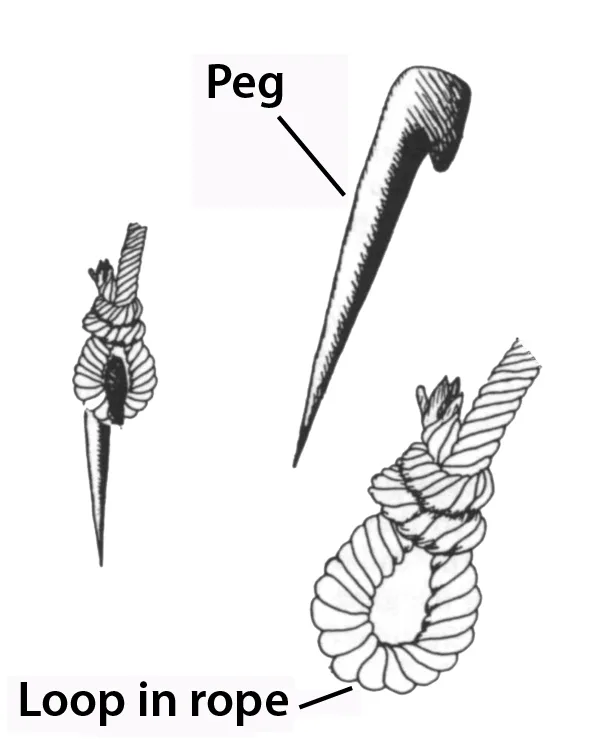
Description and usage
The tent peg was a shortened stick, pointed on one end. It was driven into the ground, and tent ropes were tied to it to anchor the tent in place. See the illustrations at Tent.
Translation
The stakes of the Tabernacle, mentioned in Exodus and Numbers, were made of bronze. They were used to anchor the various coverings of the Tabernacle (see Coverings) and also some of the standing posts (see Upright beam, tenon, crosspiece, rung).
The tent stake provided security. It guaranteed that the tent would not fall nor be blown out of its place by winds. Thus it is sometimes a symbol of stability and security. This element of security may be reflected in translation in EZR 9:8 and ISA 33:20; for example, in EZR 9:8 the literal clause “to give us a tent peg within the place of his holiness” is rendered by RSV as “to give us a secure hold within his holy place,” and GNT has “live in safety in this holy place.”
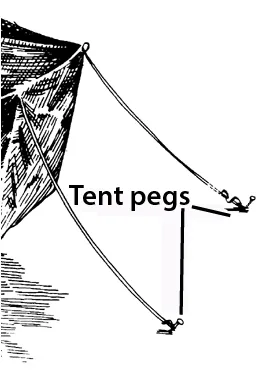
SIR 14:24: The Greek word passalos refers to a tent peg. The Hebrew version of Sirach has a word that, with a very slight emendation of part of one letter, could mean “tent cords” or “tent pegs.” With either reading, the basic meaning remains the same and is expressed well by GNT: “Camp as close to her house as you can get.” If translators wish to maintain the image of the tent and the house, they may say “he attaches his tent to the wall of her house.”