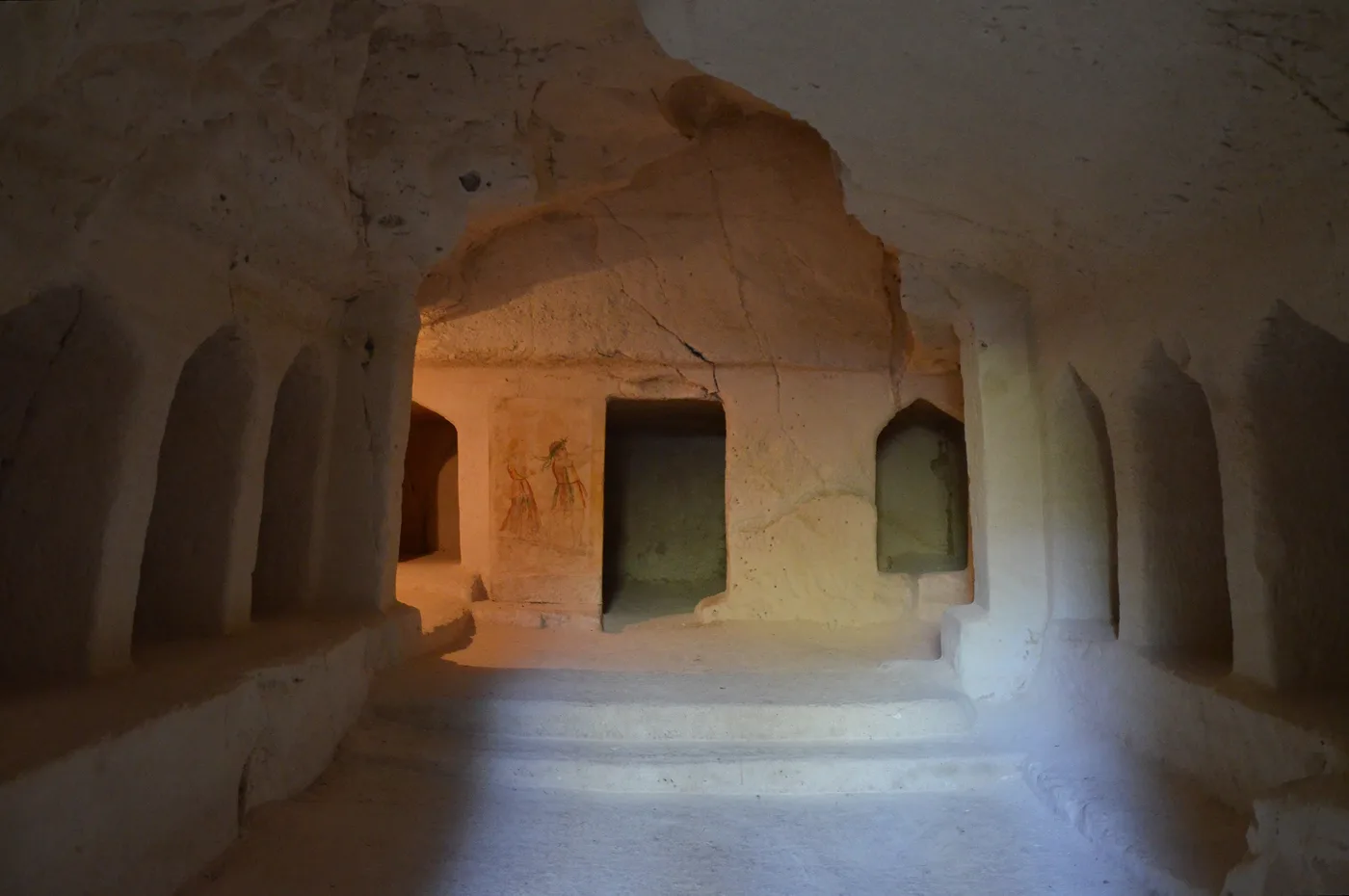
Description and usage
The tomb was a construction for the burial of the dead. Since much of the land of Israel, especially in the hilly regions, has little topsoil, tombs were often hewn out of bedrock. In some cases natural caves were used for burial. The entrance to a tomb was closed with a stone (see Stone for closing a tomb).
Translation
Death is a universal experience, and all languages and cultures have words to express the disposal of a dead body. In a number of languages it is important to distinguish clearly between a grave (a hole in the ground in which a corpse is placed) and a tomb (a construction built above the surface of the ground for housing one or more corpses). In some contexts, however, it may be better to use a more generic expression, for example, “places where people are buried” or “places where corpses are placed.”
In some passages the word “grave” is used as a symbol for death. Translators should consider whether the physical burial place is in focus or rather the fact that a person has died. In the latter case, it may be better to use a term indicating “death.” This will be true especially in poetic passages. For example, JOB 3:22 is literally “who rejoicing unto joy are glad when they find a grave,” but GNT has “They are not happy till they are dead and buried.” JOB 5:26 is literally “You will come to the grave at an old age,” but GNT says “you will live to a ripe old age.”
Certain verses speak of “graves” in the plural. Here it will often be appropriate to use a word like “graveyard” (GNT in JOB 21:32) or “cemetery.”
In the upper levels of Israelite society burial was often done in two stages. In the first stage the body was either laid on a kind of shelf inside a burial chamber or it was placed in a large box called a sarcophagus (“flesh eater”) in English. After about a year, when the flesh had rotted, the bones were moved to a designated place in the chamber. By New Testament times the bones were being placed into an ossuary (“bone box”). These practices gave rise to two expressions in the Hebrew language: “he lay down with his fathers” and “he was gathered to his fathers.” In 2CH 16:14, the place where the body was laid out (mishkav in Hebrew) is referred to in the burial of King Asa of Judah. Some translations render the word as “bier” (RSV, NIV; see Bier, coffin), but the structure of the verse indicates that Asa’s body was taken into the tomb and laid in its permanent place, that is, on a shelf in the tomb. The rendering of NJPSV gives the sense better with “resting-place.”
1SA 13:6: The meaning of the Hebrew word tsrichim in this verse is uncertain. Some versions understand it to mean “tombs” (RSV, CEV, GECL, ITCL). These would be cave-like structures hewn out of the rock. Others use a more generic term, such as “pits” (GNT, NIV) or “vaults” (NJB). Some have thought this word is related to a Hebrew word meaning “stronghold” or “tower” in JDG 9:46, JDG 9:49, but this meaning does not seem to fit the context here.
In MAT 23:29 the Greek word mnēmeion may also be understood as referring to monuments built as memorials to people who have died. Here it may be translated “monuments to the dead.” This is also its meaning in LUK 11:47. The Latin word monumentum in 2ES 2:16 may be understood in the same way.
In MRK 5:2 it is important to avoid a term that would designate merely graves, for the demoniac who met Jesus was not living down in graves in the ground, but had found some habitation either in burial caves or in tombs constructed above ground.