Description and usage
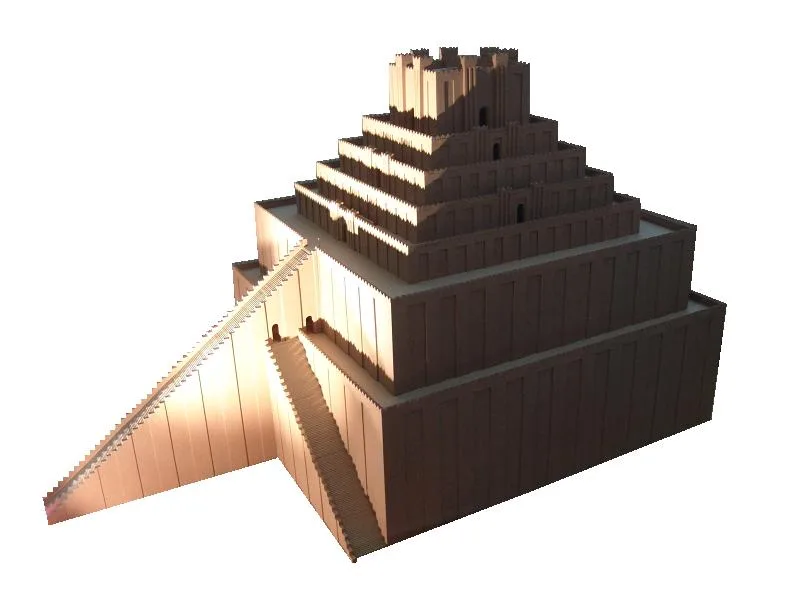
The ziggurat was a very high tower built for religious or ceremonial purposes. It had a staircase around its outside and a shrine at the top.
Translation
In Mesopotamia there are imposing ruins of enormous structures in the form of stepped towers or pyramids, called ziggurats. The most important of these ziggurats are the ones of Ur and of Babylon, dating respectively from the end of the third and the beginning of the second millennium B.C. The ziggurat in Ur is square, measuring 43.3 meters (142 feet) wide by about 62.5 meters (205 feet) long. It has not been possible to calculate precisely its original height, but it appears to have had seven stages or stories. The account of GEN 11:1; GEN 11:2; GEN 11:3; GEN 11:4; GEN 11:5; GEN 11:6; GEN 11:7; GEN 11:8; GEN 11:9 seems to refer to the ziggurat of Babylon. Its nucleus was made of mud bricks and was about 15 meters (50 feet) thick. The platform upon which it was built measured 457 meters (1500 feet) by 415 meters (1360 feet), but the ziggurat itself measured only 91.5 meters (300 feet) on each side. As in the case of the ziggurat in Ur, the one in Babylon had three flights of steps—two lateral ones 30.5 meters (100 feet) high and a central one 40 meters (132 feet) high. According to a tablet found in the ruins of the nearby sanctuary of Esagil, it must have had a height of about 91.5 meters (300 feet). The Greek historian Herodotus (Histories, Book I, 181 [185]) describes this ziggurat as being square and having eight levels or “towers” one on top of the other. Like the ziggurat in Ur, it had a shrine near its middle, to which there was access partly by a flight of steps and partly by a ramp.
In most translations it will be sufficient to translate the Hebrew word migdal as “tower” in GEN 11:4; GEN 11:5. Where there is no appropriate word in the receptor language, translators may say “high house with many stories” or even “very high ladder.”