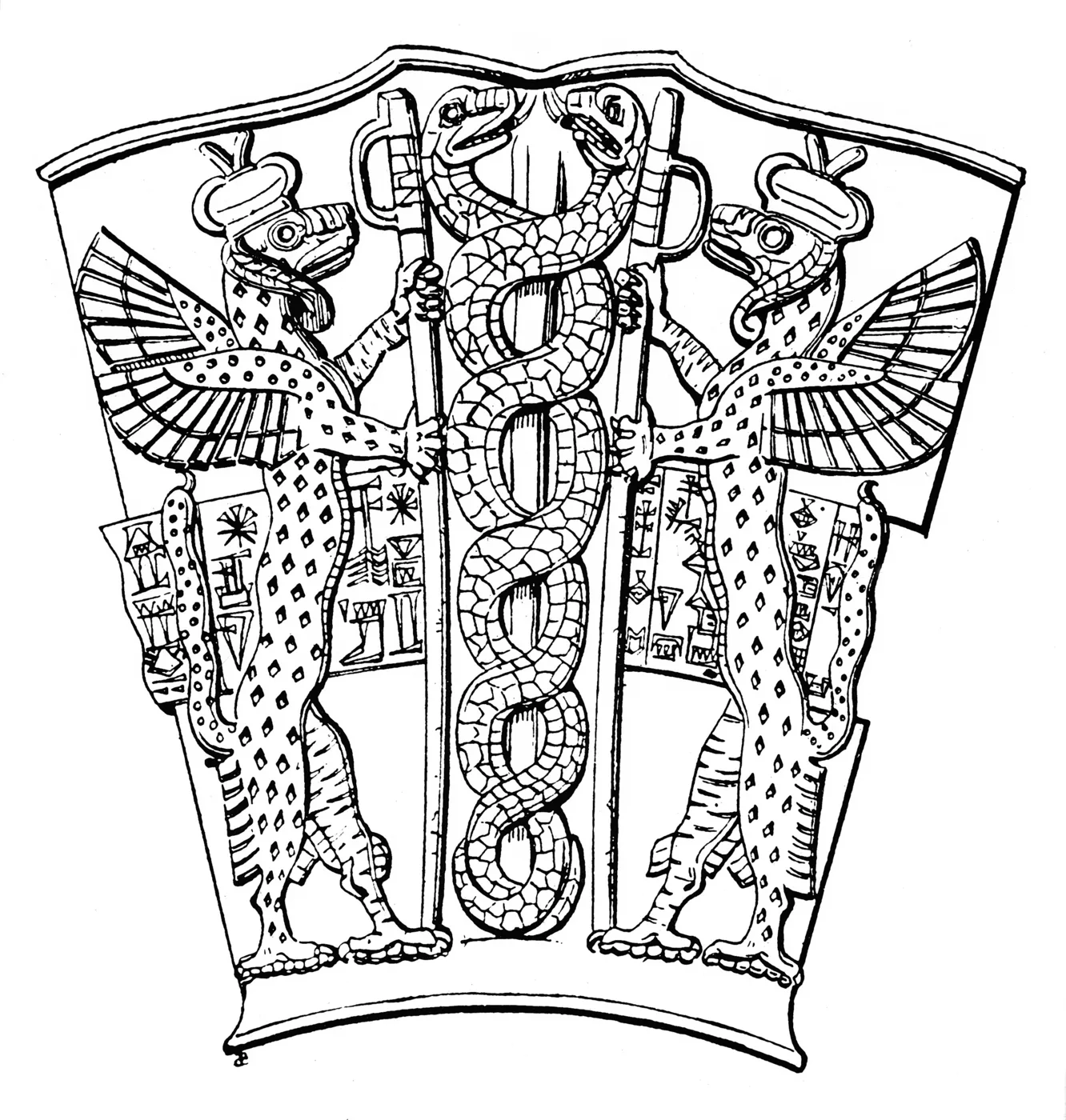
Discussion
The word tannin is traditionally translated as “serpent” or “snake” in EXO 7:1 and also in DEU 32:33 and PSA 91:13, where the word occurs in parallel with another word for “snake". (See Snake.) Apart from these references and NEH 2:13 and LAM 4:3 (where the word means “jackal"), in all other occurrences tannin is used to refer to a mythical sea monster. It seems likely that tannin is a generic word for all such mythical sea monsters, and that behemoth and livyathan are the names of two specific monsters. In later Rabbinic literature the beliefs about these monsters were expanded and developed, and they were used in apocalyptic writings, where the monsters represent the enemies of Israel.
Another possibility has been suggested by the Jewish scholars Cassuto and Hacham in their commentaries on Exodus. They note that, while in Moses’ rod is said to turn into a nahash in the desert, along the banks of the Nile (EXO 7:0) Aaron’s rod turns into a tannin, which they interpret to mean “crocodile". Each miracle would then be appropriate to its setting: a snake in the desert, a crocodile by the river. Hacham also points out that in EZK 29:3 Pharaoh is called “the great crocodile [tanim ] that lies in the midst of his rivers,” and that the Egyptians used to worship the crocodile. While no translation has adopted this proposal, it should be given serious consideration. (A picture of a crocodile appears below in Leviathan.)
The Greek word drakōn is translated as “dragon” in all English versions, except in the NEB translation of SIR 25:16, where it is translated as “snake". In the Septuagint translation of the Hebrew Bible, drakōn is normally used to translate the Hebrew tannin.
The Greek word kētos refers to any giant creature. In most cases it is used for sea monsters, but in 112 3:79 NEB translates this word as “whale".
Description
There are no detailed descriptions of these mythical monsters in the Bible, but the few contexts that shed light on their appearance hint that they were seen as some sort of gigantic serpents that lived in the sea.
Special significance or symbolism
Jewish thought viewed the sea monster or dragon as a) the embodiment of the chaos that existed in the primary stages of creation, and b) the symbol of the nations that were the enemies of Israel. In the New Testament this second idea is taken up and modified slightly so that the dragon is the symbol of the evil forces that are at war against the church of Jesus Christ.
Translation
Most translations use a phrase meaning sea-monster, or a more descriptive phrase, such as “enormous sea animal” or “enormous sea snake". In some cultures, dragons are a symbol of good fortune and prosperity, and in others sea monsters or giant serpents represent benevolent spirits, often associated with rain. In these cultures it is necessary to include footnotes to indicate that the monster of the Scripture passage symbolized the chaos that existed in the early stages of creation (in contexts where this is clearly the case), or that the monster represents the enemies of Israel or the church (in those contexts where this is clearly the case).
In the Septuagint kētos is the word used for the “great fish” in JON 2:0. See also Fish.
LAM 4:3: This should be read as tanim “jackals” rather than as tannin “sea-monster” (compare RSV, JB, NIV, and HOTTP). NEB and REB, surprisingly, have “whales” but this is unlikely and has little support from commentators.