Discussion
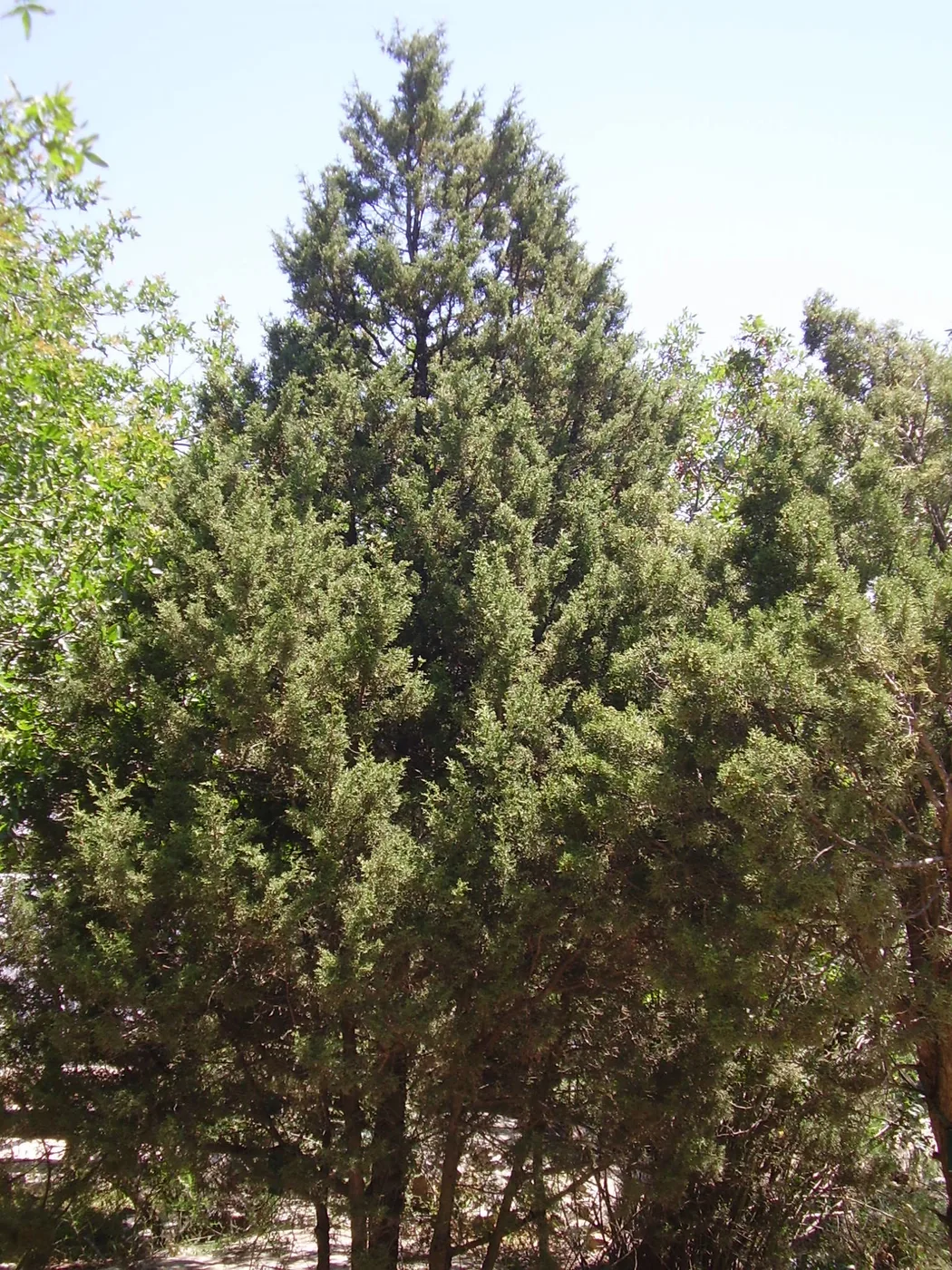
A tall evergreen, the Grecian Juniper Juniperus excelsa, also known as the Eastern Savin, grew in the mountains of Lebanon along with cedars, firs, and cypress (the Hebrew word berosh probably covered all three of these trees). The association of berosh with Mount Senir in EZK 27:5 argues for the Grecian juniper there, since Mount Senir was known to have plenty of Grecian junipers. Lebanese people up to today refer to the juniper as brotha, a likely cognate with berosh. King Solomon undoubtedly hauled these trees to Jerusalem along with cedars and firs to use in constructing his palace and the Temple of Yahweh. The Israeli botanist Hareuveni advocates translating berosh as juniper, presumably the Grecian species.
Description
The Grecian juniper is a conical tree reaching a height of 20 meters (65 feet). Its “leaves” are round rather than flat, and the fruit is an inedible seed-bearing, fleshy cone.
Translation
There is no single Hebrew or Greek word that refers specifically to the Grecian juniper. In our discussion of cypress and fir, we have advocated translating berosh generically or as “fir” or “juniper” in 1–2 Kings and 2 Chronicles (where it is typically associated with Lebanon or cedar). If no generic word is available in the receptor language, a descriptive phrase such as “strong, beautiful tree/wood” can be used. In poetical passages like HOS 14:9; EZK 31:8; and ZEC 11:2, local poetic equivalents could be considered.