Discussion
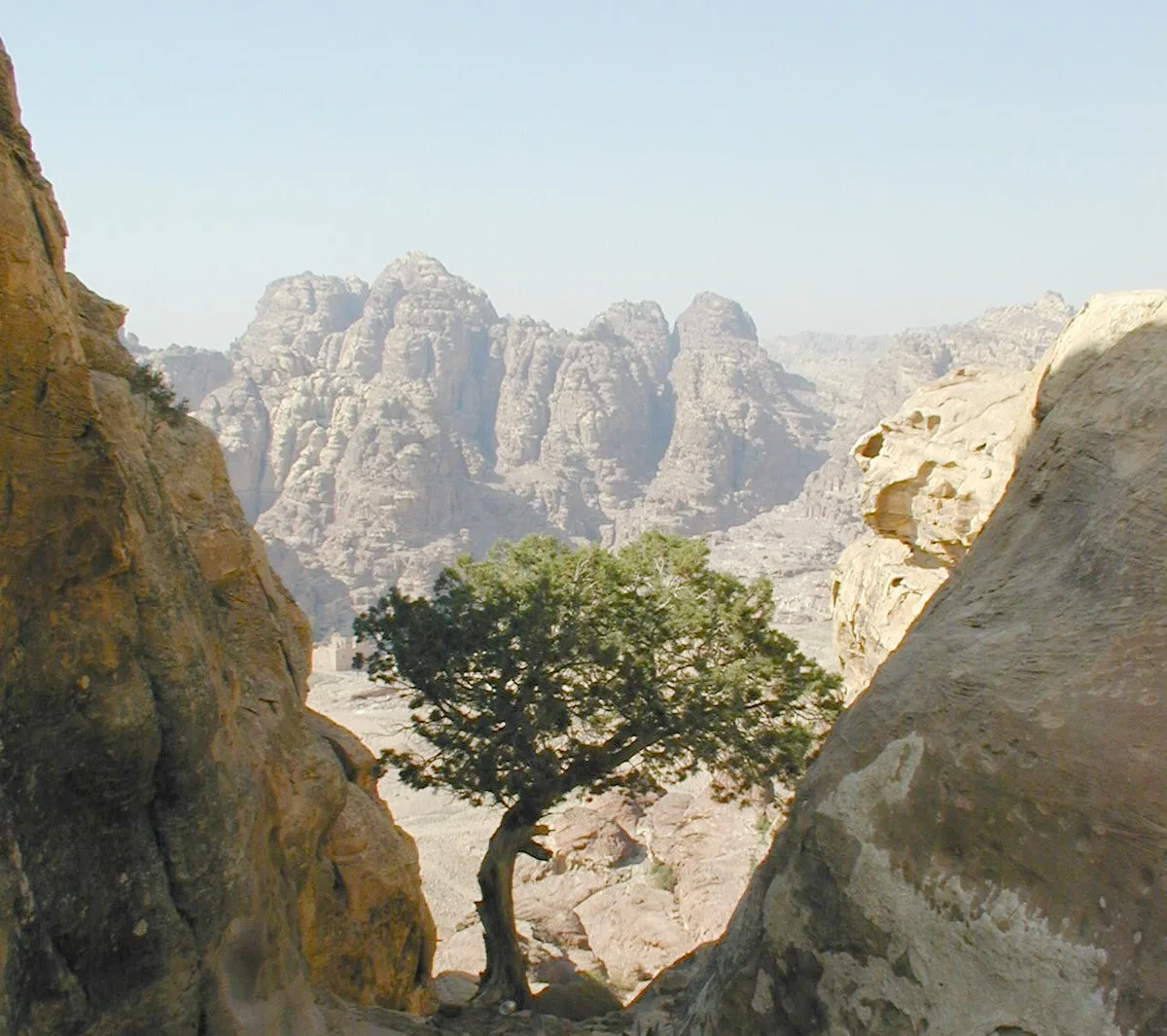
The Phoenician Juniper Juniperus phoenicea is a lower-altitude cousin of the Grecian juniper discussed in the previous entry. At present it is found scattered throughout the mountains of northern Sinai and southern Jordan, and Hepper notes that it occurs throughout the higher parts of Sinai and Arabia. In ancient times it may have been found throughout the Negev. DEU 2:36 refers to a town on the edge of the Wadi Arnon called Aroer, which is probably cognate with the Hebrew word ‘ar‘ar, indicating that these trees may have grown there. The identification of ‘ar‘ar /‘aro‘er as the Phoenician juniper is supported by the fact that Arabs in several countries call this juniper ‘ar‘ar. Since it is closely related to the cedars, some people also call it the “Phoenician cedar.” Note that Hebrew uses the same word ’erez to cover both the Phoenician juniper and the mighty cedar of Lebanon. For ‘ar‘ar in JER 17:6, Nogah HaReuveni (Desert and Shepherd in our Biblical Heritage, p 67–71) makes a literary case for the “apple of Sodom” (Calotropis procera). The Sodom apple, which lives in an “uninhabited salt land,” has attractive green leaves and fruit, but the fruit turns out to be hollow and toxic — a strong contrast with the fruitful tree that lives by a stream. However, other botanists have not followed this, relying more on the linguistic evidence from Arabic.
Description
The Phoenician juniper is a short shrub or tree that may reach 5 meters (17 feet). It has tiny leathery leaflets and small berry-like cones.
Special significance
In NUM 24:6 Balaam compares Israel’s encampments to gardens of God with fragrant aloes and verdant ’arazim. We can’t tell in this context whether the prophet envisions the modest Phoenician juniper here, or the glorious cedar of Lebanon. In JER 17:6 we read that a person who trusts only in human beings is “like a shrub (‘ar‘ar) in the desert.” The picture here is of something alone in a harsh environment, in contrast to the person who trusts in the LORD (verses 7–8).
Translation
Following Zohary, we advocate translating ’erez as “juniper” in Leviticus and Numbers, if that species is known, or using a transliteration from a major language. The reference to ‘ar‘ar in JER 17:6 is poetic, and a cultural equivalent may be used. As the Sodom apple is common throughout Africa and Asia, the local word for "Sodom apple" may be useful. Some scholars take the Hebrew word ‘aro‘er in the last line of JER 48:6 as meaning “juniper.” There is a textual problem with the Hebrew word. There are four positions:
1. Transliterate the Hebrew and render this line as “Be like Aroer in the desert” (so NJPSV). Aroer was a desert town.
2. Amend ‘aro‘er to read ‘arod, and render this line as “Be like a wild donkey in the desert” (so RSV, GNB, CEV, NJB, NAB). The Hebrew letters for “r” and “d” are very similar.
3. Take ‘aro‘er as a reference to a juniper shrub on the basis of the Arabic use of ‘arar for juniper. NCV comes close to this by saying “Go like a bush being blown through the desert.”
4. Read ‘aro‘er as ‘ar‘ar, which means “destitute.” REB does this by saying “and become like one destitute in the desert.”