Description
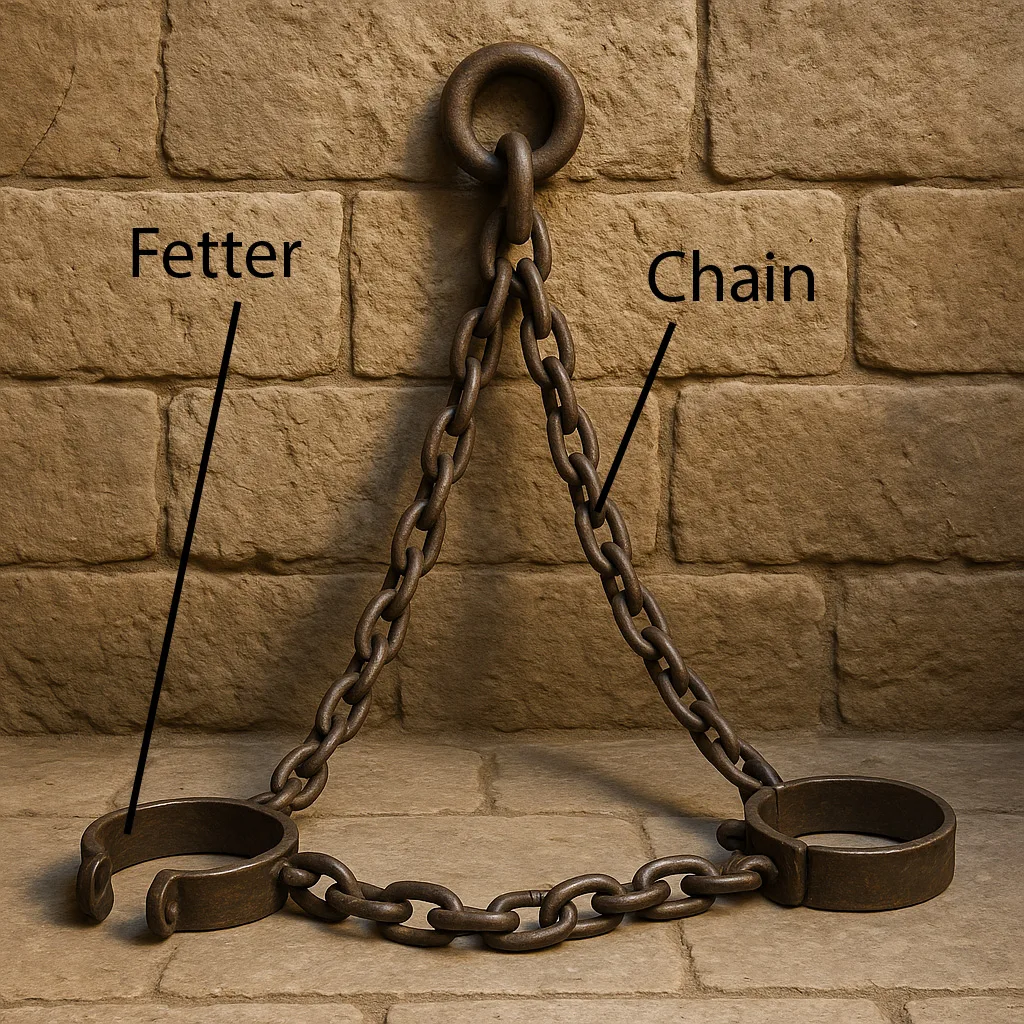
The chain was a series of links, usually made of metal.
Usage
A chain was normally used for restraining or for holding objects together. It is especially associated with the restriction of the movement of prisoners. See also Necklace, chain, cord.
Translation
In a number of languages the expression for “chain” is simply “metal rope.” In other languages it may be rendered “linked rope” in contrast with “twisted rope,” that is, a rope made out of some kind of fiber. In some languages a distinction is made between terms for a chain used in tying up a person and one employed in agricultural or industrial work.
In some of the passages listed above “chains” is symbolic language for imprisonment. Many translations will want to follow the model of GNT in a passage like PHP 1:7. In the middle of this verse the Greek text says literally “in that I am chained,” but GNT has “now that I am in prison.”
The chains placed by Solomon in front of the Holy of Holies (1KI 6:21) were made of gold and served primarily as decoration, although they would also have reminded those serving in the sanctuary not to come any closer to the Holy of Holies.
In JOB 38:31 two Hebrew words demand special attention. The word ma‘adanoth (which appears also in 1SA 15:32 with an unrelated meaning) comes together with a verb meaning “to tie, bind.” The word ma‘adanoth is of uncertain meaning, but it seems likely that there has occurred a reversal of two Hebrew letters from a word meaning “ring,” so that ma‘adanoth means a series of connected rings, that is, a “chain” (RSV). Some translations prefer to combine the verb with the noun and render them simply “tie together” (so GNT, GECL) with no reference to the object used to bind. The second Hebrew word, moshkoth, appears only here in Scripture. It comes from a verb meaning “to pull, draw.” In modern Hebrew moshkoth means “reins” (leather straps for controlling a horse), and this is reflected in NJPSV, which renders the second line of this verse as “Or undo the reins of Orion.” Other translations (NEB, REB, GECL) understand moshkoth to refer to the three aligned stars that make up the “belt” of the Orion constellation.
PSA 149:8: For this verse RSV has “to bind their kings with chains and their nobles with fetters of iron.” “Their nobles” is parallel to “their kings” and indicates the military leaders. In some languages the use of “chains” and “fetters of iron” will tend to give the impression that the kings were bound with chains that were not made of iron. The poetic parallel, however, indicates that they are equivalent. In some languages this verse may be rendered “to capture their kings and leaders and tie them up.”
REV 20:1: “A great chain” (RSV) may be rendered “a heavy chain” (GNT) or “a thick chain.” We assume the chain was made of metal. The expressed purpose of this chain is to restrain Satan. In cultures where metal chains are unknown, translators may say “a big [or, thick] rope,” or they may employ some other material that is used for tying up people.