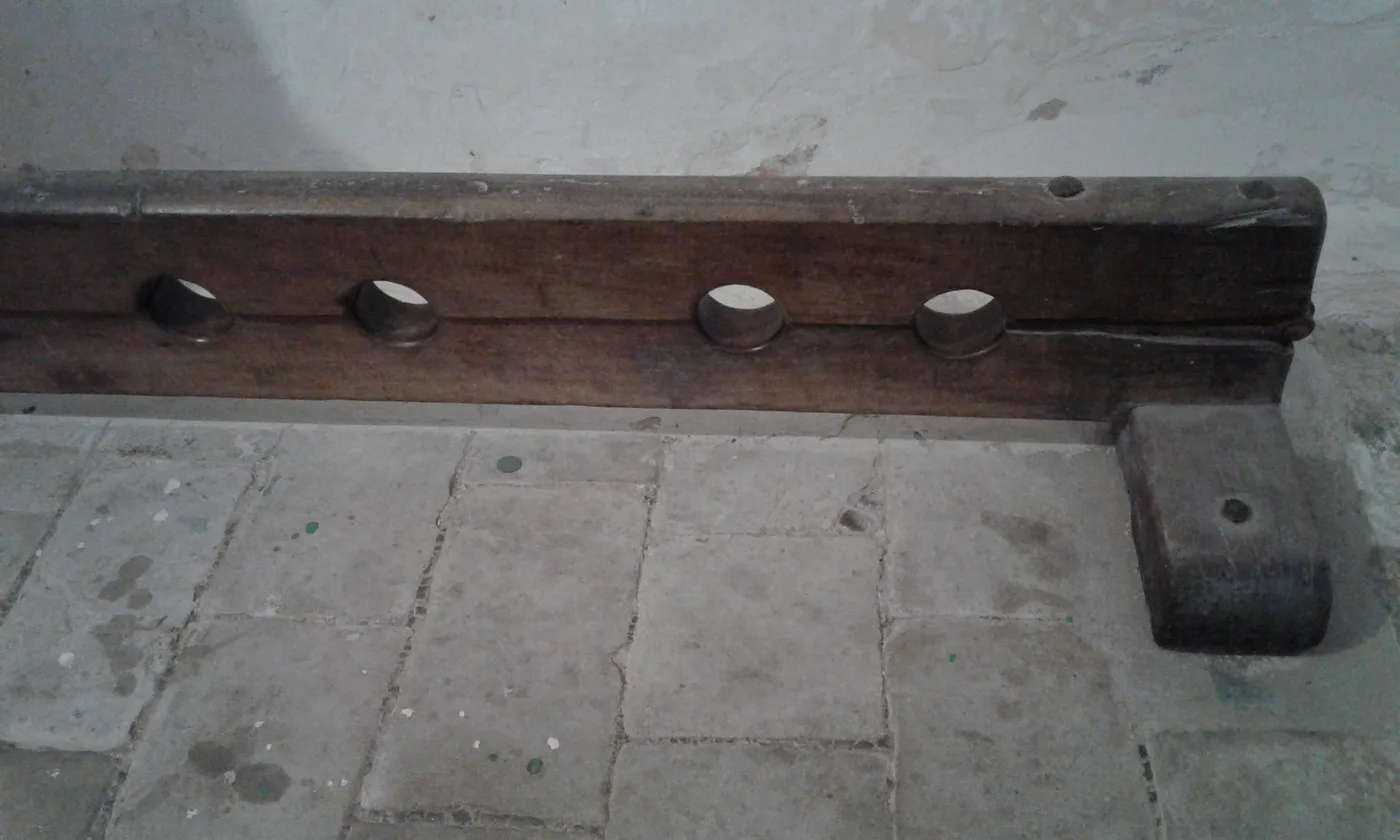
Description and usage
Stocks were a device consisting of blocks of wood through which the legs, arms, and/or head of a prisoner were placed and then securely fastened. Two pieces of wood each had half-circle holes cut in them. When placed together, they formed circular holes that held the limbs or head of the prisoner. The two pieces were then locked together so that the prisoner could not move. Stocks were employed both as an instrument for imprisoning and also as a means of punishment.
Translation

JOB 13:27: Here Job pictures himself as God’s prisoner, with his movements severely restricted. In the first line of this verse “stocks” refers to a wooden block in which a prisoner’s feet were locked, but according to the second line, there may have been some possibility of movement. GNT translates the first line as “You bind chains on my feet.” This line may also be rendered “You tie my feet together” or “You tie my feet so I cannot walk.”
ACT 16:24: For the phrase “in the stocks” (RSV), GNT has “between heavy blocks of wood.” The term “stocks” was avoided by GNT for two reasons: (1) it was felt that its meaning would not be readily understood by the readers for whom the GNT was designed, and (2) the stocks used by the Romans were of a different type from those otherwise known. The Romans used stocks as an instrument of torture. It had more than one pair of holes for the legs, so that a prisoner’s legs could be spread wide apart, causing him great pain.