
Description
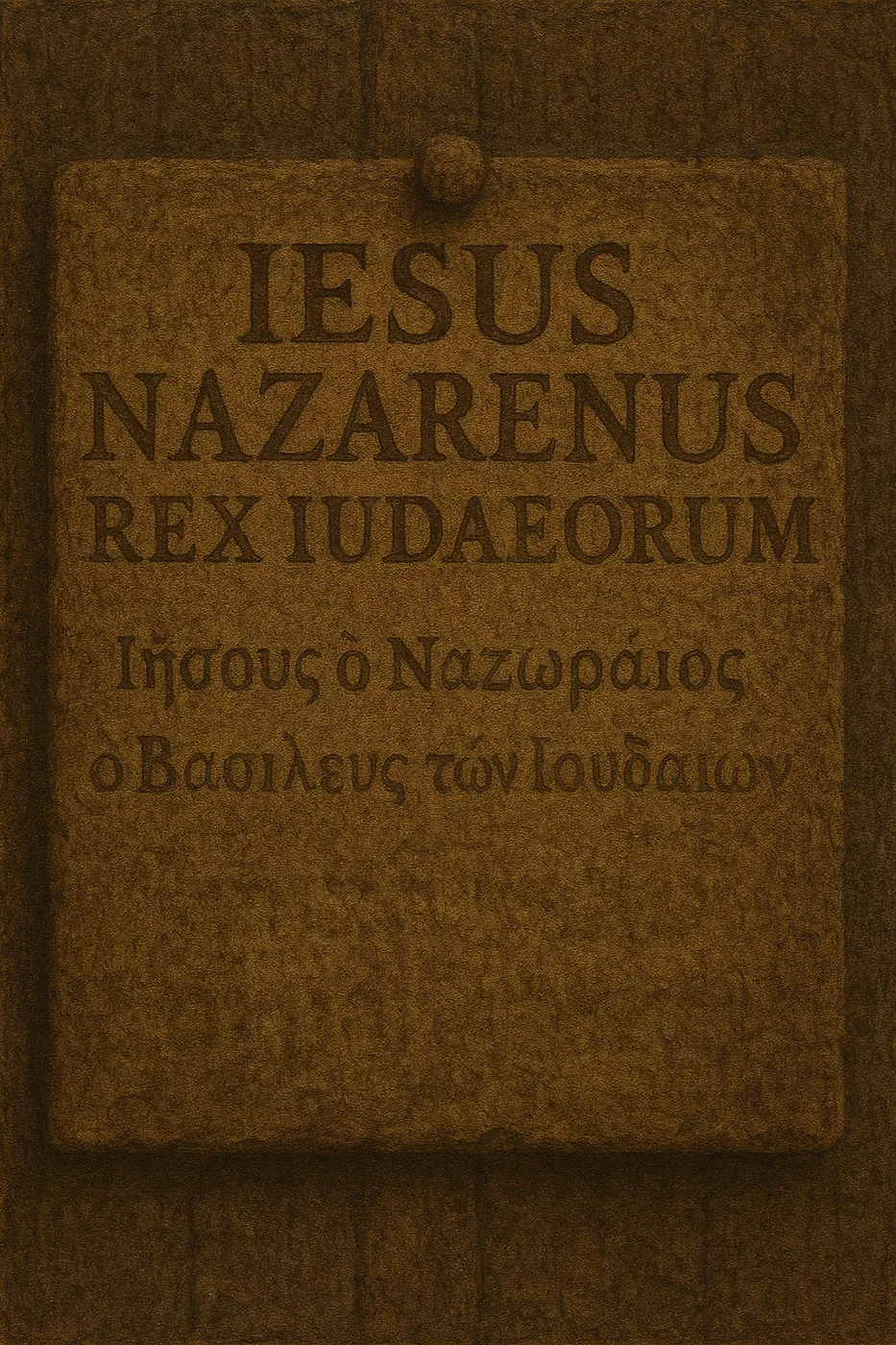
The cross was a pole stuck into the ground in an upright position with a crosspiece attached to its upper part so that it was shaped like a T or like a †. Also found, although possibly less common, was a cross in the shape of an X made from two sticks. The fact that Jesus had a writing attached above his head indicates that his cross probably had the † shape.
Usage
The condemned man often carried the horizontal part of the cross to the place of execution, where the vertical pole (or even the trimmed trunk of a tree) was already standing. His hands were nailed (through the wrist just below the palm) to the horizontal bar and then the man and the bar were raised up to the vertical pole and the bar was tied to it. Sometimes the man sat on a small projection from the vertical pole. The feet were then nailed to the pole, one nail (or spike) holding both feet through the ankles, which were turned sideways. Death was usually slow, frequently taking several days.
Translation
Because of the symbolism associated with the cross, translations of the New Testament in all languages preserve some expression that will identify the cross, not only as a means of capital punishment, but also as having a particular form, namely, an upright pole with a crossbeam. In some receptor languages the term for a cross means simply “crossbeam.” In other languages it is expressed by a phrase meaning “crossed poles.”
The Greek word xulon is literally “wood.” Outside the New Testament xulon often refers to a gallows; in the New Testament contexts that speak of capital punishment, the reference is to the cross on which Jesus was crucified. In GAL 3:13 it is not necessary to render xulon by a term that means a live tree. The Greek term here may refer simply to a “post,” and it may be more appropriate to employ a term that would also be applicable to a cross. To use an expression that must refer to a live tree would introduce an unnecessary inconsistency. While the phrase in this verse is in part a quotation from DEU 21:23, the translator should not try to harmonize the two texts. The commandment in Deuteronomy is to put a sinner to death and then hang the dead body on a tree. Unlike crucifixion, this hanging was not a means of execution but probably some kind of public warning.