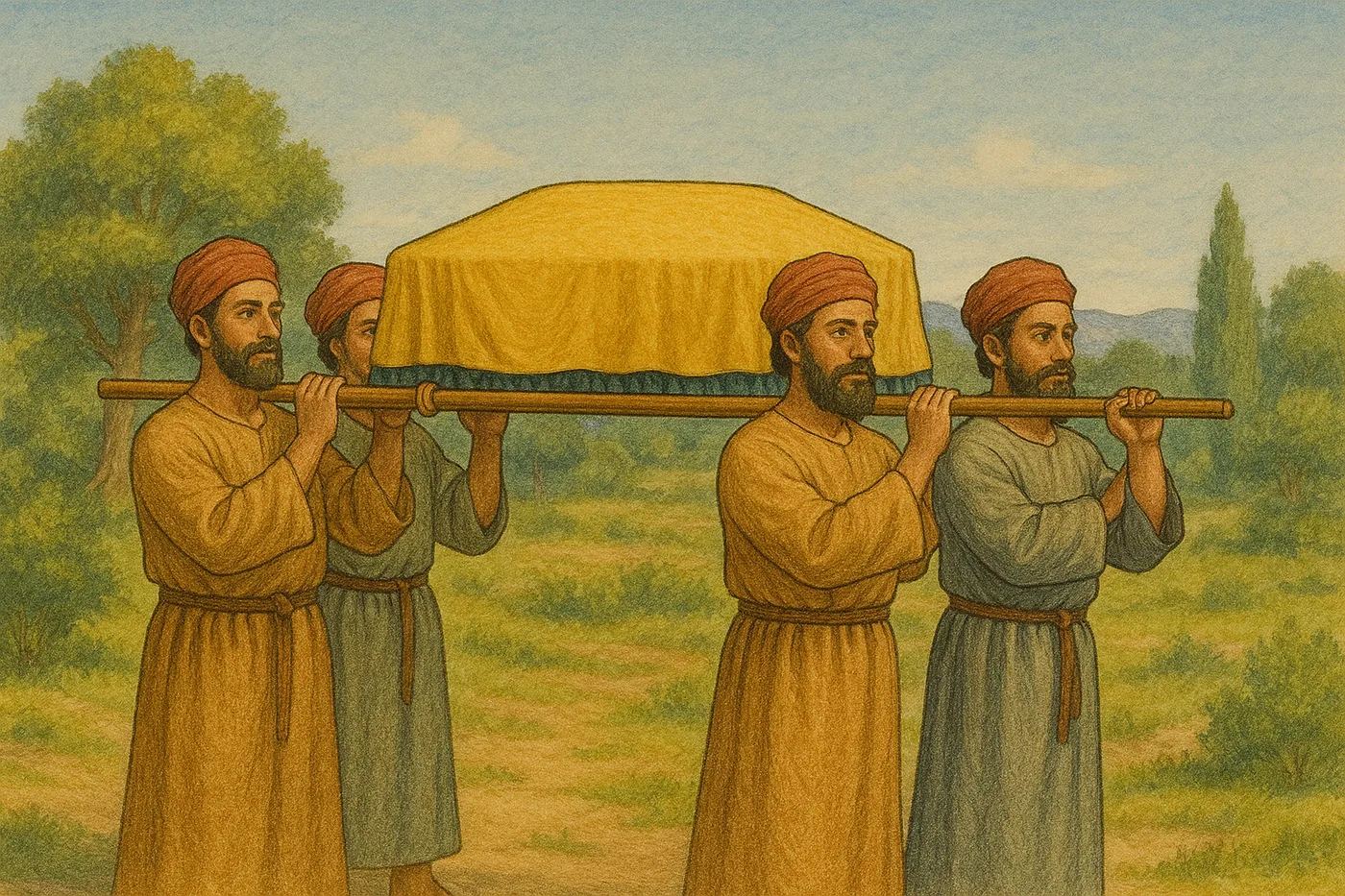
Covenant Box, Ark of the Covenant

OAI-0009_ark

Description

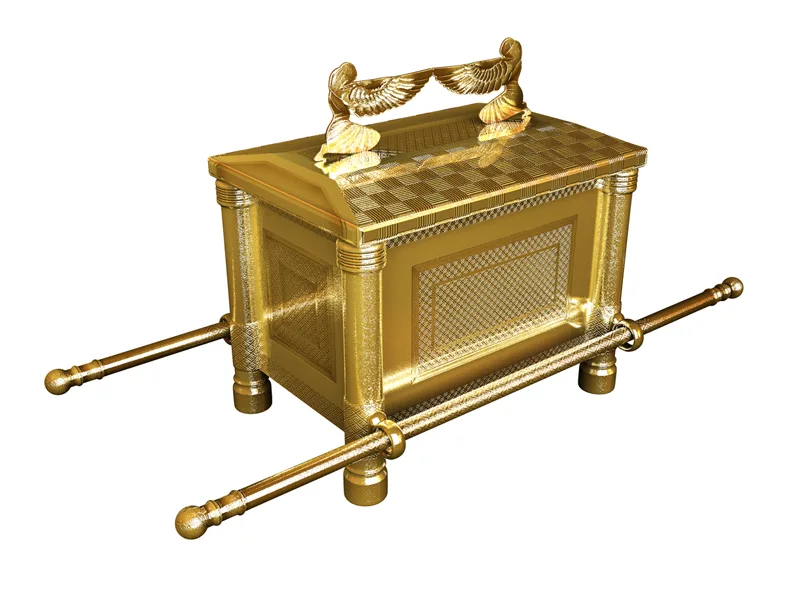
The instructions for making the Covenant Box are found in EXO 25:11, and its construction is described in EXO 37:0. It was a rectangular box, about 125 centimeters (49 inches) long, 75 centimeters (30 inches) wide, and 75 centimeters (30 inches) high. It was made of acacia wood and was overlaid with gold. It had a raised gold rim or molding around it for decoration. Evidently it stood on four legs on its corners. A gold ring was attached to each of the four feet. Through these rings were inserted two poles for carrying the Box. (In the illustration below, the rings and poles should be at the bottom, nearer to the foot of the Box; see the illustration above.) The poles were also of acacia wood overlaid with gold. Their length or circumference is not given. Inserting the poles through the rings made it possible to lift and move the Box without actually touching it. The Box had a special lid or cover (see Mercy seat, atonement cover, atonement lid).


Translation
WEB-0440_convenant_box
In English some people object to speaking of the so-called “Ark of the Covenant” as “the Covenant Box,” since they assume that the English word “ark” has some special meaning equivalent to the corresponding Hebrew or Greek terms. However, the term “ark” in Old English and Middle English is simply a transliteration of the Latin word arca, which means “box, chest, coffer.” Indeed, the Hebrew word for “ark” (’aron) is used also to refer to other types of boxes (GEN 50:26; 2KI 12:10; 2KI 12:11; 2CH 24:8; 2CH 24:9; 2CH 24:10; 2CH 24:11; see, for example, Bier, coffin).

In present-day English the term “ark” is known primarily from the context of “Noah’s ark.” Translators should be aware that it is only by historical accident that the same word was used in older translations in English, French, and some other European languages both for Noah’s ship (see Ark, ship) and for the Covenant Box. Hebrew uses a different word for Noah’s vessel. No attempt should be made to render them identically in the receptor language.

Molding: The gold “border” or “band” around the Covenant Box seems to have been for decoration. In 2CH 24:11 the Hebrew word rendered “round about” by RSV means “all around it,” as GNT renders it, since the word has the basic meaning of encircling. NAB has “around the top of it,” but the molding may have been placed somewhat lower than at the top edge of the Box. For the last half of this verse CEV has “put a gold edging around the lid”, but this seems to miss the point since the edging was around the Box itself.

Poles and rings: Several pieces of the Tabernacle furniture were carried by means of long poles inserted into rings attached to the objects. The translator should employ the same terminology uniformly for these poles and rings. It is explicitly stated in EXO 25:15 that the poles of the Box were not to be removed. In NUM 4:10; NUM 4:12 the Hebrew word mot is rendered “carrying frame” by RSV, GNT, and NIV. REB understands it to be a “pole” from which a bundle was hung.

Scripture References (187)