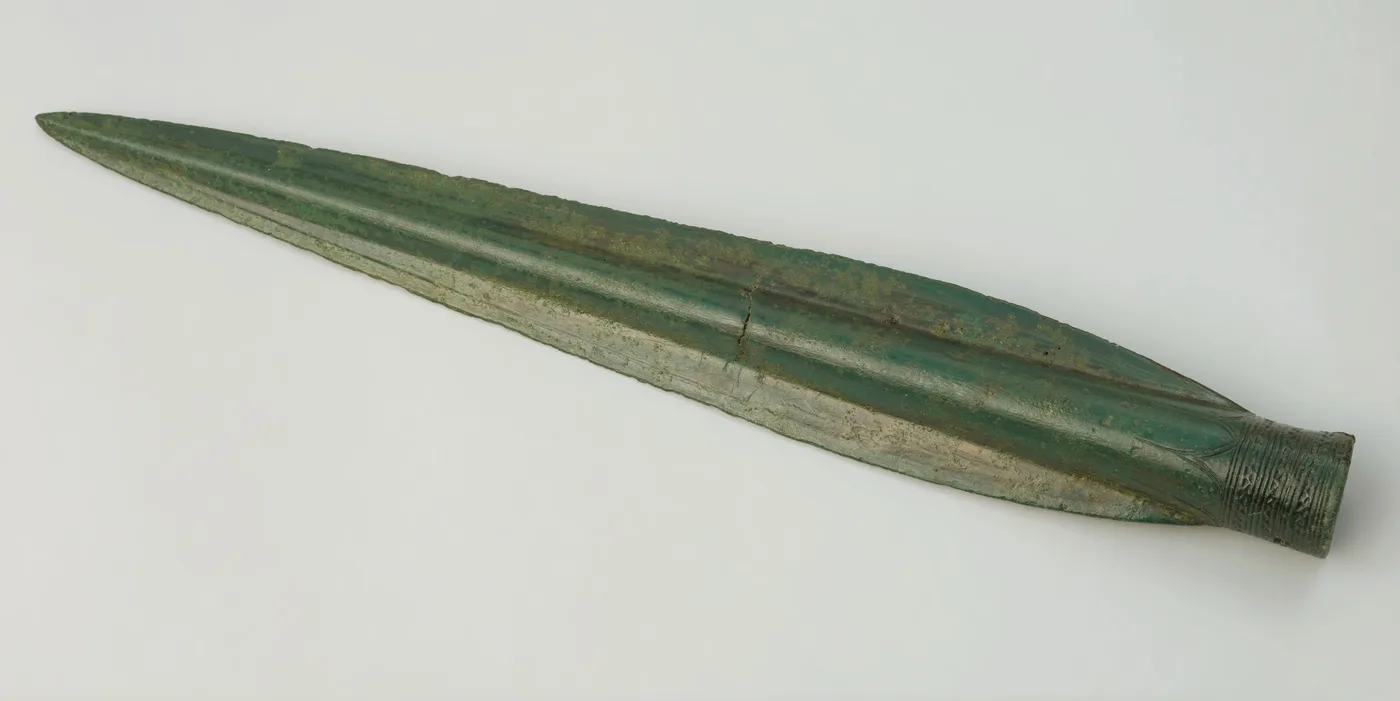
Description and usage
The javelin was a type of short spear or large arrow (see Arrow). It was lighter than the spear and, unlike the spear, was suited for throwing at the enemy from a standing position or while riding on a horse or in a chariot. Javelins were made of wood or reed. Like the spear, the javelin had a metal head or point fixed in the same way as a spearhead (see Spearhead). It often had a cord wrapped around its middle and looped over the finger of the thrower. As the javelin was released, the cord unwound, spinning the javelin and giving it greater stability, accuracy, and distance.
Translation
“Javelin” may be rendered “throwing spear” or “light spear.”
Roland de Vaux suggests that the Hebrew word kidon refers to a long sword or type of scimitar. This interpretation has been followed by GECL, CEV and NJB in some of the passages listed above. REB has “sabre” at JOB 41:21, but it shortens the weapon considerably at JOS 8:26 with “dagger.” Most translations, however, prefer “javelin,” “spear,” or “lance.”
The Hebrew word shiryah in JOB 41:18 refers to a weapon, but it has not been definitely identified. Many translations have “javelin” (RSV, NIV), GNT says “lance,” and NLT uses “pointed shaft.”
In JHN 19:29 the Greek word hussos is a variant reading that is accepted by some scholars (but rejected by most) instead of the better-attested hussōpos (“hyssop”).