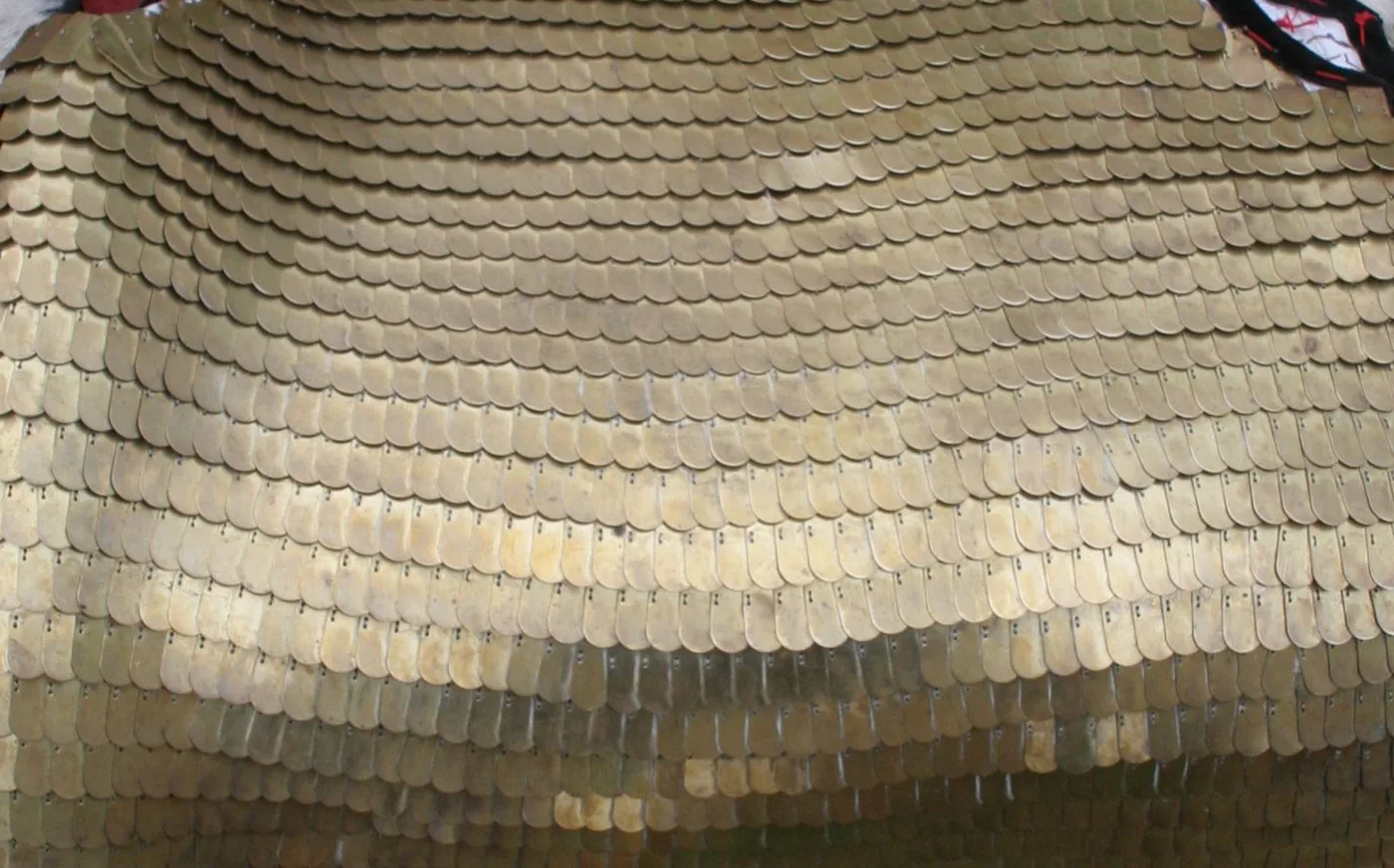
Description and usage
Scale armor was a kind of vest or shirt covering the upper part of the body. It was made of several hundred small bronze scales or platelets overlapping each other and sewn on a cloth or leather base. The scales were thin and about 11 by 6 centimeters (4.5 by 2.5 inches). Such armor was lighter than a solid metal breastplate (see Breastplate, chest protector) and was also more flexible, giving greater maneuverability. It was used especially by a soldier who could not carry a shield but still needed protection in battle (for example, a chariot driver).
Translation
Many languages will not have a specific term for such armor. In 1SA 17:5 both RSV and NRSV have the somewhat archaic term “coat of mail.” NIV has “scale armor,” and NCV says “coat of … armor.” Where body armor is unknown, translators may say “shirt covered with thin metal plates to protect the chest.”
King Ahab was killed when a stray arrow penetrated some weak spot in his armor (1KI 22:34; 2CH 18:33). The Hebrew word used to refer to this weak spot in the armor is deveq. RSV renders it “scale armor,” but it seems more likely that the word refers to a joint between two parts of the armor. GNT has “between the joints of his armor,” and CEV says “where two pieces of his armor joined.”