Description and usage
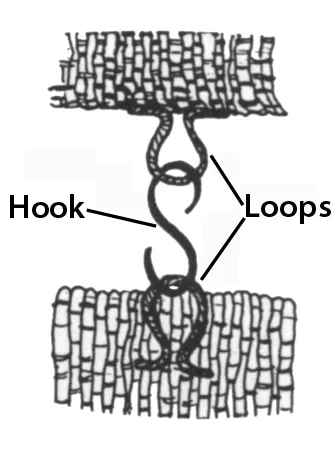
The two larger pieces of cloth (see Linen cloth strips and Goat hair cloth strips) were joined in the middle with a system of loops and hooks. Loops made of cord were sewn at intervals along one edge of one of the large pieces of cloth. Along the edge of the second large piece of cloth, metal hooks were attached so that they were exactly opposite the loops on the first piece of cloth. When the hooks were inserted into the loops, the two pieces became one large cloth. This system was used for both the linen curtain and the goat hair curtain.
Translation
The Hebrew word for “loops” suggests a “U-shaped” doubling of the blue yarn with both ends of the “U” sewn to the edge of the linen strip, leaving an opening just large enough for a gold clasp to pass through it. In some languages it will be necessary to make the action of “sewing” explicit in EXO 26:4 by saying “Make loops out of blue cloth and sew them to the outside piece in each set” or “Use blue cloth and make loops ….” In some languages “loops” will be rendered “ears” or some similar object.
The Hebrew word for “hooks” (GNT, CEV) can also mean “clasps” (RSV) or “fasteners” (REB). It is derived from the verb meaning “to bend over.” They were possibly S-shaped.