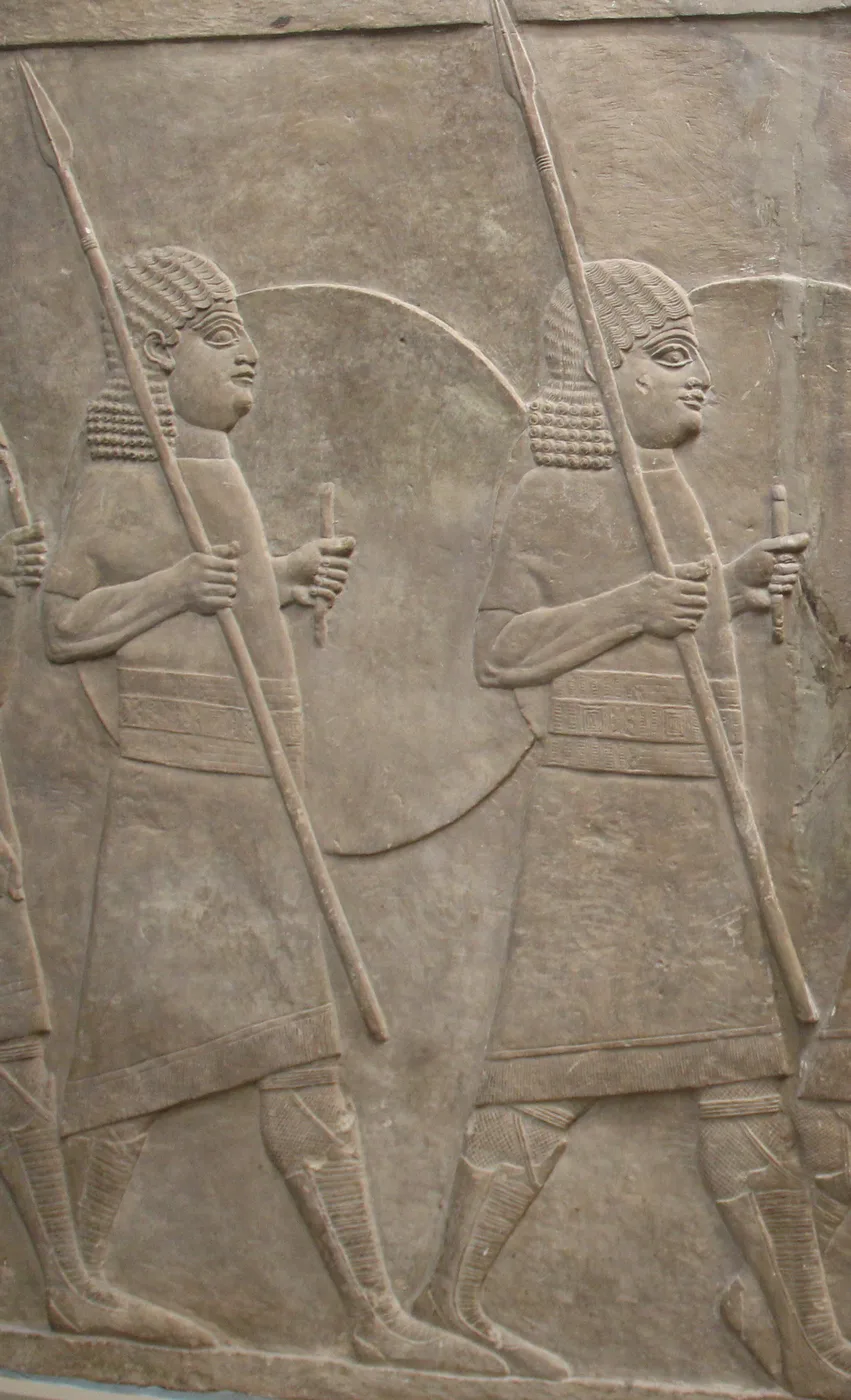
Description
Like the larger shield, this shield could be made of wood (sometimes covered with leather) or metal. It varied in shape but was usually round. Wooden shields were often reinforced by metal spikes or by being covered with metal plates.
Usage
See Large shield.
Translation
See Large shield. 2SA 1:21 and ISA 21:5 speak of oiling the shield. Shields that were covered with leather were oiled periodically to keep the leather from cracking. Oiling also preserved metal shields by keeping them from rusting. Where the idea of oiling a shield may be obscure to the readers, translators may wish to follow the example of GNT for the last part of ISA 21:5, where it has “Prepare your shields!” (similarly NCV). Another possible model is CEV “Grab your shields” or even GECL “to arms!”
In many passages, particularly in the Psalms, God is figuratively likened to a shield. Where such a comparison might be misunderstood, it may be replaced with a description of God as protector or defender; for example, in GEN 15:1NCV renders the literal clause “I am your shield” as “I will defend you.” It is also possible to expand the translation in such cases; for example, in 2SA 22:3 the Hebrew word rendered “my shield” by RSV becomes “He protects me like a shield” in GNT. Such figurative references are found in GEN 15:1; DEU 33:29; 2SA 22:3; 2SA 22:31; 2SA 22:36; PSA 3:4; PSA 7:11; PSA 18:3; PSA 18:31; PSA 18:36; PSA 28:7; PSA 33:20; PSA 59:12; PSA 84:10; PSA 84:12; PSA 89:19; PSA 115:9; PSA 115:10; PSA 115:11; PSA 119:114; PSA 144:2; PRO 2:7; PRO 30:5.
PSA 46:10: Some translations render the Hebrew word ‘agaloth as “chariots,” but most scholars agree that “chariots” cannot be meant and that “shields” is more likely. The word ‘agaloth is related to the Hebrew word for “round,” and this makes it likely that the smaller, round shield is intended. Ancient shields were most commonly made of wood and leather, and frequently rubbed with olive oil. As a result they would burn easily. Where shields are known only to be made of metal, it may be helpful to include a note explaining how shields can be set on fire.
The Hebrew word shemesh, which normally means “sun,” also carries the meaning of a round shield that formed part of the protection at the top of a city wall (see the illustration at Firing platform, siege tower). Thus, the phrase “sun and shield” (RSV) in PSA 84:10 speaks of two types of shield. Most modern translations wrongly retain “sun,” but compare NJB, which has “rampart and shield.” NJPSV gives “bulwark” in the margin. “Protector and glorious king” in GNT keeps the idea of “sun” in “glorious king,” but it reverses the order as it is found in the Hebrew.