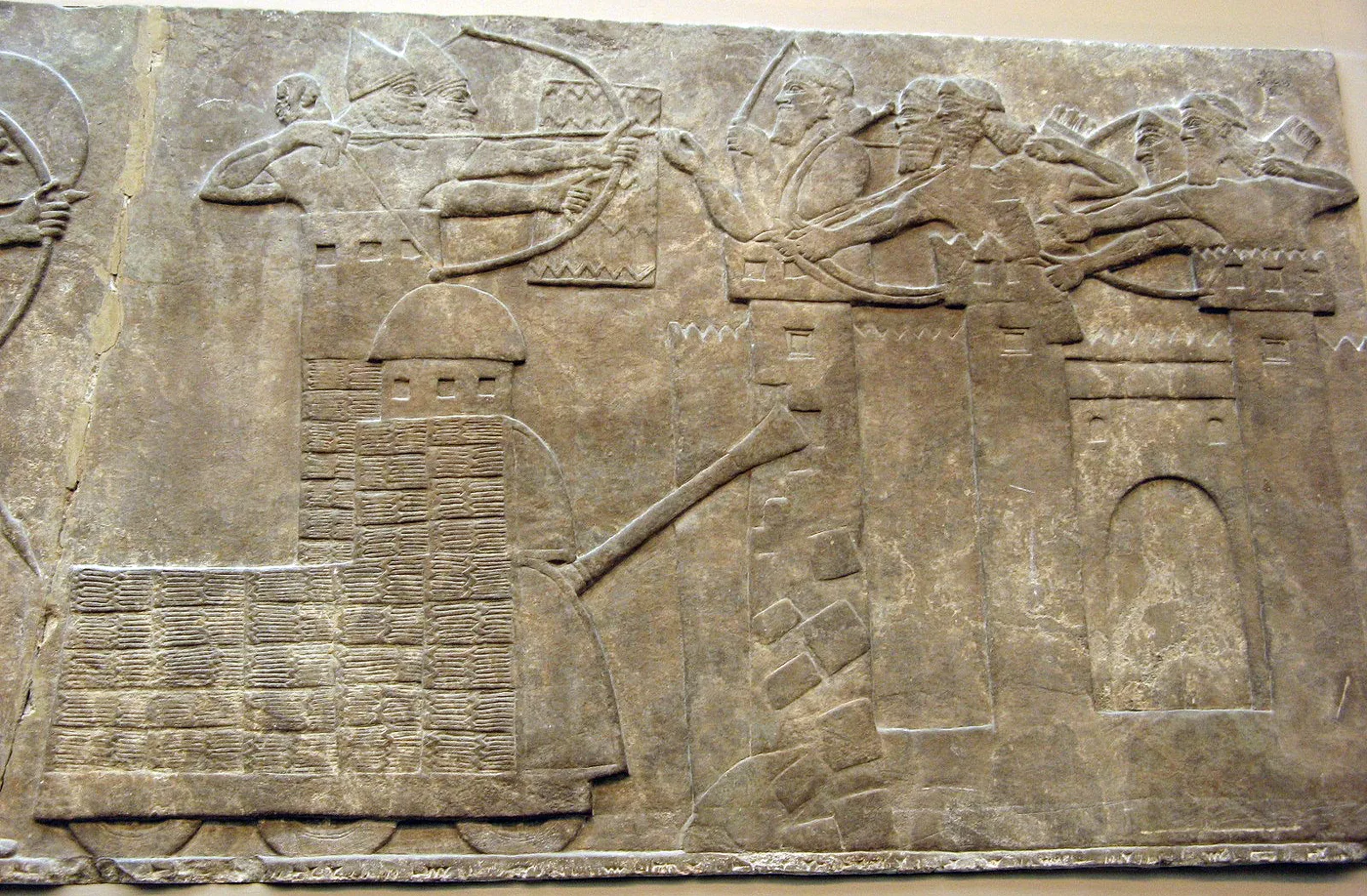
Description
The siege tower was a high, wooden structure that enabled a besieging army to fire arrows, stones and other missiles into the besieged city. It was sometimes constructed with wheels so that it could be pushed closer to the walls. Near its top was a platform on which the attacking soldiers could fire their missiles at the defenders on the walls as a cover for their own troops while they undermined the wall or attacked it with a battering ram.
Translation
The Hebrew word matsor and its derivative mtsurah refer to both the act of besieging a city and the implements that were built for the siege (see Siege wall). Elsewhere the word can indicate a kind of tower (see Watchtower, tower). ISA 29:3 says literally “I will raise towers against you.” The “towers” in this context are siege towers. This line may be rendered “I will build battle towers from which to attack you.” Some translators may prefer a more general rendering, such as “I will … attack from all sides” (CEV) or “I will surround you … with devices to attack you” (NCV).
The Hebrew word bachun in ISA 23:13 is an emendation for bchin. Almost all translations take it to be some kind of tower. Most have “siege towers” (RSV, GNT, GECL). NJPSV says “watchtowers,” while others do not make a choice and just have “towers” (NAB, ITCL, Vulgate).
In 1MA 6:20 the Greek word belostasis has been rendered “siege towers” (RSV, NRSV), “siege platforms” (GNT), “embankments” (ITCL), “batteries” (NJB), “ballista” (TOB), and “catapults” (NAB). Liddell and Scott define the word belostasis as “battery of warlike engines,” since it is a rather generic term. Translators may want to reflect this by saying “devices to aid in bombarding the city.”