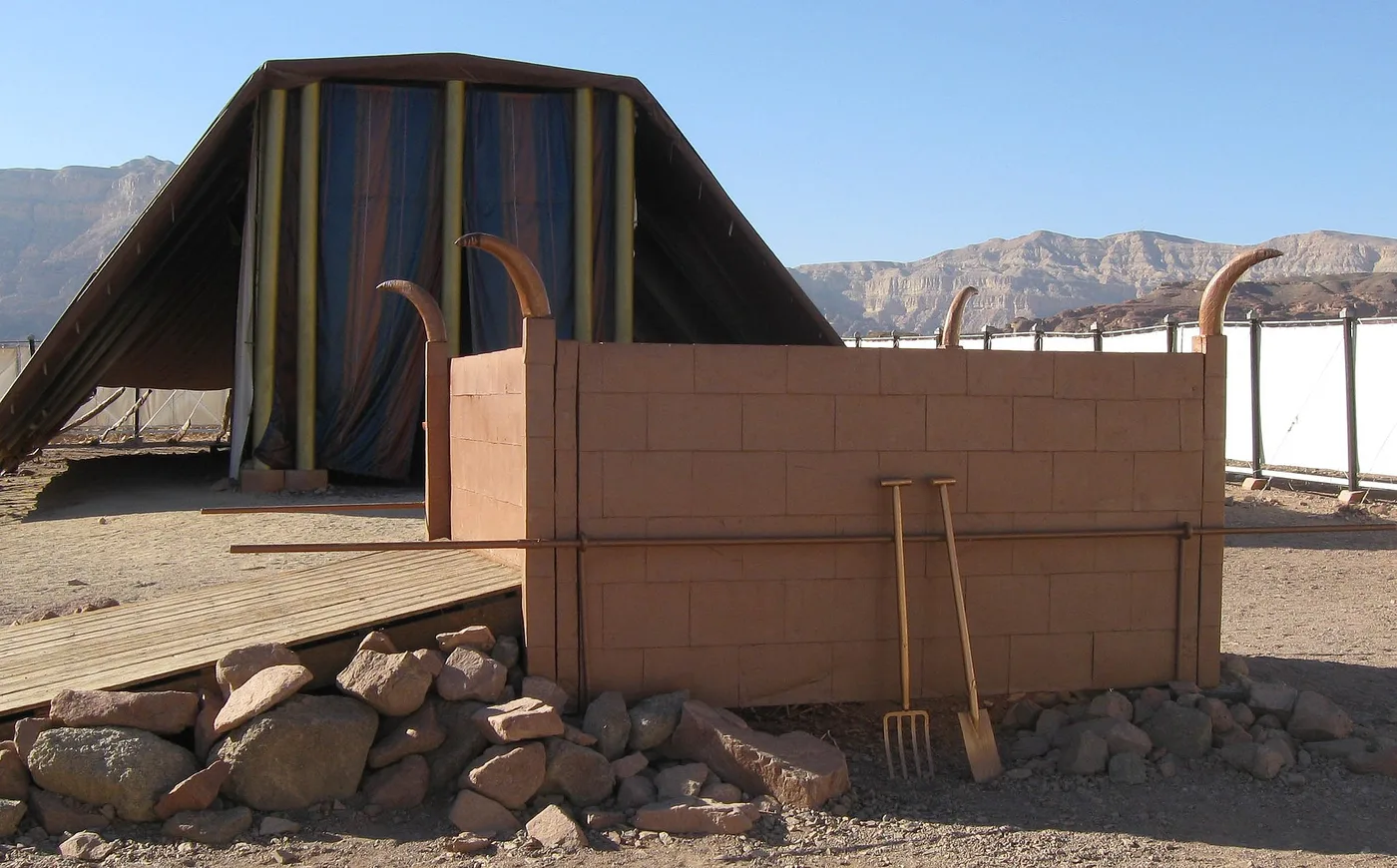
Description
The Tabernacle altar was made of acacia wood overlaid, perhaps inside and out, with bronze. It measured five cubits (2.5 meters; 8.3 feet) on a side and stood three cubits (1.5 meters; 5 feet) high. Around its top was a kind of ledge or rim (karkov in Hebrew), the purpose of which is not given. The altar was hollow.
Translation
See Altars and Stone altar above.
Rim, ledge: The Hebrew word karkov is found only in EXO 27:5 and EXO 38:4, and its meaning is unclear. Some scholars think of it as a decorative “rim” (GNT) around the altar that could also support the weight of the altar when lifted by the rings on the grating (EXO 27:4; see Temple altar for an illustration of a rim). Others imagine that it may have been a “ledge” (RSV) wide enough for the officiating priests to stand on, but this is unlikely since the altar itself was only about 1.5 meters (5 feet) high.
It is not clear whether this rim was at the top, the middle, or the bottom of the altar. Neither is it clear whether it was on the inside or the outside of the altar. NAB translates karkov simply as “around,” since its root meaning may have been to surround or encircle. EXO 27:5 a in NAB reads “Put it [the grating] down around the altar, on the ground.”
Note that the Hebrew clause in EXO 27:5 uses both the words “under” and “below,” possibly for emphasis or clarity. NJPSV has “Set the mesh below, under the ledge of the altar,” and NJB says “You will put it below the ledge of the altar, underneath.” Since there is so much uncertainty about the meaning of these terms, translators must choose either the idea of a “ledge” or a “rim.” We may assume that it was a structural rim located probably around the top of the altar.