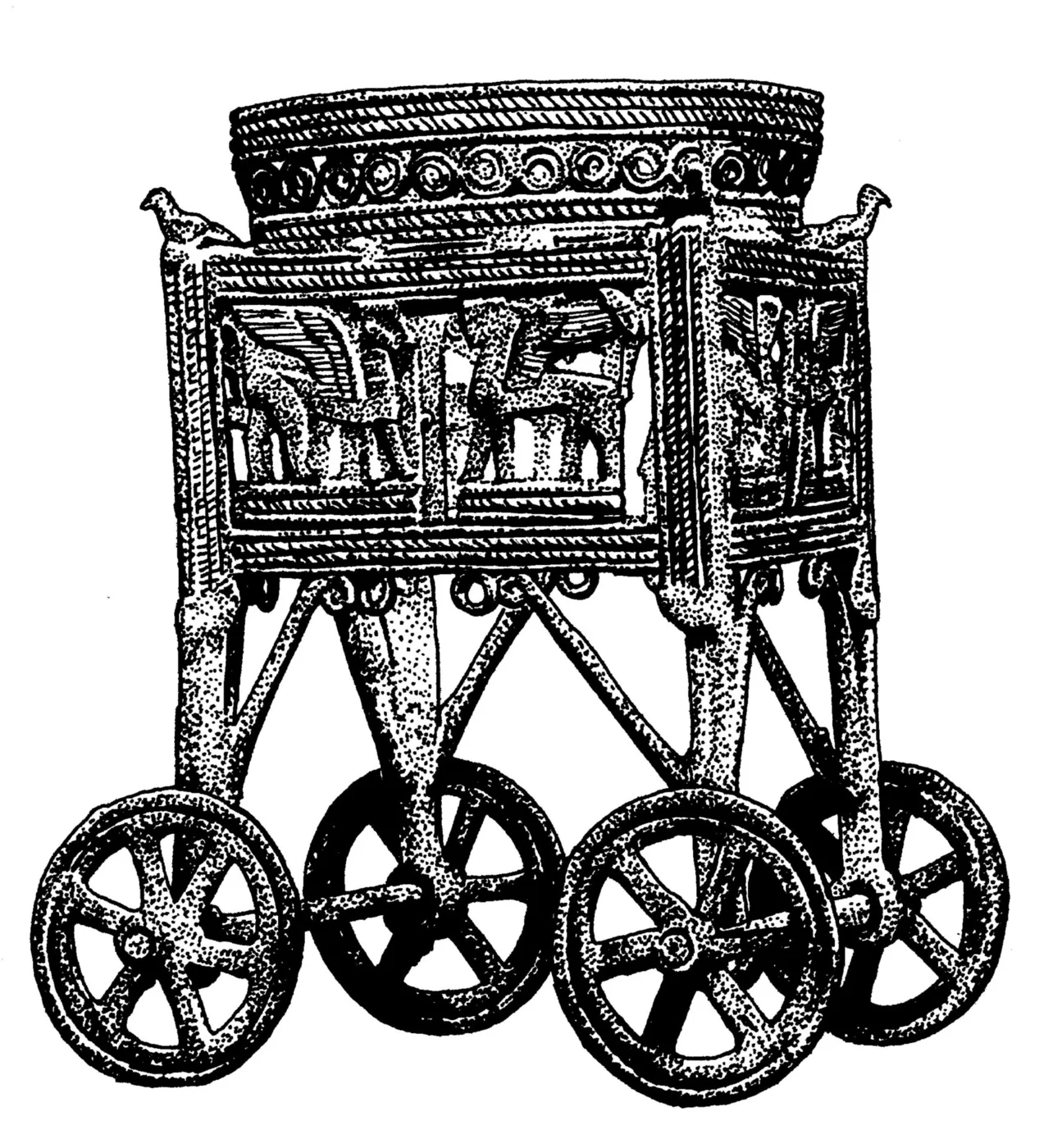
Description and usage
A detailed description of the movable stand is given in 1KI 7:27–1KI 7:39. It was a box about 2 meters (6.5 feet) long, 2 meters (6.5 feet) wide, and 1.5 meters (5 feet) deep. The sides were bronze panels decorated with figures of various animals. The box stood on four wheels connected to axles on its four corners. The wheels were about 65 centimeters (25 inches) in diameter. On the upper corners of the box were four handles. Thus it was a kind of large decorated pushcart.
The top of the box was left open, and lining the top part of its inside was a round strip or sleeve in which sat a round container, also made of bronze. This container may have been shaped like a bowl or basin, or it may have been more like a cone, tapering down almost to a point. According to 2CH 4:6, the container held water for washing the parts of the animals that were to be burned as sacrifices (see LEV 1:9, LEV 1:13). Given the size of the cart, the fact that it was made of bronze, and the weight of the large volume of water in it (about 800 liters [200 gallons]), it would have been very difficult to move, even though it had wheels. It has been estimated that each stand, when filled with water, could have weighed between two and three tons.
Translation
Box on wheels: For the Hebrew word mkonah, some translations choose a word that indicates a more or less stationary object (KJV and SPCL “base”; RSV “stand”), while others have a word which indicates that movement was normal (GNT and FRCL “cart”; REB “trolley”). Perhaps better than any of these words is “movable stand” in NIV and CEV. This expression indicates that the object normally stood in one place but was designed to be moved if necessary. 1KI 7:39 may indicate that the ten stands/carts had fixed positions.
Water container: Most translations consulted render the Hebrew word kiyor in the passages listed above as “basin” (for example, GNT and NIV). Perhaps it is better to say “tub” or “vat” (TOB). While the word kiyor is the same one used for the washstand in the Tabernacle, its construction was quite different in the Temple.
As noted above, 1KI 7:27–1KI 7:39 describes in detail the structure of the movable stand. Several other elements are named there. These include the rectangular or square panels (misgaroth in Hebrew) that formed the walls of the box, the frames (shlabim) into which the panels were set, the spoked wheels (’ofanim; see Wheel) and the axles (sarnim or yadoth) on which they turned, and four corner supports (yadoth or kthefoth) for the water. The round opening (‘agol) at the top of the stand was decorated with “carvings” (GNT; NASB “engravings”; miqla‘oth), and the base was decorated or carved with something that may have resembled “wreaths” (loyoth; GNT “spiral figures”). The water container was set in a circular collar (kothereth, literally “crown”). See the discussion on these verses in A Handbook on 1–2 Kings.