Description
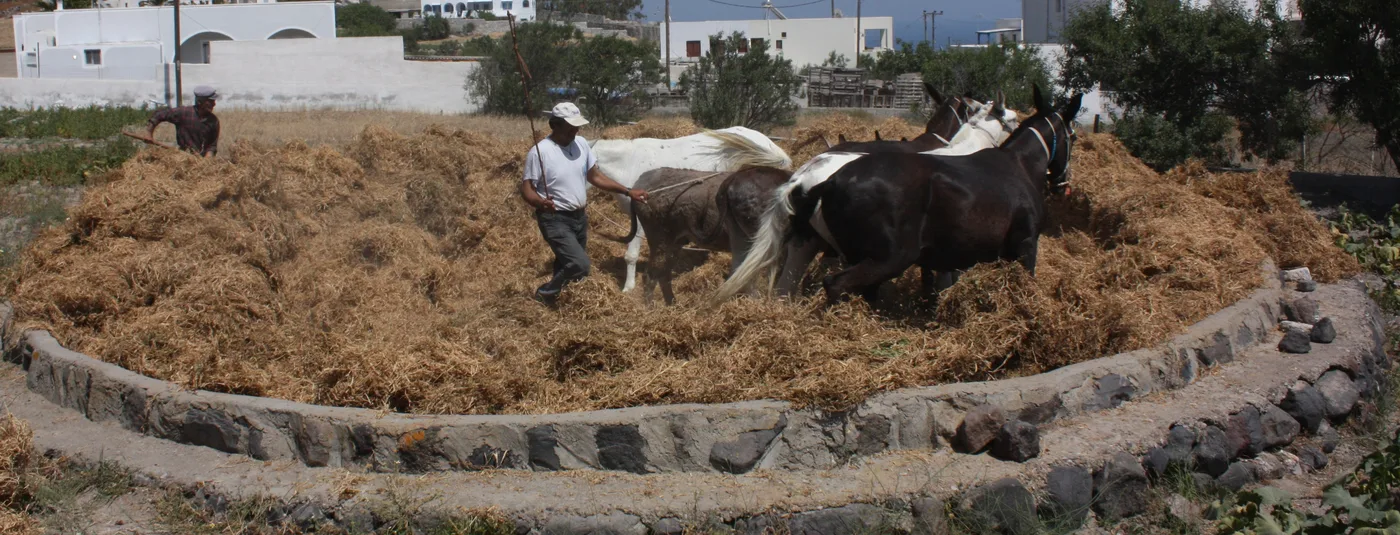
The threshing floor was a level, circular area about 7.5 to 12 meters (25–40 feet) in diameter. It was usually located near the fields where the grain was grown, and if possible it was in an elevated area that was exposed to the breeze (see Winnowing fork). Where possible, the threshing floor was located near the village so that the grain could be guarded. The floor was either bedrock or earth that was packed down to make it hard. It was often bordered with rocks to hold in the grain.
Usage
After grain has been cut, the individual kernels have to be separated from the stalk and the outer seed covering. The cut grain was laid out on the threshing floor. The process of separating the stalks and seed coverings from the kernels could be done by several methods: 1) dragging a threshing sledge (see Threshing board, sledge) over the grain, 2) having animals walk back and forth over it, or 3) beating it with some implement.
Translation
In JER 51:33 and MIC 4:12 the threshing floor symbolizes judgment or punishment. Where threshing is unknown and the meaning would not be clear, it may be made explicit; for example, GNT renders MIC 4:12 b as follows: “They do not realize that they have been gathered together to be punished in the same way that grain is brought in to be threshed.” Compare also the alternative suggested by A Handbook on The Gospel of Matthew for MAT 3:12: “He is ready to judge and separate the good people from the bad, like the farmer who is ready to separate the grain from the chaff with his winnowing fork; he will keep safe the good, like the farmer puts wheat into his granary, and just as the farmer clears his threshing floor of the chaff and burns it in a fire, he will cause the bad people to burn in a fire that never goes out” (page 70).
In MAT 3:12 and LUK 3:17 the meaning of halōn as “threshing floor” forms the basis for the figurative extension of meaning referring to the threshed grain still lying on the threshing floor. This meaning may be made clear by rendering the literal text “he will clear his threshing floor” as “he will thresh out completely all of the grain.” On the other hand, it is possible to interpret halōn in both New Testament references in a literal sense and translate “he will clean up his threshing floor,” that is, by gathering up the grain and getting rid of the straw and chaff.