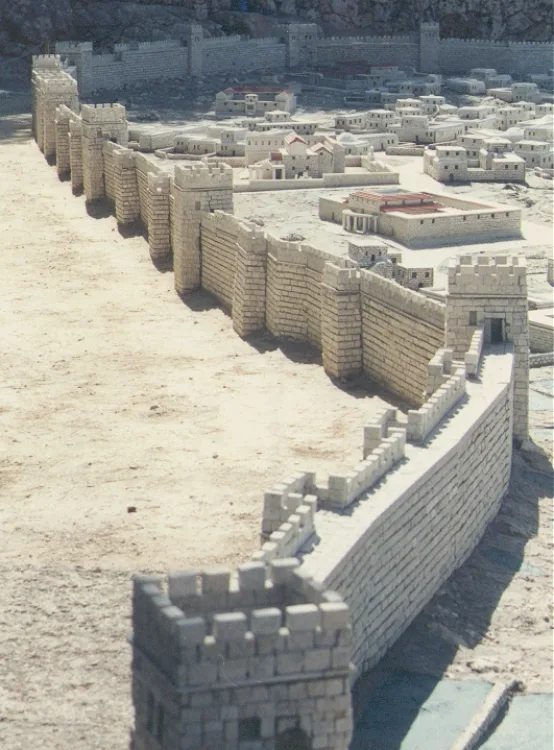
Description
A strong, permanent wall was built around a city or fortress for its protection. Some cities were even surrounded by two walls. The outer wall had to be breached before the inner one could be attacked. This outer wall is sometimes called the rampart. A single wall or the inner one of two walls was most often built of stone, sometimes of mud brick. The outer wall could also be made of one of these materials or simply of piled earth.
The battlement or parapet was the uppermost part of a defensive wall. It was built with openings through which soldiers could look and use their weapons.
Translation
City walls are not part of municipal structures in most parts of the world today, and it is often necessary to employ a descriptive phrase to render “city walls,” for example, “walls that protect the city from its enemies” or “walls that keep the enemy outside the city.” In many areas a fence of bushes, branches, earth, or stones is placed around a house or garden to protect it, and the term used for such a protection may be appropriate. However, such a fence may not be wide enough for people to walk on. Where the text speaks of people walking or doing other things on the city wall, translators should avoid creating a picture that will look impossible or ridiculous to the readers. In such cases, it may be necessary to expand with something like “thick fence made of stones around a city” or “fortified fence around a city.”
The Hebrew words chel and chomah appear several times parallel to each other. There may be some distinction between them, where chel speaks of extra fortification or strengthening of a chomah. However, where only one term for a city wall exists, it will usually be possible to treat them as one term. Where chel and its related terms stand alone, translators may add a modifier, saying “strong wall” or “fortified wall.”
In a few places (1SA 25:16; PRO 18:11; SNG 8:9; SNG 8:10; ISA 26:1; JER 15:20; ZEC 2:9) the word chomah is used figuratively, signifying strength or protection. In 1SA 25:16GNT has dropped the wall figure and begins simply with “They protected us.”
JOS 2:15 refers to Rahab’s “house built into the city wall” (GNT). Archaeological excavations reveal that at one time Jericho had two city walls, an inner one and an outer one, separated by a space of about 3.5 to 4.5 meters (11.5–14.5 feet). Houses were built on heavy timbers laid from one wall to the other. The window through which Rahab let the men down looked out from the outer wall. The phrase “a house built into the city wall” could possibly be unclear; it may be more satisfactory to translate “a section of the city wall formed the outside wall of Rahab’s house.” Moreover, it may even be necessary to include a footnote, indicating more precisely the relation between the house and the city wall.
JDT 14:1: Where a technical term for “parapet” does not exist or is obscure, it is possible to render the literal phrase “the parapet of your wall” in this verse as “the town wall” (GNT) or “the top of the town wall” (CEV).