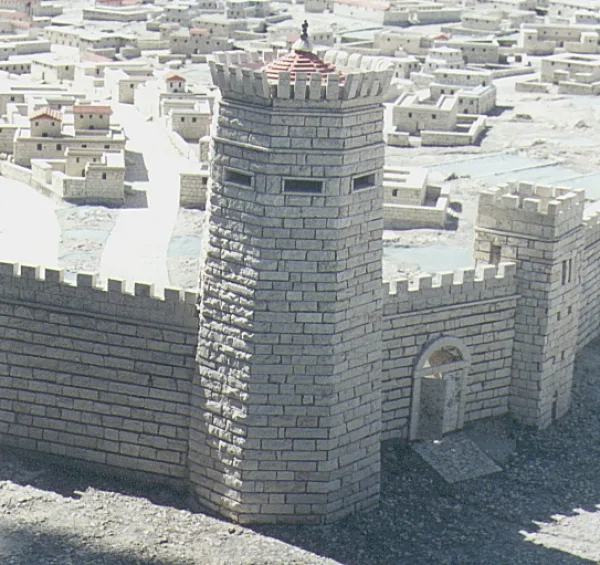
Description
The watchtower was a tall structure with a lookout at the top.
Usage
Watchtowers were placed at intervals along city walls to watch for an approaching enemy. They also allowed the defenders of the city to shoot at an attacker from his flank. Sometimes towers were built on private property to protect it. See also Firing platform, siege tower.
Translation
In a number of languages the expression for “tower” is simply “high building” (though of course not a skyscraper). In other instances it may be more appropriately rendered “high platform” or “high lookout place.”
The Hebrew word ’alman in ISA 13:22 means literally “his widows.” It is very similar to a word meaning “palace” (see ’armon under Palace). It is not clear if there is a textual corruption here or if the author has deliberately interchanged the letters in order to suggest “desolation” (see de Waard, A Handbook on Isaiah, page 61).
2CH 20:24: While some translations (for example, NRSV, GNT, CEV) translate the Hebrew word mitspeh as “tower” or “watchtower,” it is just as likely that the mitspeh was simply a high natural point from which a person had a good view. So where RSV has “the watchtower of the wilderness,” NIV says “the place that overlooks the desert,” NCV renders “a place where they could see the desert,” and ITCL has “a hill from which it was possible to see the desert.”
The Hebrew word pinah is literally “corner.” In the references given the word may not necessarily mean a distinct structure but rather just a corner of the city wall. In ZEP 1:16 some translations have “corner towers” (NIV, NJPSV), while others are more general with “lofty battlements” (RSV; similarly NLT).
Some older translations (for example, KJV) rendered the Hebrew word tsafith as “watchtower” in ISA 21:5. It is now commonly accepted that it means “carpet” (see Carpet, rug).
In the New Testament the Greek word purgos may designate any type of tower, whether employed for military purposes or used by watchmen protecting a harvest (see Watchtower). In LUK 13:4 the tower was probably part of the ancient walls of Jerusalem.