Description
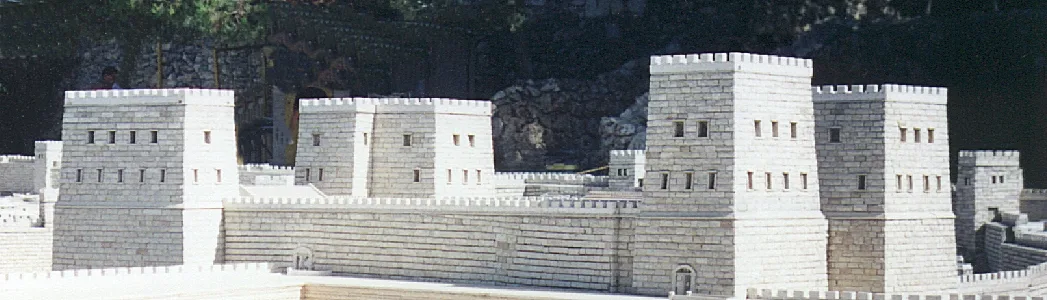
The fortress was a large fortification, often part of the defense of a town. In the Middle East such fortifications were built of stone. A fortress could consist of one extra strong building or of a complex of buildings surrounded by its own strong wall.
Translation
In some languages the word “fortress” may be rendered in terms of its function, for example, “place for protection” or “place to defend oneself.” Often, however, a fortress is described in terms of its construction, for example, “strong-walled place.”
The Hebrew word birah in NEH 2:8; NEH 7:2 refers to a fortified enclosure that stood on the northwest corner of the Temple complex in Jerusalem to guard the Temple on the northern side, from which attacks were most likely to come. It was later expanded and strengthened by Herod the Great and named the Antonia (see Pavement, The Pavement). In NEH 2:8CEV renders the literal phrase “the fortress of the Temple” as “the fortress near the temple”; GNT has “the fort that guards the Temple”; REB says “the citadel, which adjoins the temple.”
The Hebrew phrase migdal shkem in JDG 9:47; JDG 9:47; JDG 9:49 is understood in various ways. Most English translations consulted have “tower of Shechem” or “fortress of Shechem”; some capitalize “Tower” (RSV), suggesting that it could be a place name. Many non-English translations (for example, SPCL, FRCL, DUCL, TOB) take it to be a place name and simply transliterate it (DUCL “Migdal-Sichem”).
In the New Testament the Greek term ochurōma occurs only in 2CO 10:4, where it is used figuratively of the strength of false arguments. In a number of languages it may be more satisfactory to render the word in a simile in order to mark this figurative usage; for example, the verse may be rendered “The weapons we use in our fight are not the world’s weapons but God’s powerful weapons with which to destroy false arguments in the same way that people would destroy fortresses.”