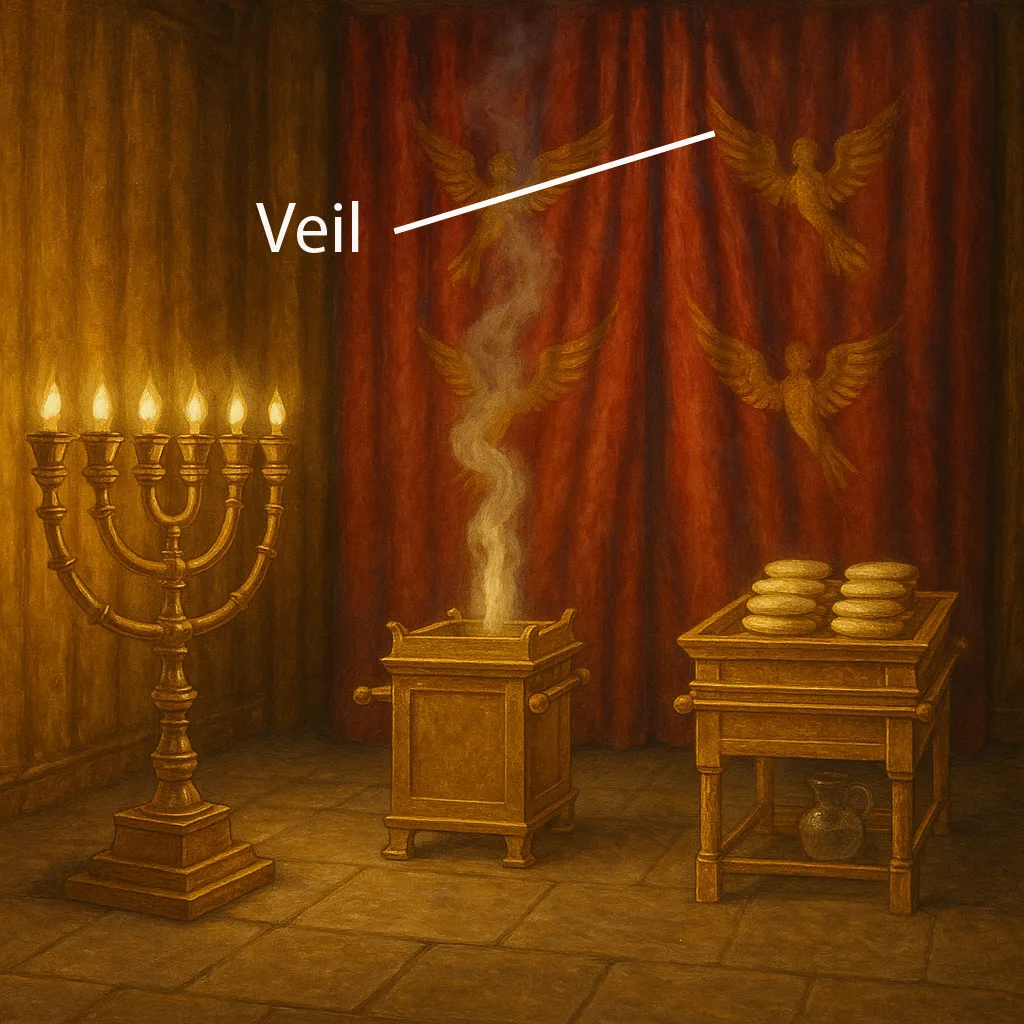
Description
The veil was a hanging cloth that covered the entrance to a room or served as a divider between two parts of a room. In the Tabernacle and in the Temple, it hung in front of the Most Holy Place and divided the Most Holy Place from the Holy Place, standing directly in front of the Covenant Box. Some scholars say the veil did not hang but was draped over the top of the enclosure in which the Covenant Box stood, forming a kind of pavilion. The veil was woven of three colors of wool and one of linen and was decorated with figures of winged creatures. It was a heavy cloth (post-biblical Jewish tradition saying it was as thick as the width of a man’s hand).
Usage
In addition to shielding the Most Holy Place from view, the veil served the same purpose for the Covenant Box when it was being moved. When the Tabernacle was dismantled, the veil was lowered from the front (or above) directly onto the Box, thus preventing anyone from seeing the Box even during the transitions.
Translation
The Hebrew word paroketh literally means “partition.” In Jewish tradition it was identified with a special partition that separated a king from the people. Some languages may have a special word for such a partition.
The Hebrew word paroketh and the Greek word katapetasma in connection with the Temple have been traditionally rendered “veil” in English, but a literal corresponding word for “veil” in another language could be misleading since it might suggest something that merely covers the face. Even a corresponding word for “curtain” could be misleading since it might suggest something that covers a window. Frequently it is necessary to use some kind of descriptive equivalent, for example, “large piece of cloth hanging down from the ceiling” or “large piece of cloth covering the entrance.”
EXO 26:31 provides a description of this object. The “veil” (RSV; Hebrew paroketh) was a “curtain” (GNT), of course, but it is good to distinguish this from the “screen” (RSV; Hebrew masak) at the entrance to the Tabernacle, which was also a curtain (see EXO 26:36 and Screen, entrance curtain). The word masak has the primary meaning of covering something, or even hiding something, while paroketh primarily means making a division and setting something apart. Some translations make no distinction between the two words (GNT, NIV), but others have “curtain/screen” (NRSV, NJPSV, NJB, REB), “veil/curtain” (NAB), “Veil/Screen” (Durham), “screen/covering” (TOT), and even “curtain/veil” (Mft). The paroketh, however, was there to separate the Holy Place from the Most Holy Place (see EXO 26:33). So this information may be brought forward to this verse. This will indicate that it was a “screen” or “veil” to hide the contents of the Most Holy Place. In cultures where a “curtain” such as this is unknown, translators may say “holy [or, taboo] cloth.”
EXO 26:33: “And you shall hang the veil from the clasps” (RSV) is literally “And you [singular] shall place the veil under the clasps.” “The clasps” refers to the gold clasps mentioned in 26.6, which held together the two large pieces of the inner linen layer of the Tabernacle. When this layer was placed over the framework according to the instructions, the row of clasps would be exactly ten cubits (4.5 meters, or 15 feet) from the west end. NAB and NIV suggest with RSV that the veil was suspended from these clasps, but NRSV has corrected this to “under the clasps.” This means “under the row of hooks in the roof of the Tent” (GNT).