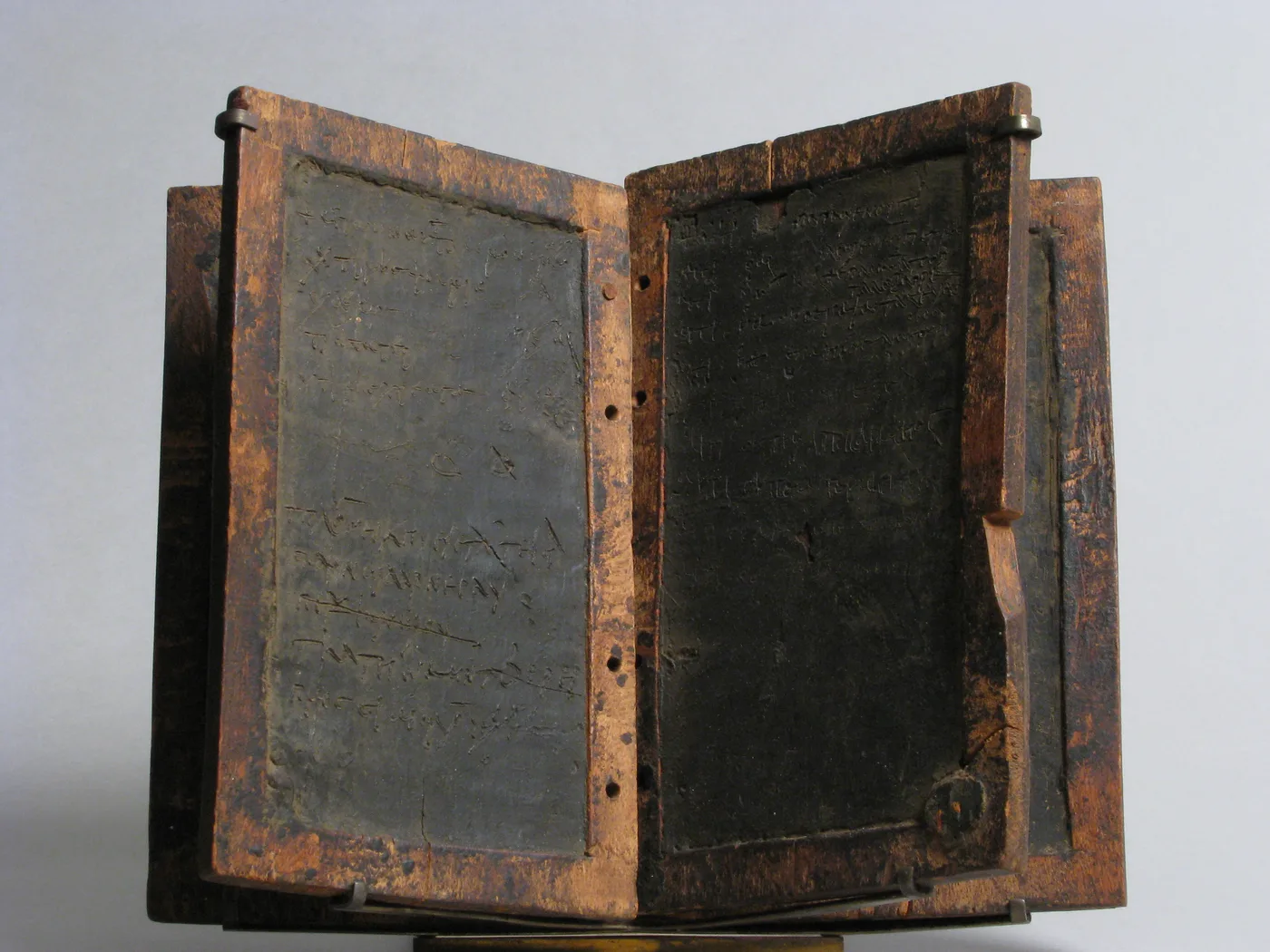
Description
The writing tablet was a small, flat board, normally made of wood. It was coated on one side with a thin layer of wax. A pointed stick or stylus was used to make marks and letters in the wax layer for short messages. After use, the wax could be smoothed out and used again. Several tablets could be connected along one edge by cord in order to make a kind of book. See the illustration at Stylus. It is possible that the Old Testament references are to tablets made of clay, metal or stone, on which words were scratched directly with a hard, pointed object.
The tablets mentioned in 1 Maccabees were flat pieces of polished brass or bronze on which words were inscribed. The sizes of these tablets are unknown, but they would probably not have been very large.
Translation
Translators should avoid a word that indicates a modern “tablet” of writing paper.
PRO 3:3; PRO 7:3; JER 17:1: The Hebrew word luach has a figurative meaning in these passages and may be rendered without reference to an actual writing tablet; for example, GNT renders PRO 7:3 b as “write it on your heart,” and ITCL has “guard them in your heart like a treasure.”
Although one or two of the references with the Greek word deltos speak of the tablets as containing “letters” (that is, correspondence), such tablets were not the normal medium for letters. According to 1MA 8:22, they were special memorial documents, intended “as a memorial of peace and alliance” (RSV). Some cultures may have special documents that are exchanged between people groups when they make treaties or alliances.