Discussion
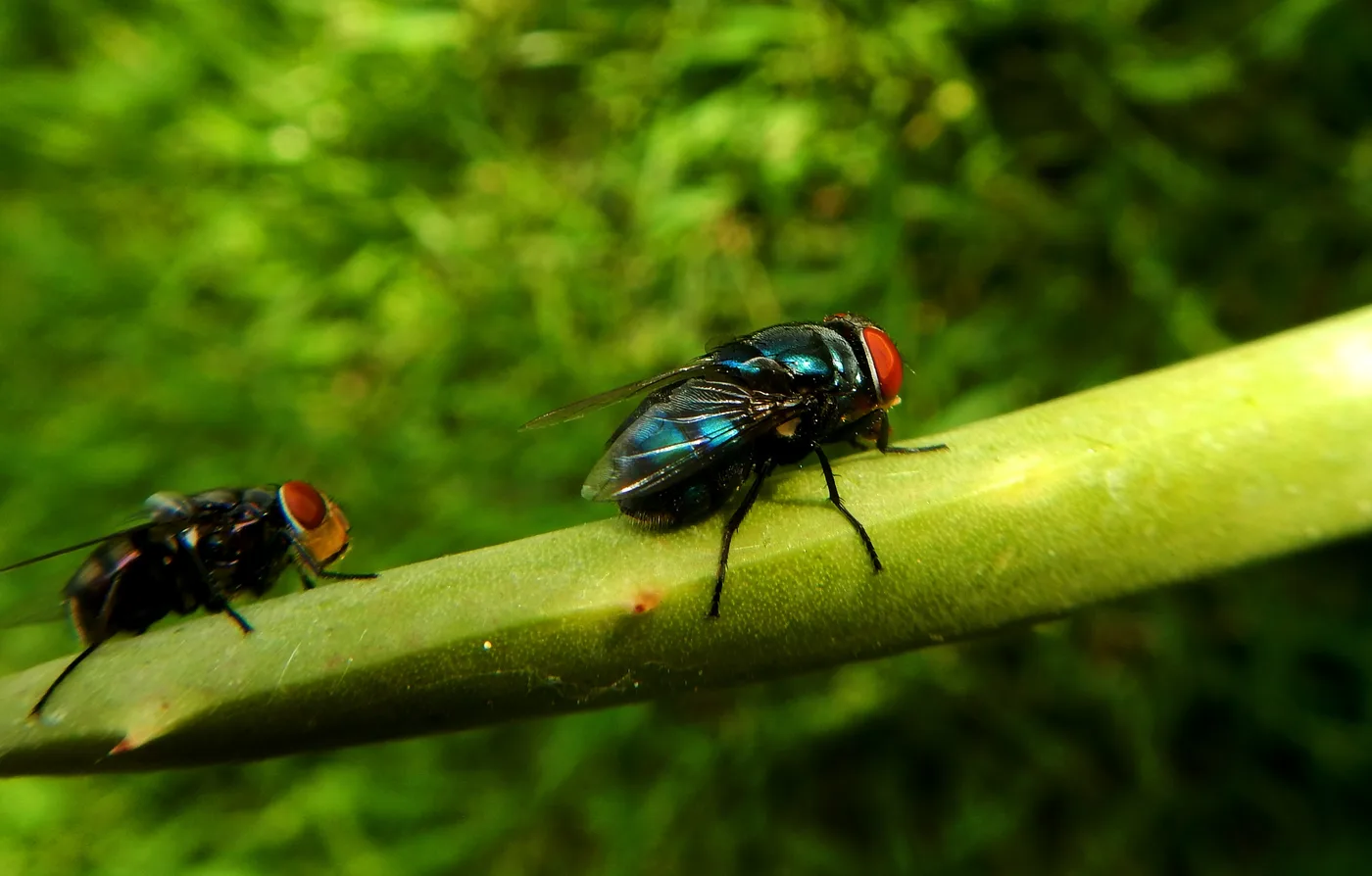
Flies of many varieties are very common in Egypt and the Middle East. The Common Housefly Musca domestica is the variety found in almost every house and wherever cattle, sheep, or goats are kept.
Description
The common housefly is a two-winged insect with large composite eyes. It feeds on a large variety of vegetable and protein matter and converges on food, rotting fruit or meat, dung, and household garbage. It is thus capable of carrying germs and viruses from various sources onto human food and may cause diseases related to food contamination.
Flies usually lay eggs on or near one of the sources of food; for example, rotting vegetation or protein such as meat, which is warm as the result of bacterial activity. The eggs hatch as small maggots, which feed on the rotting material. A few species of fly lay their eggs near sores on the skin of humans or animals, and the maggots feed on the flesh of the sores.
Special significance or symbolism
Flies were associated with decay and uncleanness.
Translation
Houseflies are found all over the world, and it should not be difficult to find a local equivalent.
The name of the god of Ekron in 2KI 1:2, Baal-zebub, may possibly mean “Lord of the fly", in other words the god who protected people from the sores and diseases caused by flies. However, the name may instead be related to the Ugaritic word zebul, “the highest,” and thus may have originally been Baal-zebul, the Canaanite equivalent of “Most High Lord,” but it was changed sarcastically by the people of Israel to Baal-zebub, “Lord of the fly.” Because of the doubt about the proper derivation of the word, it is probably best to transliterate the name rather than try to translate it, and add a footnote as follows, “This name means ‘Lord of flies’ and may be a mocking corruption of the god’s real name Baal-zebul” (compare JB).
The word ‘arov means literally “mixture” and does not actually indicate a specific insect. For this reason the New Jewish Publication Society Version and the New American Standard Bible (NASB) render “swarms of insects", and Traduction oecuménique de la Bible and the German common language version (GECL) have “vermin". Most English translations have “flies", while some translations prefer a type of fly that stings, “horsefly” or “gadfly” (compare Luther, Dutch common language translation [DUCL ], New Jerusalem Bible [NJB ], and Spanish common language version [SPCL ]. At EXO 8:21 SPCL adds the footnote, “It is not clear which insect the text is referring to. It is probably using a general term to indicate a terrible invasion of all sorts of insects."
Note: In ISA 51:6 NIV and REB have “die like flies", which is a good English idiom, but see Gnat, mosquito, louse.