Discussion
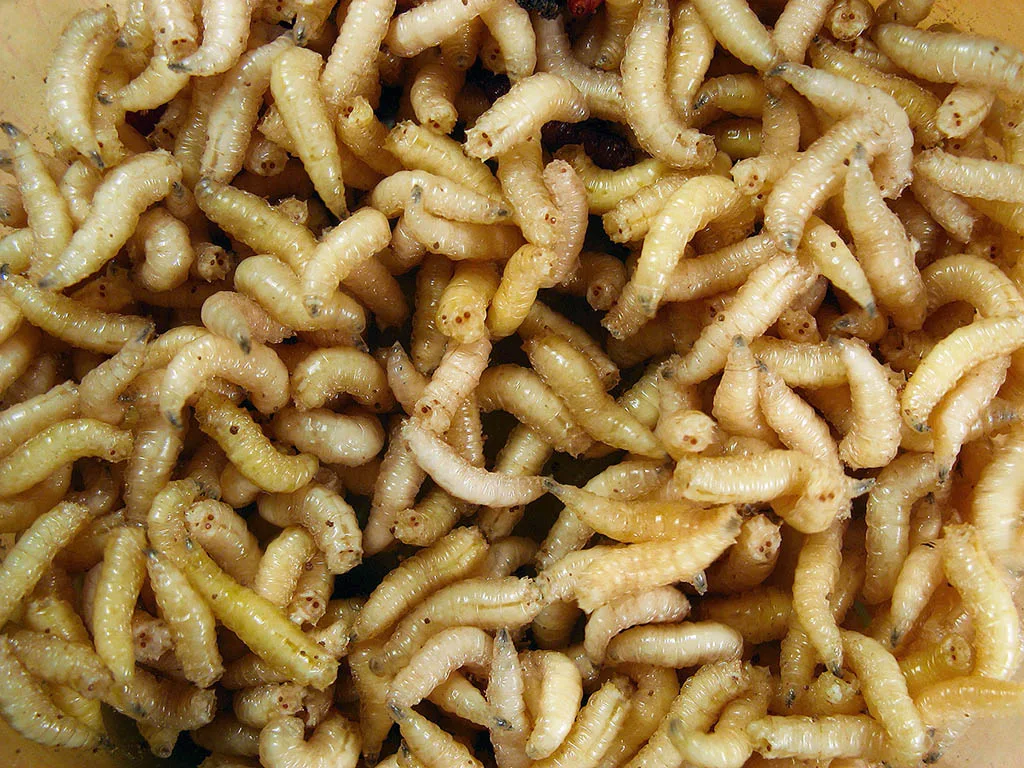
In English, “worm” is a fairly general word, while “grub” refers to worms and insect larvae that eat fruit and some vegetables such as beans. “Maggot” refers to the worm-like larvae flies and beetles, which feed on decaying meat or flesh. The Hebrew words tole‘ah and tola‘ath are fairly general terms for worms of all kinds, regardless of what the worms eat.
In Exodus, Leviticus, and Numbers there occurs the phrase tola‘ath shani, literally “worm of scarlet". The Hebrew name indicates both a scarlet color and the dye producing this color. The dye is made from the kermes insect Coccus ilicis, which was found in the Ararat region. The dye was traded by the Phoenicians, who carried it to the Middle East, North Africa, southern Europe, Mesopotamia, and even further.
Unlike the more general words tole‘ah and tola‘ath, rimah and its Greek equivalent skōlēx refer exclusively in the Bible to flesh-eating worms, in other words, maggots. The use of “worm” and “vermin” in modern English versions is motivated by the fact that to say that one’s own body is covered with maggots is repulsive and impolite in English culture. It may not be in other cultures.
Description
Worms, grubs, and maggots are small, soft, legless, tube-shaped creatures that have no bones or shells. They typically feed on overripe fruit, rotting meat, and similar things. Most are actually larvae that hatch from the eggs laid by flies or some beetles. Most of them mature into pupae and then into adult forms of the parent insects.
Special significance or symbolism
In the Bible worms and maggots are symbols of uncleanness, decay and insignificance. In PSA 22:6 and ISA 41:14 the word tola‘ath signifies a very insignificant human being or even nation. Where comparing a person with a worm or maggot will not convey the same meaning, it may be possible to find some other insect which symbolizes insignificance. Where no such comparison exists, it will be necessary to follow something like “weak and helpless as a worm” (GECL for ISA 41:14).
Maggots were a symbol of uncleanness, decay, and death. In JOB 25:6 the maggot is symbolic of a repulsive, insignificant person.
Translation
Worms and maggots are found universally, and finding equivalents should not be too hard. However, in many languages there are specific words for different kinds of worms or maggots, but no generic word that includes them all. In such cases the individual contexts should guide the translator. When the reference is to worms destroying grapes or olives, a suitable word for such a context should be found; when the reference is to maggots that feed on corpses, a suitable word for these contexts should be used. It is more important to translate appropriately for a given context than it is to translate one Hebrew or Greek word the same way every time.
The use of a word for a flesh-eating worm or maggot is appropriate for all contexts.
In JOB 24:20 the Masoretic Text is very obscure and difficult to understand. It contains a reference to rimah. RSV supports a correction of the Hebrew text, changing rimah “maggot” to shemo “his name". However, many commentators and most modern English versions interpret the verse without making this change and have wording similar to:
The womb [that is, his mother] forgets him,
And worms feast on him [or, suck him dry].
Thus are evil men forgotten,
like broken trees.
Reference is also made to maggots in MRK 9:44,MRK 9:46, but these two verses are not in the best Greek texts and are usually included only in footnotes.
In ACT 12:23 there is a Greek verb skōlēkobrōtos, which means “eaten by maggots". The death of Herod Agrippa was seen as punishment for an evil life, and it was believed to result from his being eaten by maggots. The reference may be to sores that did not heal (as may happen with gangrene, diabetes, syphilis, or tropical ulcers) and in unhygienic conditions became infected with maggots, eventually leading to blood poisoning and death. Another possible interpretation is that the “maggots” are intestinal parasites, such as tapeworms or liver flukes, which may cause ill health and eventually death.
See also Fly.