Discussion
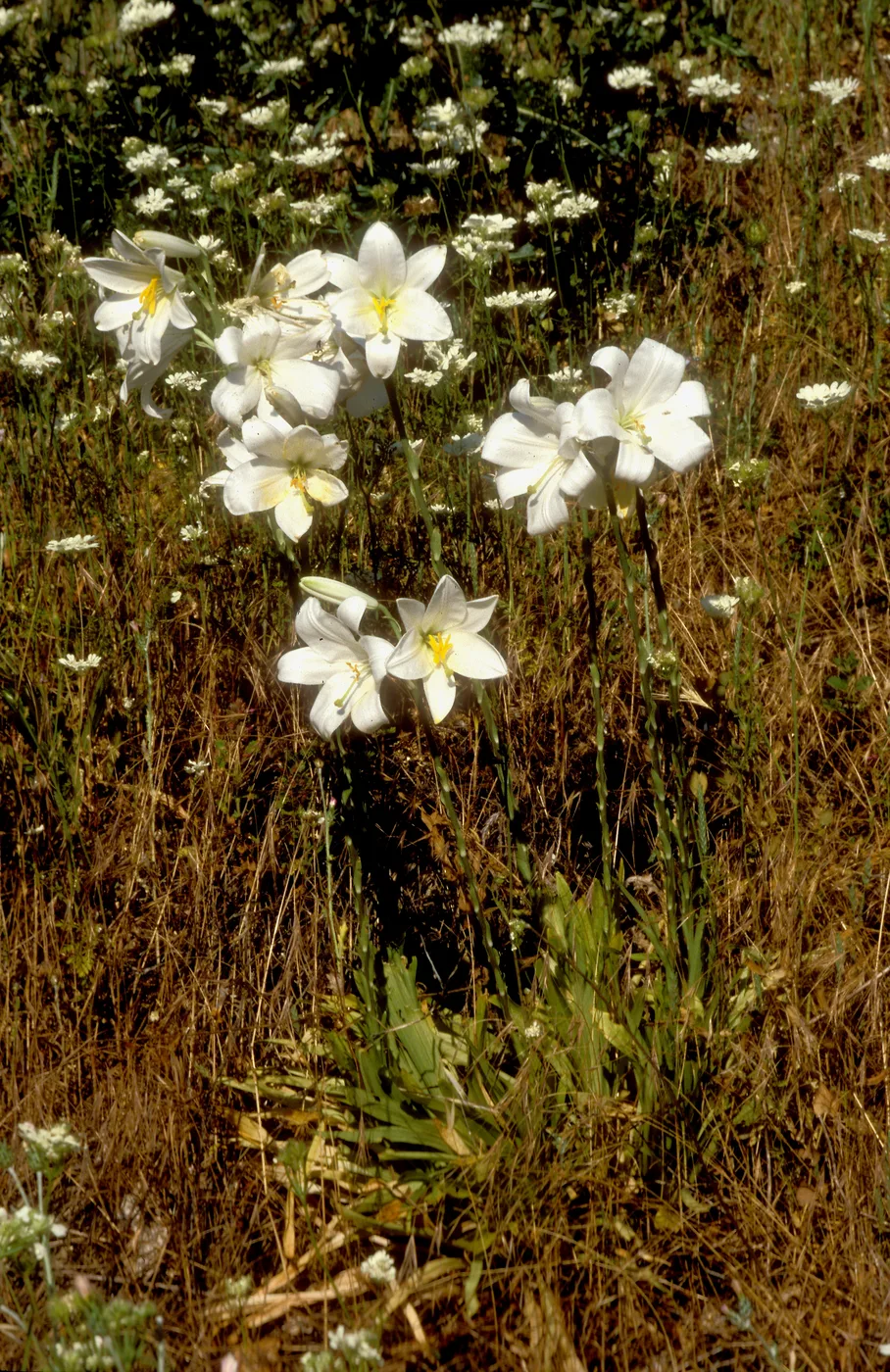
The main linguistic support for translating the Hebrew word shushan as “lily” is that its cognates in other languages (Syriac, Coptic, and Arabic) refer to the white lily. White lilies were and still are rare in Israel, and before 1925 many scholars were convinced that they did not exist in the Holy Land. (Two other types of lily are fairly common there.) However, many botanists now believe that shushan could refer to the White Lily Lilium candidum, at least in several contexts. This lily is also known as the Madonna lily due to its frequent association with the Virgin Mary in medieval art and poetry. Zohary believes that the Hebrew word chavatseleth in SNG 2:1 (“rose” in RSV) and ISA 35:1 (“crocus” in RSV) should also be translated as “lily,” but we have reason to disagree with this.
Some scholars have suggested that the shushan adorning the tops of the Temple pillars in 1KI 7:19; 1KI 7:22 are white lilies, on the basis of images engraved into the capitals of columns elsewhere in the Ancient Near East. If so, then it is likely that the shushan used later in the same chapter (1KI 7:26) to describe the downward-curving rim of the great bronze water basin outside the Temple could refer the same plant (also found in 2CH 4:5). In all these cases, any type of lily would have been possible, since they all have distinctive curved petals.
The word shushan also occurs in Nehemiah, Esther and Daniel to refer to Susa, the capital city of Persia. Some scholars have written that this name comes from an abundance of lilies found in the area. Others hold that the name comes from “Inshushinak,” the name of the god of the city. This does not necessarily cancel out lilies as the origin of the name; it is a question of what came first.
The word shushan is also found in several Psalm titles (PSA 45:1; PSA 60:1; PSA 69:1; PSA 80:1), where lilies are appropriate but not necessary to the thought of the passages.
HOS 14:6 (5) envisions a renewed Israel that “shall blossom as the lily.”
We also find shushan mentioned in the Song of Songs, where the context suggests a broader range of flowers. For example, SNG 2:16; SNG 6:3 refer to pasturing a flock among the shushan in the field. The botanist Moldenke commends AT for using “hyacinths” here, a flower blue in color. But it could as well be the crown anemone, the common poppy, or some other flower that blankets the valleys and pastures in the springtime. The third line of SNG 5:13 reads “His lips are shoshanim.” Some suggest that the red color is the ground of comparison here, so Ariel and Chana Bloch translate “his lips [are] red lilies.” However, as Murphy points out, “The use of the flower here may have less to do with the color of the man’s lips than with the delight they provide” (page 166). In SNG 7:3 (3) the woman is wearing a string of shushan around her waist. They could have been almost any flower, but presumably would have been an abundant one. So, in practice, if not in theory, we recommend a generic expression such as “beautiful flowers” in these verses.
The Greek word krinon in MAT 6:28; LUK 12:27 is now thought to refer to the crown anemone, the common poppy, or to a whole class of plants (see Anemone).
Description
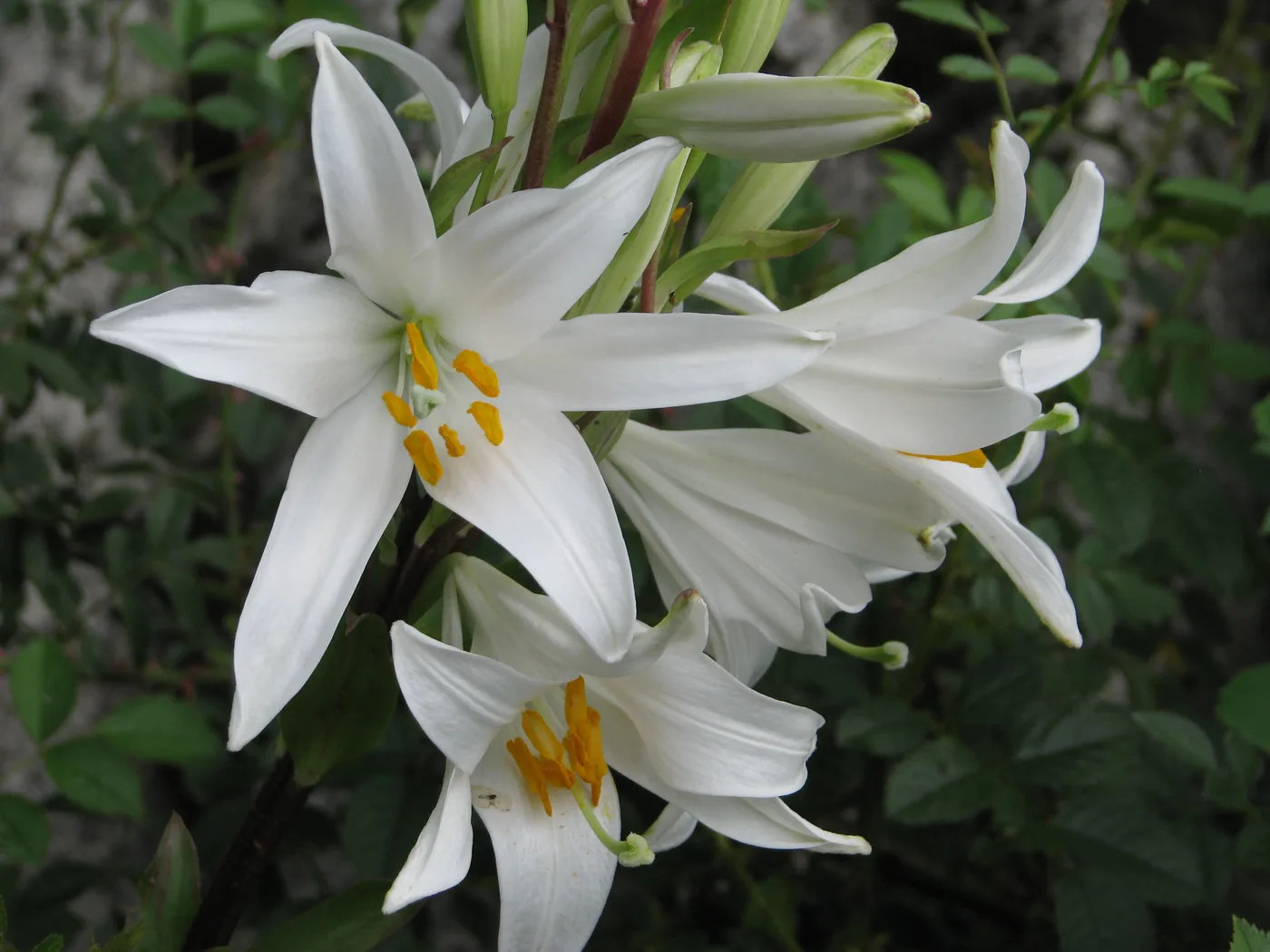
The white lily can grow to 1.5 meters (5 feet) in height. It has a bulbous root and an erect stem with long narrow leaves. Its cone-shaped flowers, usually with 5–6 petals, protrude straight out or slightly downward from the stem.
Special significance
Almost all the Bible references to shushan suggest a quality of unsurpassed beauty. From antiquity in the Ancient Near East and in Europe, lilies have been cultivated for their beauty.
Translation
Translators who are convinced that shushan refers to a specific flower can use local species, if there is one, or substitute a cultural equivalent. Lilies are known throughout the world both as wildflowers and as cultivated flowers. Many translators will prefer to use “flower” or a phrase such as “beautiful flower,” as some common language versions have done. Transliteration is not advised in the poetical passages. In Song of Songs English versions generally say “lily/lilies,” but FRCL has “anemone[s]” and La Biblia: Traducción en Lenguaje Actual uses “rose[s].”
Lily of the field: See Anemone.