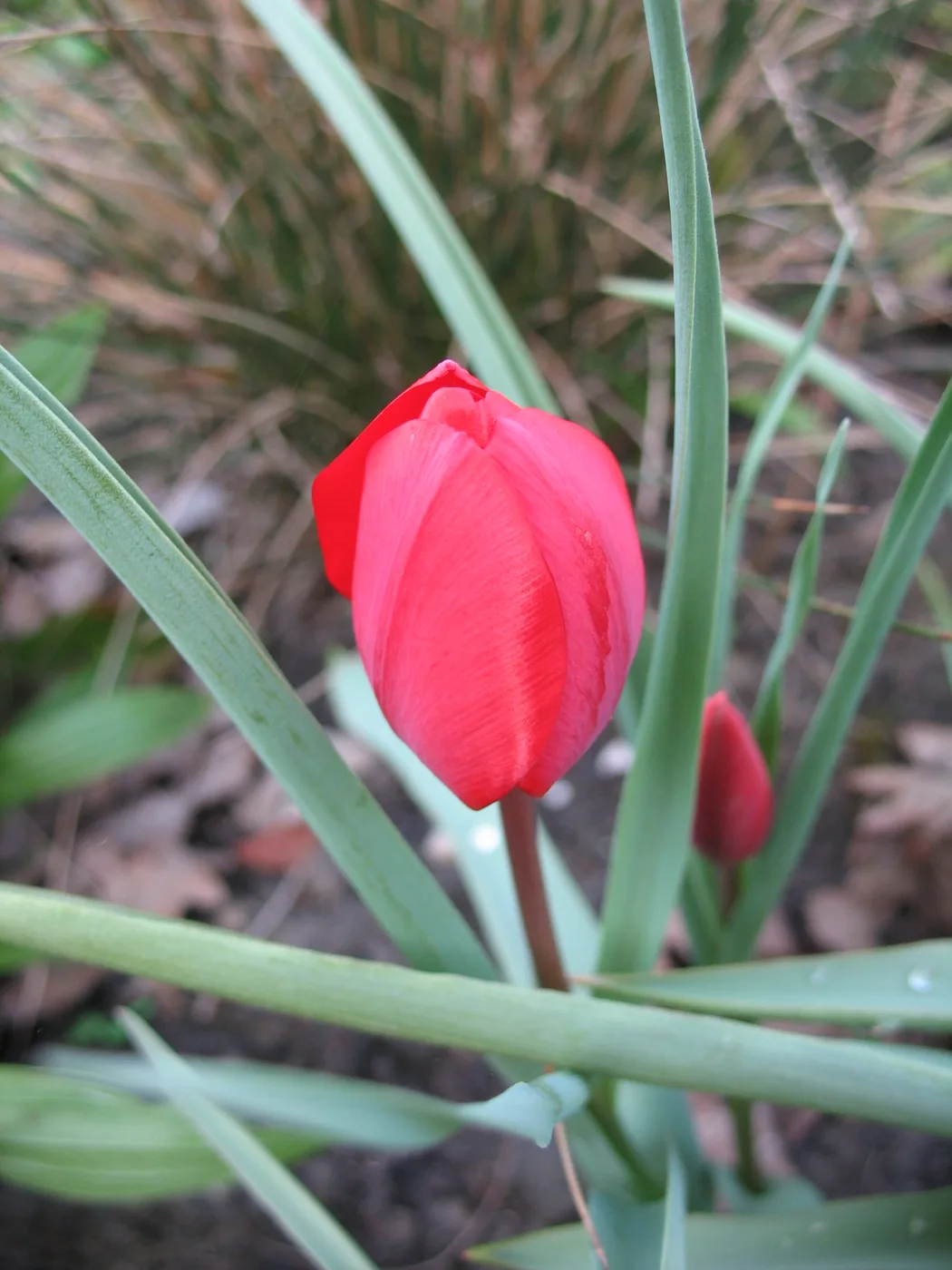
Tulip (mountain tulip, “rose of Sharon”)

Tulip
Tulip (Esther Westerveld (Wikimedia Commons))

Reference:”

Hebrew חֲבַצֶּלֶת (chavatseleth)

Discussion

Tulip
Tulip (Zachi Evenor (Wikimedia Commons))
In SNG 2:1 the woman describes herself as “a rose [chavatseleth in Hebrew] of Sharon, a lily [shushan ] of the valleys.” Sharon is a fertile plain along the Mediterranean coast between Mount Carmel and Joppa. Most botanists agree that the “rose” of Sharon is not a rose, despite persistence of that name to the present time in English versions (for example, RSV, CEV, NIV, NLT, NJB, NJPSV). The Hebrew word chavatselah may be related to the verb batsal, meaning “to form a bulb,” and this has suggested a variety of possibilities that include the crocus, narcissus (daffodil), tulip, and Madonna lily. The unopened flower of these plants is indeed a bulb-shaped bud before it opens up and the petals curve out. The same word is found in ISA 35:1, where we read that the renewed Israel will “blossom like the chavatseleth.” The parallel reference in HOS 14:6 b (5; “he shall blossom as the shushan ”) might suggest that chavatseleth is clearly synonymous with the true lily. However, we have argued above that shushan may in fact have a general sense (see Narcissus (daffodil)) and that chavatseleth in ISA 35:1 refers to the narcissus/daffodil (see Narcissus (daffodil)). So in SNG 2:1 we are left with three other possibilities: the saffron crocus, the narcissus/daffodil, and the tulip (either the mountain tulip or the Sharon tulip). (Incidentally, commercial florists have added to the confusion by naming two other species of flower “rose of Sharon.” One is actually a hybiscus; the other, a hypericum.) Following Professor Hareuveni of the Hebrew University and the botanist Moldenke, we favor the Mountain Tulip Tulipa montana for chavatseleth in SNG 2:1, with the Sharon Tulip Tulipa agenensis as a close second (some botanists hold them to be the same species).

Description

Both the mountain tulip and the Sharon tulip grow to 15–30 centimeters (6–12 inches) and have gray-green spear-shaped leaves. Its single flower grows on a long stem and has 4–5 dark red petals that overlap each other like the cloth of a turban. The names for tulip in Turkish (shuliban) and Persian (thuliband /dulband) mean “turban.” The English word tulip comes from the Old French dulipan, which came from Persian thuliband.

Special significance

Whether chavatseleth refers to the tulip, the crocus, the narcissus or anything else, the apparent quality in SNG 2:1 is beauty.

Translation

In SNG 2:1 chavatseleth is translated “rose” (RSV, KJV, NKJV, NIV, REB), “asphodel” (NEB), “wild flower” (GNB), “flower” (FRCL), and “saffron [crocus]” (AT). Recent commentators feel that the young woman in this verse is downplaying her beauty by naming two ordinary flowers for comparison. So GNB renders the first line as “I am only a wild flower in Sharon.” Translators may consider using a local species with the same characteristics. Alternatively, a generic expression can be used as in GNB. Poetically, a specific plant name carries more impact than a generic word.

Scripture References (3)

Song of Solomon

Isaiah

Hosea