Discussion
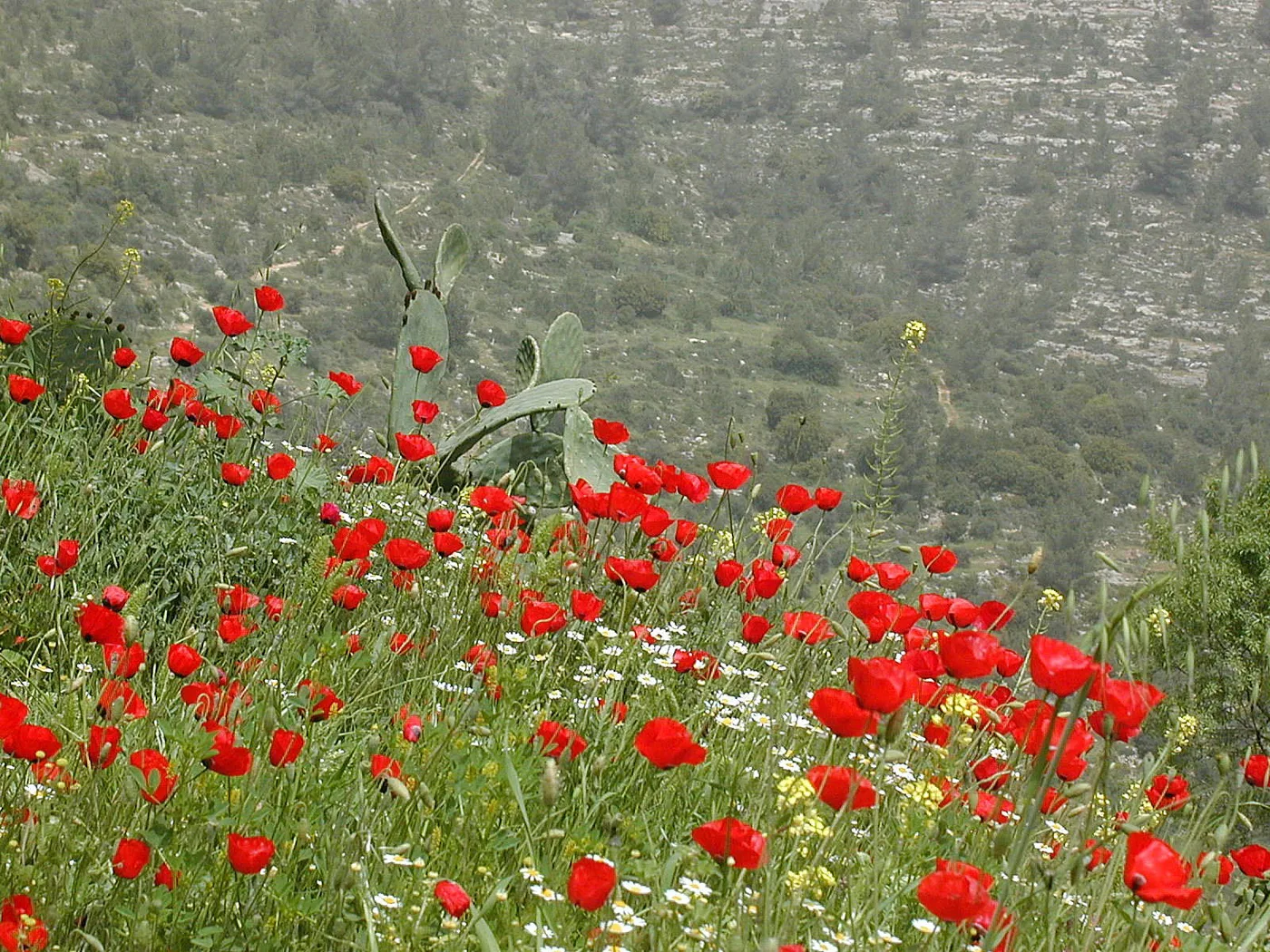
The debate over the “lilies of the field” mentioned by Jesus is endless. The problem many scholars have with “lily” is that the popular “white lily” was not well known and was not a “flower of the field” at the time of Jesus. The Greek word krinon may have been a generic word for many types of lily (as it is in English). One botanist (Smith, of Kew Gardens) claimed that the red Martagon lily was native to the Levant, but this is disputed. Krinon may in fact refer to a broader group of flowers. We can only suggest some of many possibilities. One is the Crown Anemone Anemone coronaria, which blooms profusely in different colors every spring throughout the Mediterranean basin. It belongs to the buttercup family and blooms from January to March.
Description
The anemone plant grows to nearly 50 centimeters (20 inches). It has a thick rhizome or root that stores up nutrients and water and enables the plant to endure drought and dry areas. Its leaves are lacy like a carrot’s, and its flower typically has six big, brightly-colored petals, usually red. They close at night.
Special significance
Jesus uses the “lilies of the field” as an example of something beautiful but of far less value in God’s sight than his children.
Translation
There are around 120 species of anemone around the world, in thirty-five genera. Since the context for this flower is didactic in MAT 6:28 and LUK 12:27, the translator may wish to substitute an appropriate wildflower, or use the generic phrase “wild flowers.” Like RSV, many English versions still use “lilies of the field” in these passages. GNB, CEV, and NAB say “wild flowers,” while ICB has “flowers in the field” (similarly GW).