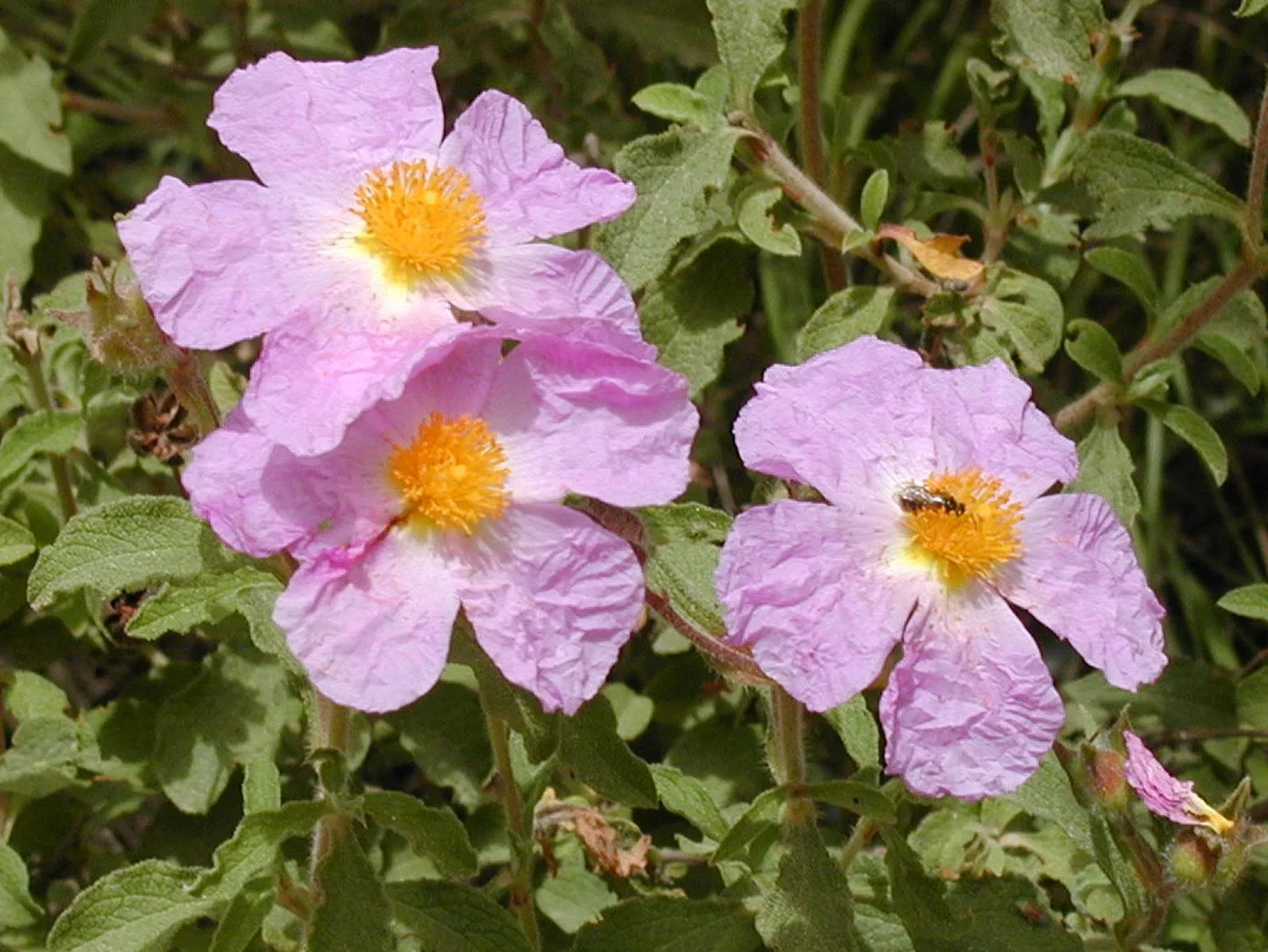
Discussion
In Genesis the Hebrew word lot is mistakenly rendered “myrrh” by RSV and some other versions. It should be translated “ladanum,” which is a sticky juice that comes out on the hairy leaves of a low shrub called Cistus or Turkish Rock Rose Cistus laurifolius. It hardens and is sold in fragrant chunks that are ground and made into medicine for cough, catarrh, and dysentery. Hepper says it was used also as perfume.
In North Africa ladanum is called latai (compare Assyrian ladanu). The Aramaic translation of Hebrew lot is letem, similar to the post-biblical Hebrew name lotem.
Description
The rock rose shrub grows to about 70 centimeters (28 inches) high and has hairy leaves and large pink flowers.
Special significance
People in the Near East collect the globs of sap that appear on the leaves of ladanum. They use small rakes with soft leather strips instead of metal teeth. On the island of Cyprus local farmers collect the gum by combing the beards of their goats that had foraged on the plants. Today it is used primarily in the manufacture of incense.
Translation
The references to ladanum are non-metaphorical, so translators have traditionally used a generic expression for it (for example, Mft with: “fragrant gum”) or a transliteration (for example, AT with “laudanum”). Other possible models are for transliteration are Hebrew lot and Arabic ladan.
EXO 30:34: Most commentators, perhaps influenced by the Septuagint, take the Hebrew word shecheleth (“onycha”) as referring to “onyx,” a kind of stone, not a plant. Zohary does not discuss it. Given the context (a list of ingredients for incense), both FFB and Hepper feel it is probably a resin-producing plant, possibly of the genus Cistus, like ladanum. Moldenke suggests that onycha may have applied to two substances, one being some kind of resin, and the other a substance coming from the shell of a mollusk living in the Mediterranean Sea. The resin option is supported by the fact that Arabic versions of the Bible have ladana, implying that the substance was ladanum. In view of the uncertainty about the identity of shecheleth, the easy way out for translators is to transliterate from a major language such as English (onika, oniki). For those who want to be more specific, “mollusk scent” (Durham) or “aromatic shell” (REB) could be considered.