Discussion
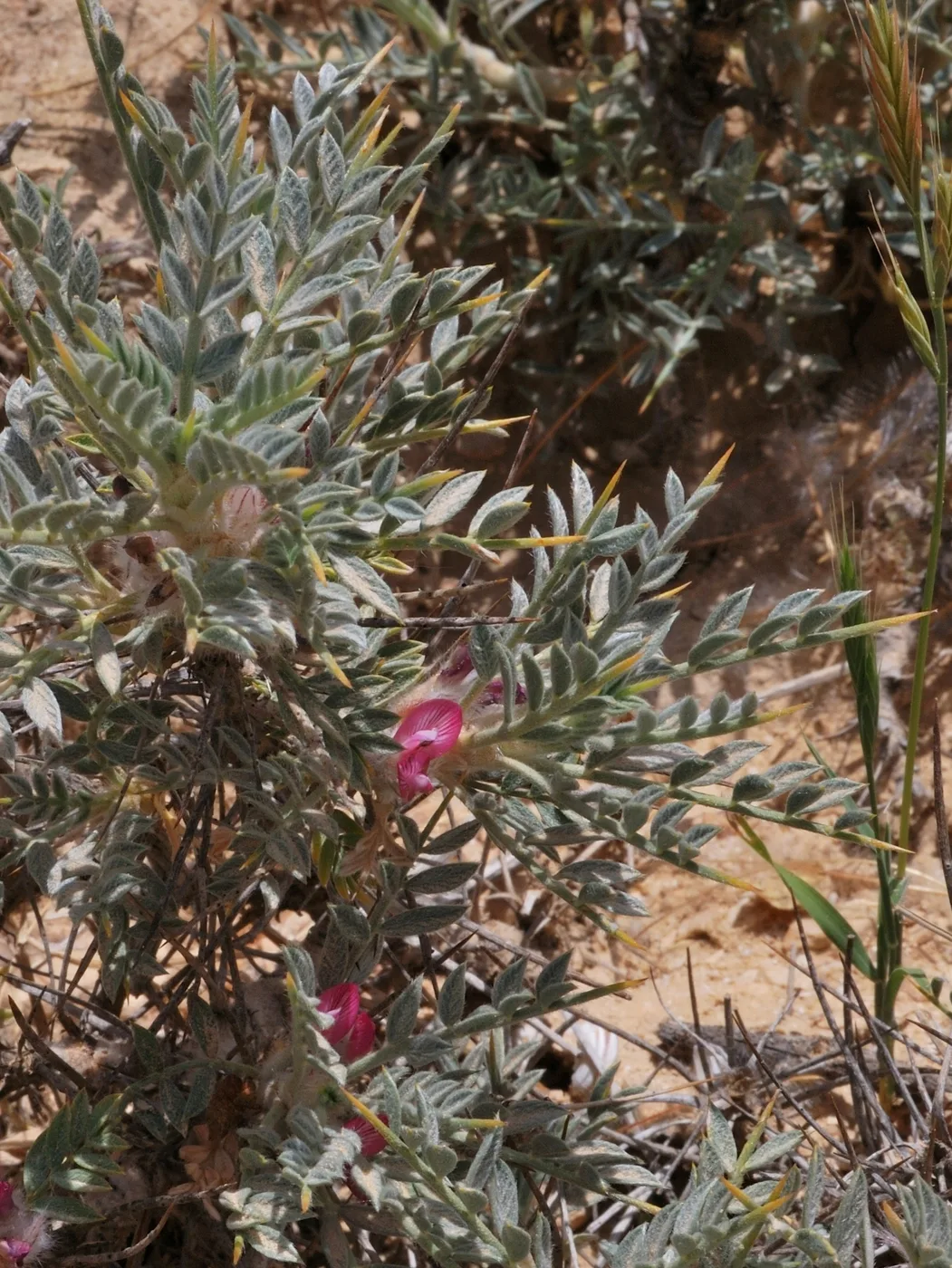
Neko’th (“gum”) is the first of three spices mentioned in GEN 37:25 as being carried by the Ishmaelites along with tsori (“balm”) and lot (mistranslated as “myrrh”) to Egypt. In GEN 43:11 Jacob urges his sons to carry some neko’th to Egypt as a gift to the Pharaoh. It was an important ingredient of incense and was probably used for medicine as well. The Hebrew word neko’th refers to tragacanth. Most the eighteen hundred species of tragacanth (commonly called “milk vetches”) of the genus Astragalus produce tragacanth gum, but the ones growing in Judea and Gilead (Astragalus gummifer and Astragalus bethlehemiticus) are outstanding in their production.
Description
The tragacanth shrub grows to about 50 centimeters (20 inches) in height and branches densely right from the base. Some of the plants at high elevations or in poor soil cling to the ground looking like sea anemones or pin cushions, with their sharp spines. The flowers, which grow from the point where the leaf joins the stem, give way to tiny wooly fruits that disperse in the wind.
Special significance
The gum of the tragacanth shrub is stored in the roots, providing moisture for the plant during the dry season. People who collect the sap expose a root, make a cut in it, and place a cup where it will catch the globs of sap that ooze from the root. They often have many plants that they tap in this way. Tapping typically begins in June. Today tragacanth is still used in incense and medicine, but also in leatherworking, baking, and even in the production of cigars.
Translation
Neko’th is rendered “gum tragacanth” by REB and NJB, and “spices” by GNB, NIV, NLT, and NCV. In GEN 37:25 GW handles the set of three substances nicely by saying “materials for cosmetics, medicine, and embalming.” The Arabic word for the plant is nakaa or nakaath.
The Genesis contexts are both non-rhetorical, so the translator may choose a general phrase to cover all of the terms in the list. If not, neko’th may be rendered “rubbing medicine,” or a transliteration from a major language may be used. A transliteration from English is “tiragacanti,” but this is unwieldy. If there is a word for the dried sap (gum) of trees, that could be used by itself or in combination with a transliteration. Arabic nakaa may be useful in some places.