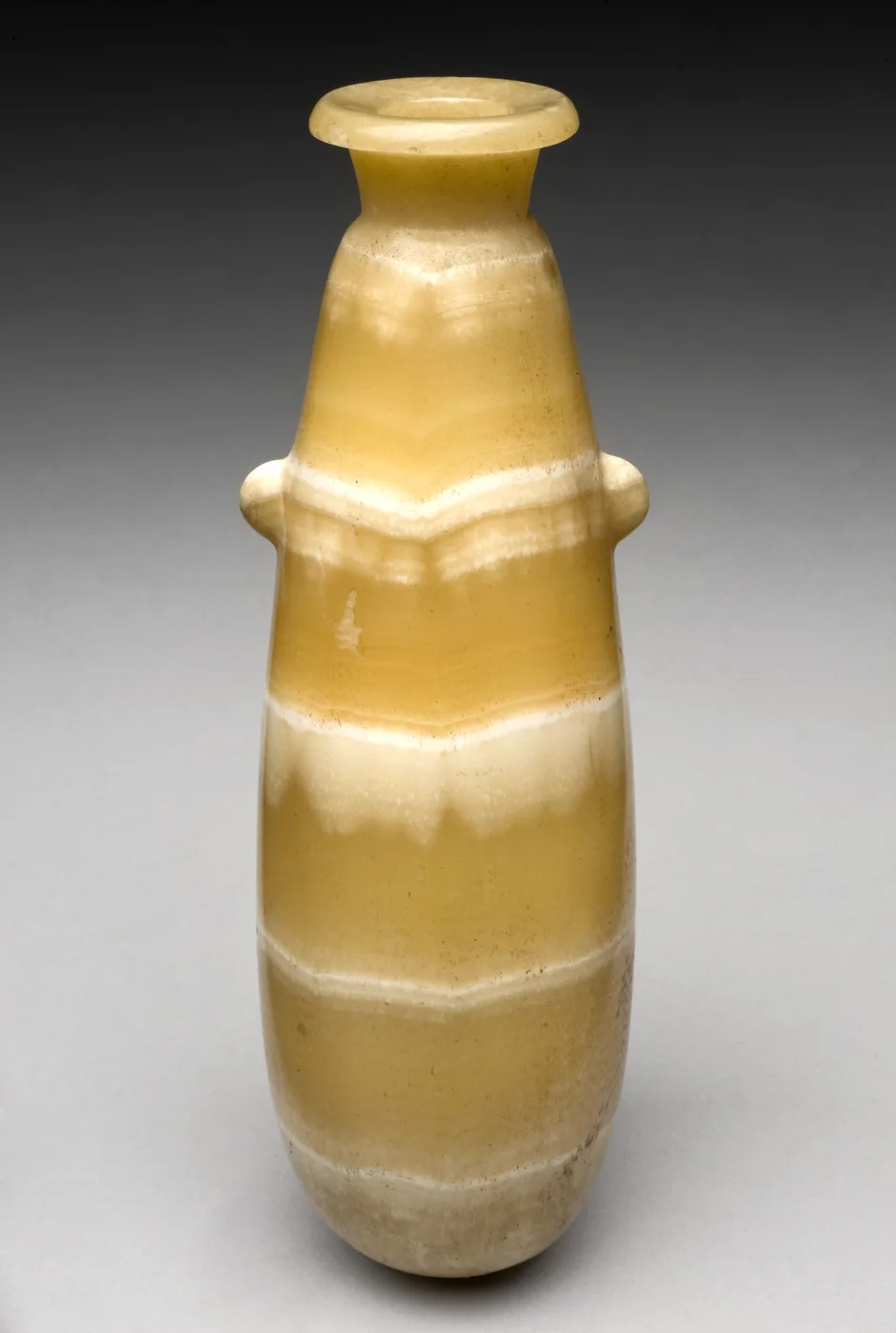
Description and usage
The alabaster jar was a jar made of calcite stone. This jar normally had a rather long neck that had to be broken off for the contents to be used. It served primarily as a container for precious substances such as perfumes. Such jars were usually small.
Translation
Archaeological and literary evidence reveals that in the Hellenistic period jars for perfume, originally of alabaster, were replaced by glass jars. But these continued to be called “alabasters.” They were sealed when purchased and were opened by breaking. This is why MRK 14:3 very properly says that the woman broke the jar, a detail not recorded in the Matthew parallel. While glass was not as expensive as alabaster, it too was not commonplace and was a valued commodity.
When rendering “alabaster jar,” many translators have used a term meaning “jar” or “flask” along with a descriptive qualifier, such as “made of alabaster stone,” “made of valuable stone,” or “made of valuable stone called alabaster.” Since alabaster is not widely known today, some translations omit this information; for example, for the literal phrase “an alabaster flask of ointment of pure nard, very costly” (RSV) in MRK 14:3, CEV says “a very expensive bottle of sweet-smelling perfume”; this, however, leaves the reader in doubt as to whether the bottle was expensive or its contents (it was the contents). GECL and the Hebrew common language version are better with “a small bottle with pure, expensive nard oil.”