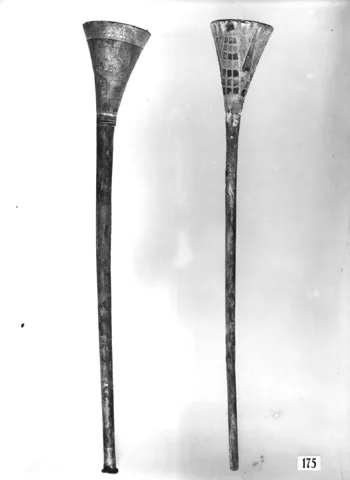
Description
The trumpet was a wind instrument, frequently used in signaling, especially in connection with war. It was made of metal (the trumpets mentioned in NUM 10:0 were made of silver). It was a straight, narrow tube, about 40–45 centimeters (16–18 inches) in length. One end had a mouthpiece, while the other end was widened into a bell shape.
Usage

The purpose of the trumpet in Israel was primarily to signal. DAN 3:5; DAN 3:7; DAN 3:10; DAN 3:15; 1CO 15:52; 1SA 10:5; 1KI 1:40; ISA 5:12; ISA 30:29; JER 48:36 lists a variety of occasions in which the trumpets were to be used, including signaling the people to break camp, calling all of the people together for a meeting, calling only the leaders together, sounding an alarm at the beginning of a battle, and blowing them for liturgical purposes during certain festivals. It is significant that it was the task of the priests to sound the trumpets.
Translation
Generally speaking, translators may distinguish between the Hebrew words chatsotsrah and shofar (see Horn, ram’s horn) by rendering chatsotsrah as “trumpet” or “bugle” and shofar with a more generic word for “horn” or with “ram’s horn.” Note the following comment in A Handbook on Psalms (page 846) on JER 48:36: “In some languages it will not be possible to make a distinction between the two Hebrew terms translated \+u trumpets\+u* and \+u horn\+u*. In such cases the local term for a horn will be used. The Greek Old Testament used only one term.”
The exact meaning of the Aramaic word qeren in DAN 3:5; DAN 3:7; DAN 3:10; DAN 3:15 is debated. It probably refers to a brass wind instrument and is best rendered “horn.”
The present-day equivalent for the Greek word salpigx is “bugle.” A bugle is generally smaller than a trumpet and is often associated with the sounding of military signals.
PSA 5:1: It may be necessary to introduce an agent in the literal phrase “at the last trumpet” (RSV); for example, “when someone blows the trumpet for the last time.” Also possible is “when someone produces a noise on the trumpet for the last time”; however, any term for “noise” should imply a meaningful sound.