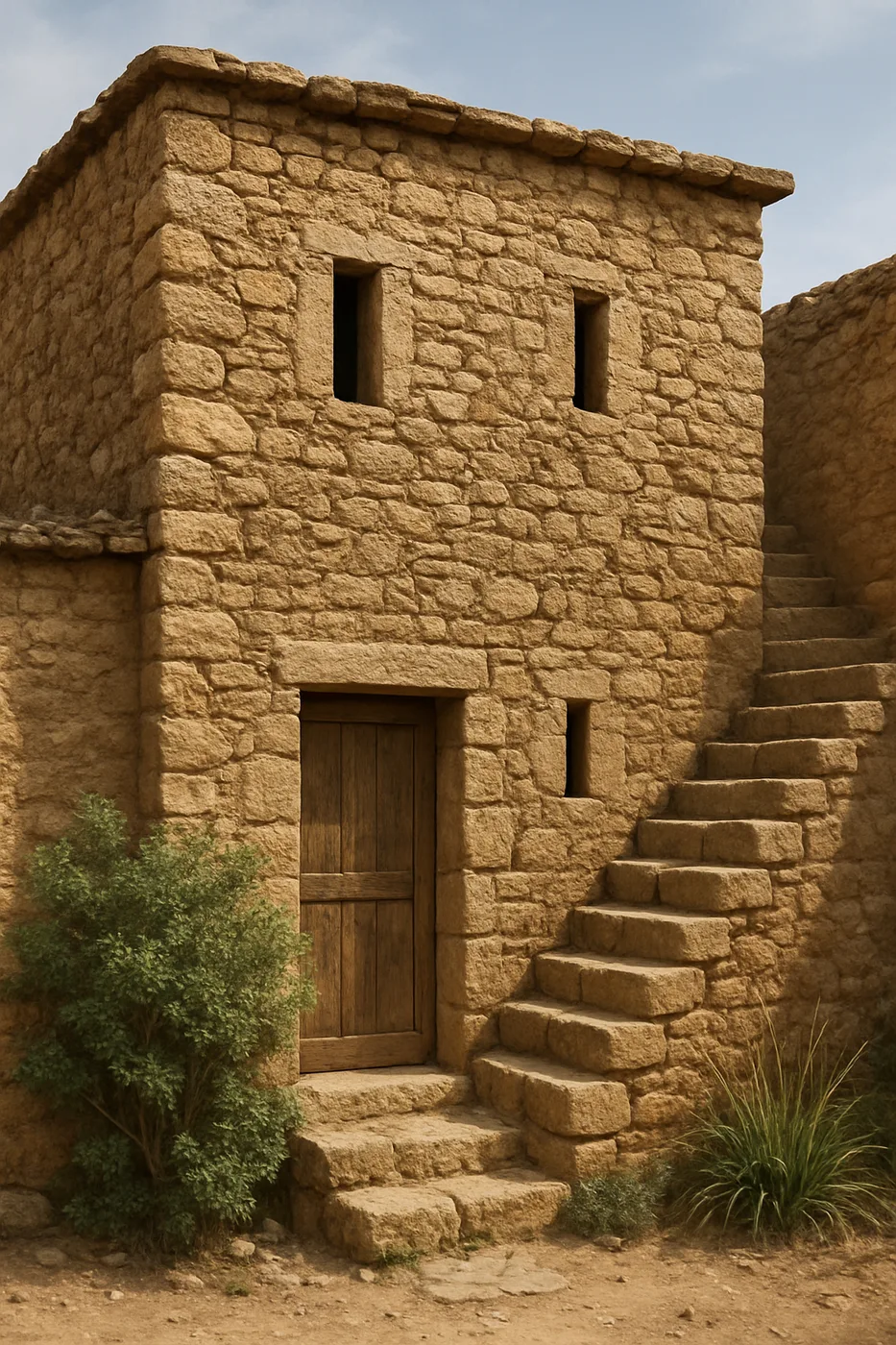
Description
The upper room was a room on the level above the ground floor (second story in American usage and first story in most other languages). This room generally would not cover an entire story but only part of the roof.
Translation
The Hebrew phrase ‘aliyath mqerah in JDG 3:20 (also called cheder mqerah in JDG 3:24) refers to a special upper room built for coolness. Its higher level exposed it to the breeze, and it was probably built facing north, where it would be less exposed to the sun.
1KI 6:6; 1KI 6:8 mentions second and third stories (American usage) built around the outside of the Temple. 1KI 6:8 refers to the “entrance for the middle story” (NRSV). HOTTP makes the following comment on this: “These stories seem to have been open arcades or galleries. Therefore it was necessary to speak, not about the entrance of the open ground-floor, but about the entrances of the first (or middle) and of the second (or highest) floor.” This comment is based on the reading of the Hebrew text, which states clearly that the entrance was to the middle story and that steps led to the middle story and from the middle story to the upper story. However, the Septuagint as well as an ancient Jewish Aramaic translation (Targum) understood the two appearances of the Hebrew adjective tikonah (“middle”) at the end of verse 8 to refer to the middle floor, while the first appearance refers in fact to the lowest floor. Thus, for example, NJB has “The entrance to the lowest storey was at the right-hand corner of the Temple; access to the middle storey was by a spiral staircase, and so from the middle storey to the third.”
PSA 104:3; PSA 104:13: The Hebrew word ‘aliyoth in these verses refers to God’s dwelling place. Many translations avoid a literal rendering. CEV has “home” in both verses, while GNT says “home” in verse 3 and “the sky” in verse 13. NJB has “palace” and “halls” respectively.