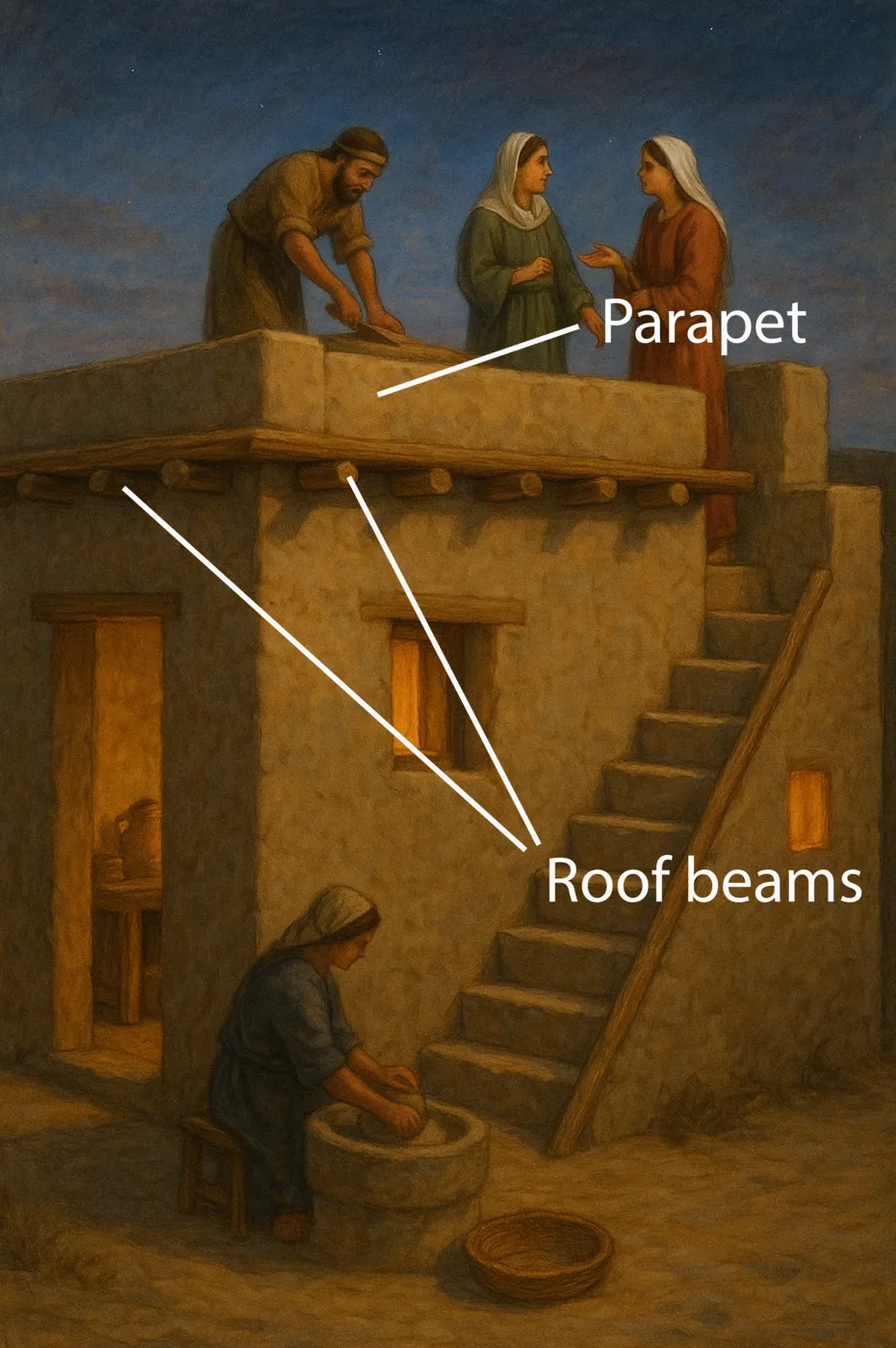
Description and usage
The average family house in biblical times was small, perhaps no more than 40–50 square meters (400–500 square feet). Its shape and the materials from which it was built varied according to location and time period; for example, houses in Egypt before the Exodus did not look like houses in Mesopotamia in the time of the later prophets, and these in turn differed from houses in Galilee in New Testament times. Where a generic term exists for a single-family dwelling, it can usually be used throughout the Bible. Where a language must specify, for example, the material of which the house is made or the shape of the house, the following discussion may be of help.
Houses in Egypt and Canaan in the time of the patriarchs were made of mud bricks. These houses were rectangular and had one story and usually one room. The floor was normally made of packed, dried mud. Mud brick construction was also used in Mesopotamia even into later biblical times. The mud brick walls were sometimes built on a foundation layer of stones.
For the construction of houses in the period of the kings, local stone replaced mud, and stone may have been the main building material in the hilly regions even from earliest times. The stones were rough and undressed (that is, not cut or manually shaped) and were piled on each other and held together by mud. There was generally no finish given to the outside of the walls, although it was sometimes the custom to plaster the interior walls in the dwelling area.
Translation
In a number of languages it is important to distinguish clearly between various types of dwellings depending upon their size and presumed importance. Accordingly, in rendering the generic Hebrew, Greek and Latin words listed above, it is necessary to use a number of different terms roughly equivalent to the English words “cottage,” “house,” “official residence,” “palace,” “temple,” and so on. See also Palace and Jewish Temple.
In some languages translators must distinguish carefully between a house and a home. A term meaning “house” would be used in referring to any dwelling as a construction, while a term meaning “home” would be used in referring to the more or less permanent dwelling of a particular person. In MRK 2:1, for example, it is significant to indicate that Jesus was dwelling in the house through the roof of which the paralyzed man was let down, that is, he was “at home” (RSV, GNT).
A number of the items that follow (for example, foundation, lintel, stairs) are structural features that are common to other buildings in addition to permanent private dwellings. They are gathered under this heading for convenience.