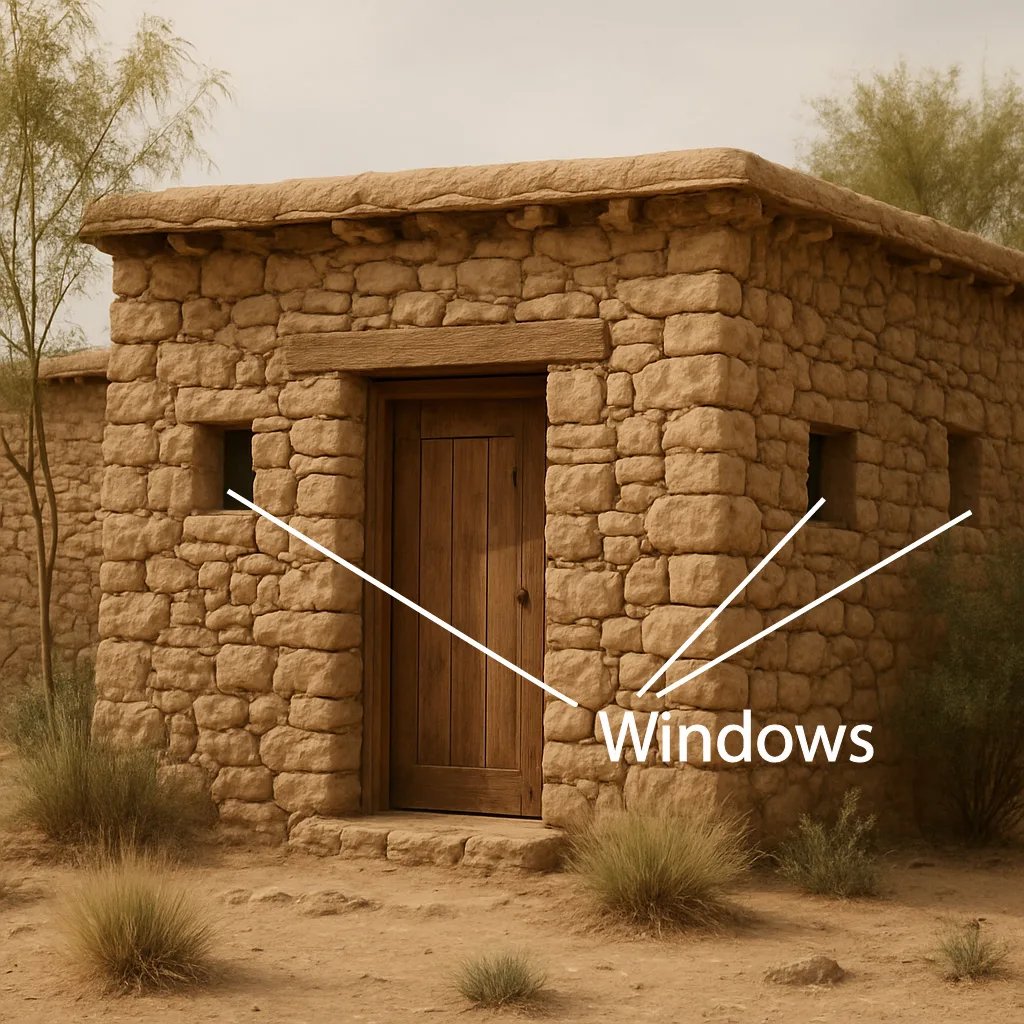
Description and usage
The window was an opening in a wall for the entrance of light and air and for the purpose of seeing in or out.
Translation
In some languages a distinction is made between windows that may be closed with glass or shutters and those that are simply openings. It is probably the latter type that is involved in HOS 13:3; ACT 20:9; and 2CO 11:33, while it is clear that GEN 6:16; GEN 8:6; and DAN 6:10 speak of the former type. Generally, translators should avoid a word for “window” which indicates something made of glass, which was not used in windows in the ancient world.
The Hebrew word ’arubah occurs in the phrases “windows of heaven” (GEN 7:11; GEN 8:2; ISA 24:18; MAL 3:10) and “windows in heaven” (2KI 7:2; 2KI 7:19). It is not necessary to translate these phrases literally, as seen in GNT, which renders the first phrase as “floodgates of the sky” in GEN 7:11 and GEN 8:2 and “Torrents of rain … from the sky” in ISA 24:18. For the literal expression “if the LORD himself should make windows in heaven” in 2KI 7:2, GNT has “even if the LORD himself were to send grain” (2KI 7:2).
Opinions differ concerning the meaning of ’arubah in ECC 12:3. Some versions (for example, SPCL, TOB, NIV) translate literally “those [women] who look through windows,” while others take it to be a reference to the eyes (CEV “your eyesight”; GNT, NCV, GECL “your eyes”).
The Hebrew phrase chalone shqufim ’atumim in 1KI 6:4 is understood in various ways. Some translations find technical words for a particular architectural feature; for example, for the whole verse REB has “and he fitted the house with embrasures,” and NIV says “He made narrow clerestory windows in the temple.” Both of these examples demonstrate what should not be done in a common-language translation, using words that may be technically correct but are obscure to the reader. They would have achieved approximately the same effect by transliterating the Hebrew. Some understand these windows to be covered with a kind of “lattice,” “grill,” or “grate” (compare SPCL). Others interpret the phrase as describing the structure of the window in the wall; for example, GNT says “The walls of the Temple had openings in them, narrower on the outside than on the inside,” and CEV has “The windows were narrow on the outside but wide on the inside.” Some think that a kind of “frame” for the window is being described: “And he made for the house windows with recessed frames” (RSV). NJB combines two of these elements into “He made windows for the Temple with frames and latticework.” When choosing a translation here, it should be kept in mind that the probable purpose of these openings was to allow light into an otherwise rather dim Temple interior. Many translations add a footnote saying that the Hebrew is unclear.