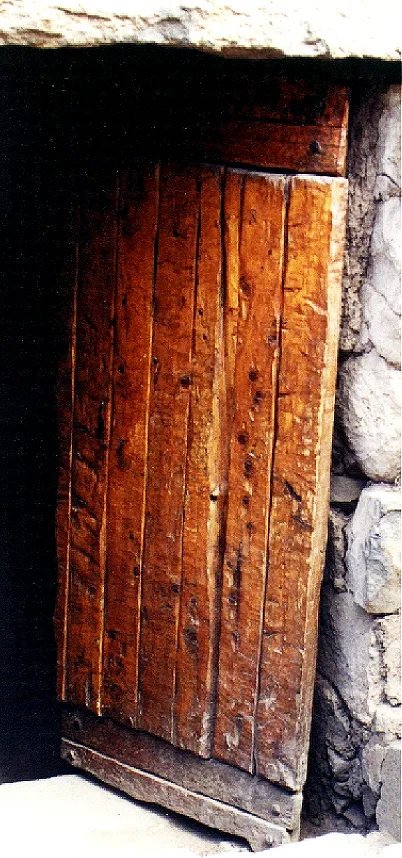
Description and usage
The door was the entranceway into a building or structure or the panel that covered that entranceway. Doors were normally made of wood. To one edge along the length of the door was attached a wooden pole which extended slightly past the top and bottom edge of the door. The protruding ends of this pole were sharpened or rounded and set into sockets or holes cut into the stone lintel and threshold, thus allowing the door to swing open and shut. Sometimes the door panel was hung on hinges made usually of leather, sometimes of metal.
Translation
In some passages “door” means simply “opening” or “doorway” without reference to the physical object (see JOB 3:10; JOB 41:6; PSA 78:23). This is especially true of the Hebrew word pethach.
Occasionally “door” is used as a figure for shutting out; for example, CEV says “boundaries” in JOB 38:8, where God speaks of limiting the extent of the sea. Similarly, in PSA 141:3 the psalmist literally asks the LORD to “keep watch over the door of my lips” (RSV). In some languages it may be better to render this line without the image, for example, NCV says “help me be careful about what I say.” CEV provides a helpful model for the whole verse, saying “Help me to guard my words whenever I say something.”
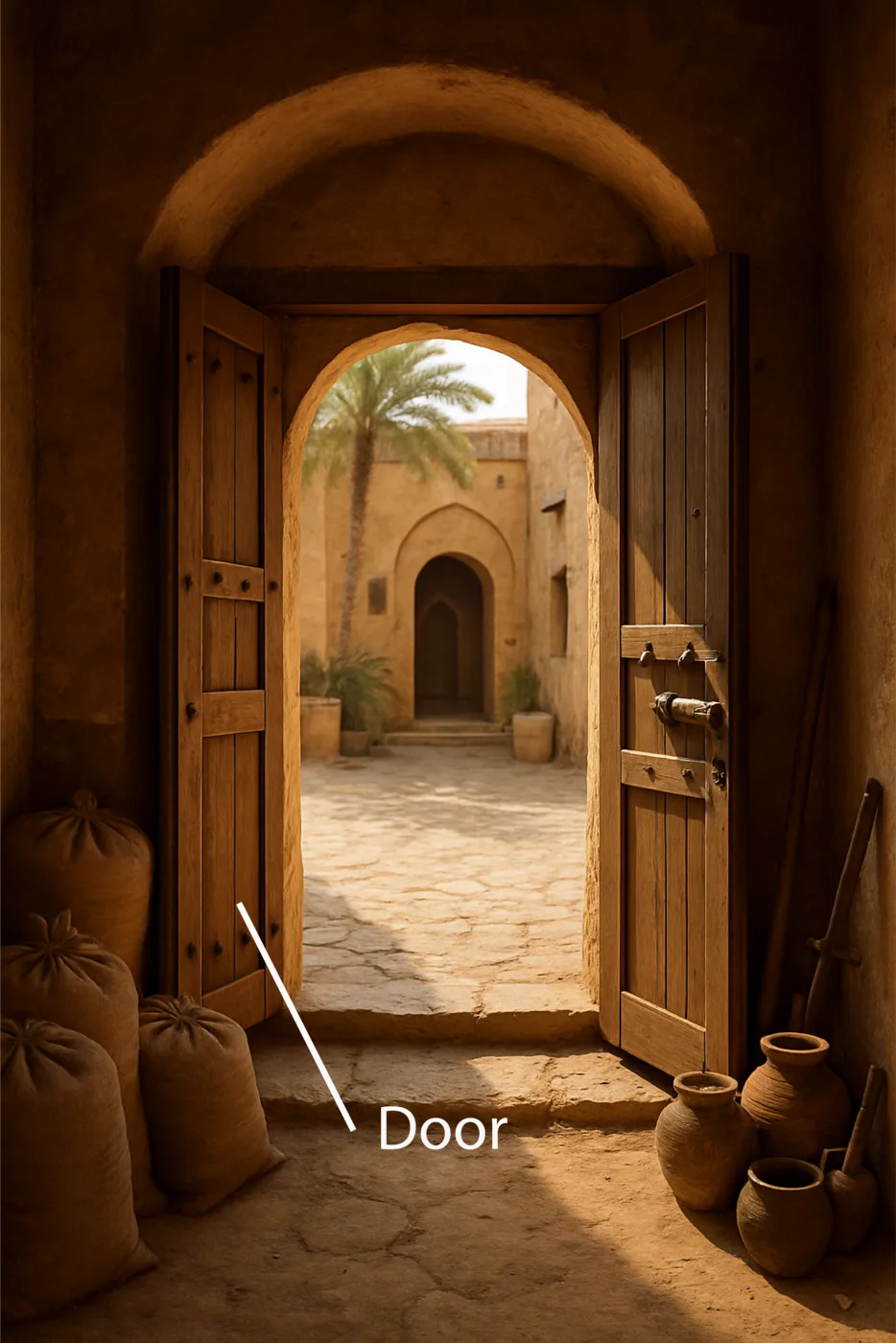
The Aramaic word tra‘ in DAN 3:26 means “gate” or “door.” Some translations have “door” (RSV, GNT, NASB), while others have “opening” (NIV, NCV). The opening may have been in the top of the furnace, but it was more likely in the side as a kind of “doorway.”
In JHN 10:7; JHN 10:9 the Greek word thura is used figuratively to refer to Jesus as the means of access to salvation. The emphasis in these verses is on the “door” as a passageway and not as an object closing off an entrance. The literal translation “I am the door of the sheep” (RSV) may often lead to misinterpretation, since the term used for “door” is likely to refer to the door panel rather than to the doorway or entranceway, thus suggesting that Jesus Christ functions primarily to prevent passage rather than to make entrance possible. The translator should use an expression such as “I am the gateway/doorway/entranceway where the sheep enter.”