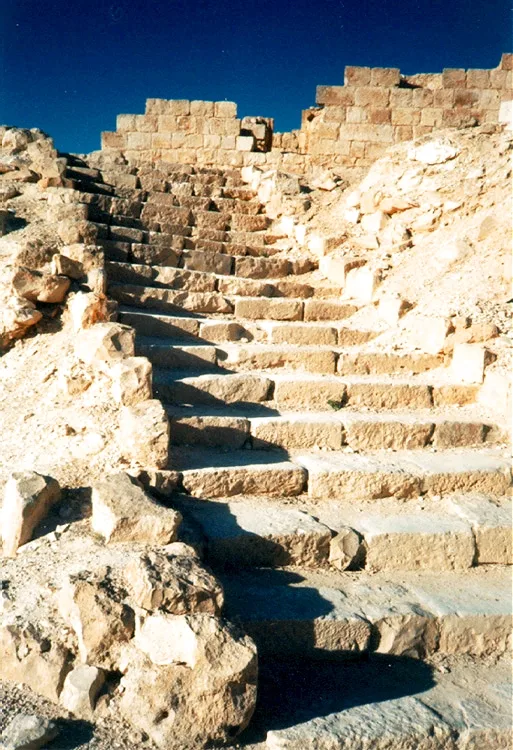
Description and usage
Steps were a series of levels by which a person could ascend or descend by foot. They connected one story of a building to another or one level of ground to another. They could be laid down as blocks of stone or cut into the earth or bedrock.
Translation
GEN 28:12: The Hebrew word sulam occurs only here in the Bible. It indicates a kind of stairway or ramp made of stones piled up. In older translations it was mistakenly rendered “ladder” (so RSV). Some scholars see here a reference to a kind of ziggurat (see Tower, ziggurat). In a footnote TOB gives “ramp, slope” as a possible alternative and suggests that the object intended is similar to the steps ascending a ziggurat. Translators should employ a word for an object on which many people can ascend and descend together at the same time.
1KI 6:8: The Hebrew word lulim refers to stairs that go up in a spiral. Some languages will make a distinction between a straight stairway and a spiral staircase; for example, REB has “spiral stairway,” and NRSV has changed RSV “stairs” to “winding stairs.” Most translations consulted, however, do not indicate the spiral form of the steps.
The Hebrew word ma‘alah is used in 1KI 10:19; 1KI 10:20 and 2CH 9:18; 2CH 9:19 for the steps leading up to Solomon’s elevated throne (see also Throne).
NEH 9:4: Some translations believe the Hebrew word ma‘aleh in this context refers to the “wooden platform” in NEH 8:4, which had been built specially for addressing the people (GNT, CEV, NASB). Others (RSV, NIV, NCV) render it “stairs,” possibly understanding it as a flight of steps leading from one courtyard of the Temple to another. In the rebuilt Temple of Herod, it is known that there was such a flight of steps on which the Levites stood and sang. The important point is that they were standing in an elevated position where they could be seen and heard by the people. A Handbook on Psalms (page 1047) says the following about the titles of PSA 120:1 - PSA 134:1: “Psalms 120–134 all have a title in the Hebrew text which is translated by RSV as A Song of Ascents (TEV [that is, GNT] does not include this title). The collection is also called ‘The Book of Pilgrim Songs.’ The Hebrew word translated Ascents comes from the verb ‘to go up,’ but other than this there is no agreement as to what the phrase means. Some take it to indicate the return of the Hebrew exiles from Babylonia; others take it to refer to a stylistic feature found in some of the psalms, in which the order of the statement progresses in a step-like fashion from one verse to the other; others take it to refer to the steps in the Temple precincts which led from one court to the other; the majority take it to refer to the ascent up the mountain on which the Temple was built (Mount Moriah, known as Mount Zion). Thus understood, these psalms are songs which the pilgrims sang as they came to Jerusalem for one of the three major annual festivals (see GECL).”
The Greek word krēpis, which appears in 2MA 10:26, is literally the “foundation,” “base,” or even “foot” or “edge” of a structure. It is used to refer to the bank of a river as well as the tiers of seats in an amphitheater. Perhaps for this reason, RSV and GNT render it “steps” in this verse, saying “the steps of/before the altar.” Similarly, NJB has “the terrace before the altar.” NAB has a good idiom, “the foot of the altar,” which may work also in other languages. It is also possible to translate more generally “in front of the altar.”