Discussion
Horses belong to an animal family that includes donkeys and zebras. They were first domesticated in the central Asian and Mongolian grasslands, the original home of the eastern wild horse, sometime before 2000 B.C. (The European wild horse was domesticated considerably later.) By 1700 B.C. horses had been imported into Canaan and Egypt. The fact that horses were imported made them very expensive, and for centuries horses were only owned by kings and wealthy local chiefs. Their military potential was soon recognized, and armies that were equipped with war chariots and had soldiers on horseback had an enormous advantage over those that did not. Horses gave armies a mobility they had never had before, and completely changed battle tactics.
In more recent times, horses have been carried abroad by European colonists and introduced to virtually every country on earth. The so-called “wild horses” of Spain, France, the Americas, and Australia are actually domesticated horses that have returned to their wild state.
Joseph, in GEN 47:17 (the first mention of horses in the Bible), used the widespread famine and Egypt’s store of grain as an opportunity to obtain horses for the Pharaoh. He thus weakened the neighboring tribes, while giving Pharaoh’s army better military capability. It is ironic that these horses were later used against Israelites under Moses.
The Canaanites also had horses and chariots, but in DEU 17:16 the people of Israel were prohibited from acquiring horses, as this was seen as weakening their reliance on God. Militarily they were thus at a considerable disadvantage in their wars against the Canaanite tribes. They counteracted this disadvantage by concentrating on fighting in the hill country, or occasionally in swampy land (JDG 4:7; JDG 5:19; JDG 5:20; JDG 5:21), where chariots were useless. They cut the hamstring tendon at the back of the hind legs on captured horses, rendering them useless to both Canaanites and themselves (JOS 11:9). Even so, JDG 1:19 states that “Judah drove out the inhabitants of the mountains, but could not drive out the inhabitants of the valleys because they had iron chariots” (NIV; compare also TEV and REB).
Joshua, Saul, and David seem to have heeded the warning not to acquire horses. However, David finally gave in to the temptation, and in 2SA 8:4 we read that although he hamstrung most of the captured horses, he kept a hundred for himself. The advantage that he gained was later turned against him when two of his sons, Absalom (2SA 15:1) and Adonijah (1KI 1:5), equipped themselves with horses from David’s stables in preparation for their revolts against him.
However, it was Solomon who made horses and chariots a major component of the Israelite army. He imported horses from Egypt and Cilicia at a cost of 150 shekels each, and he received horses as part of the annual tax paid to him by smaller states. He eventually collected 12,000 horses, which were stabled in a number of towns (1KI 10:26 ff.).
Description
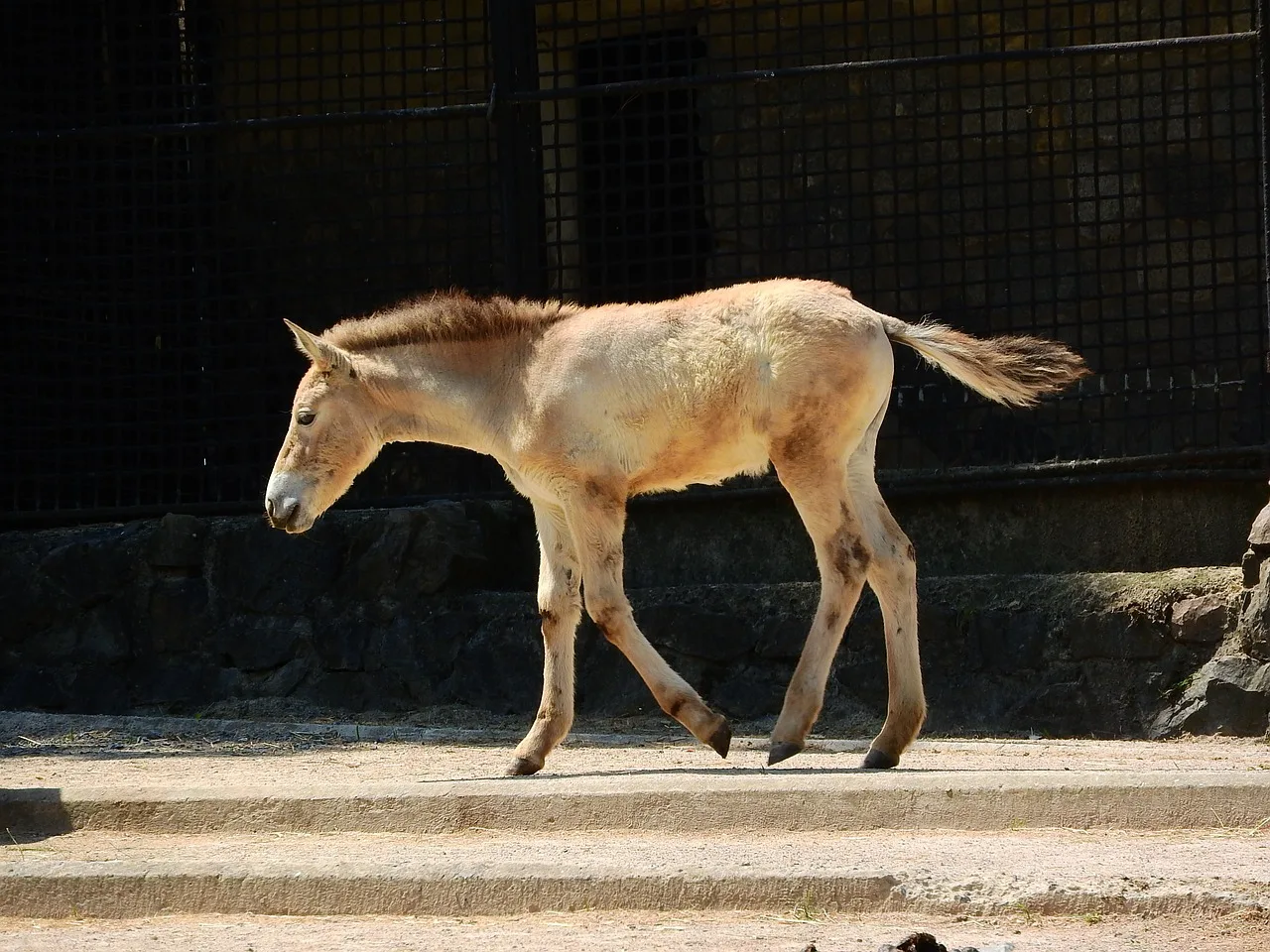
Most horses in Bible times were probably very different from today’s riding or workhorses. They were smaller, with shorter heads and thicker necks, and probably had fairly thick hair in winter. They would have been similar in appearance to the Przewalski’s horses Equus caballus przewalskii, which can be seen in some zoo parks.
Special significance or symbolism
In the Bible the horse is symbolic of military might, and the hardness and durability of its hooves are especially referred to. Horses also acquired some religious significance and were associated with the sun, which was said to ride across the sky in a chariot. Some of the idolatrous kings of Judah apparently made images of horses dedicated to the sun (2KI 23:11) and placed them in the Temple, from where they were removed by Josiah.
Translation
Since horses have been exported to almost every country in the world, there is usually no problem in finding a word, even though it may be borrowed from a dominant language of the region. It is best to make a gender distinction between male and female horses in SNG 1:9 (female) and, if the less likely exegesis “stallion” is followed, in JER 50:11 (male). Stallions neigh and fight each other to establish which is dominant, especially when they are in the presence of mares. This is what is possibly referred to in the Jeremiah passage.
The word ’abir literally means “mighty ones” and possibly could be a reference to exceptionally big, strong stallion war-horses, of the kind called “chargers” or “steeds” in archaic English. In many languages it will be best translated by a phrase meaning something like “fierce horse", or with a more figurative phrase such as “warrior horse” or “chief horse". In JER 50:11 the fact that this is a male horse is important, since this verse refers to the uncontrollable nature of stallions, especially when in the presence of female horses and other stallions.
sus and hippos are the general words for horse in the Old and New Testaments respectively. In the Old Testament the feminine form susah occurs once, in SNG 1:9. See also Swallow, swift for discussion of another meaning for sus.
The word parash, which occurs over fifty times, normally refers to a war-horse and its rider as a single military unit, a mounted trooper. In the plural it usually means cavalry or a mounted battalion. (A similar usage is to be found in some of the deuterocanonical references to hippos, which is also the word used in the Septuagint to translate parash.) NAB and NIV (the latter in footnotes) take it to mean “charioteers". This word is best translated as “soldiers on horses” in most passages, with the exception of 1KI 4:26 and 2CH 9:25, where cavalry horses seem to be referred to, without reference to the riders. In these two passages there is a difference in numbers. In the Hebrew text 1KI 4:26 refers to 40,000 stables, and 2CH 9:25 to 4,000 stables. In the Septuagint both passages have 4,000. There are a number of possible interpretations.
1KI 4:26: The rendering of NAB (similarly JB), “Solomon had four thousand stalls for twelve thousand chariot horses,” involves an inconsistent translation of parash, which is not, and cannot be, translated as “chariot horse” in the parallel passage in 2CH 9:25. It appears that this unusual translation in turn is the result of opting for the figure four thousand. If the forty thousand of the Hebrew text were accepted, there would then be forty thousand stalls for chariot horses, but only twelve thousand horses!
NIV tries to avoid this pitfall with “Solomon had four thousand stalls for chariot horses, and twelve thousand horses.” However, this actually also equates parash with “chariot horse", which it does not and cannot do in 1CH 9:25.
RSV has “Solomon also had forty thousand stalls of horses for his chariots, and twelve thousand horsemen.” This translation of parash is consistent, but it ignores the difference in context. The narrator would then be counting stables and horsemen in the same phrase, which is highly unlikely.
The majority of commentaries and the Hebrew Old Testament Text Project (HOTTP) accept the Hebrew text (forty thousand) as the better text for this verse. This is reflected by TEV ’s “Solomon had forty thousand stalls for his chariot horses and twelve thousand cavalry horses” (compare NEB, REB).
Since parash refers in different contexts to (a) war-horses and their riders, (b) only the riders, or (c) only the war-horses, this translation as cavalry horses is consistent. An option would be “war-horses” or “horses for war". The Hebrew text seems, on the surface, to give forty thousand as the number of stables, but it is possible that the writer intended to indicate the number of horses stabled there.
The NIV footnote, “charioteers", for parash has very little support.
1CH 9:25: The generally accepted exegesis of this verse is “Solomon had four thousand outbuildings for his chariots and horses, and had twelve thousand cavalry horses” (compare TEV, NEB, REB). This rendering accepts an inconsistency between 1KI 4:26 and 1CH 9:25.
A solution, which is defensible, and which avoids the inconsistency, is to follow the NEB and REB rendering for 1KI 4:26 “stables for forty thousand chariot horses,” and the TEV rendering of 2CH 9:25 “four thousand stalls,” since it is possible to house forty thousand horses in four thousand stables. However, this solution would involve translating two very similar Hebrew phrases in two different ways.
The word rekesh is best translated as “fast horse", or “best horse". EST 8:10; EST 8:14 indicate that this word refers to a horse that was selectively bred and apparently particularly swift, and so especially suited to carrying messengers. There are scholars who trace the modern Arabian breed of horse back to the ancient rekesh.
MIC 1:13: The context in this verse is one of haste, and the writer is calling on the people of Lachish to hitch to their chariots their fastest horses, perhaps usually reserved for the nobility to ride.